Install BI Windows Server
Install WorkFusion Analytics Server
To install the Analytics Server:
On the APP server, migrate the databases:
$ cd /opt/workfusion/wf_installer
$ ./install.sh migrate bi
You can also migrate the databases after the installation. In this case, run the above command and restart the Analytics server to apply the changes.
Generate configuration files required by the BI installer and make the BI installer and configs downloadable from the APP server over HTTP. For that, replace /opt/workfusion/wf_installer with correct
PACKAGE_DIRfor your environment, and execute the following commands on the APP server.$ cd /opt/workfusion/wf_installer $ ./install.sh generate_conf bi $ python -m SimpleHTTPServer 9999Here, port 9999 is used as an example. You can use any free APP server port accessible from the Analytics one(s). If, for some reason, you are not allowed to open other ports, ignore the
python -m SimpleHTTPServer PORTcommand, and copy the files manually from APP to Analytics servers.The Analytics Installer is now temporarily downloadable from the APP server over HTTP. You can stop the HTTP server after copying.
Connect to the BI server via RDP as a Windows Administrator user.
Launch PowerShell ISE as Administrator. Copy the following script and execute it in PowerShell on the BI server(s).
See the script...
Before the execution, remember to modify the lines in the section between# FILL IN THE PARAMETERS BELOWand# =========================================according to your configuration. Remember to change variable<bi1_hostname>to<bi2_hostname>, when installing to a second BI server in the high-availability mode.# INSTALL TABLEAU SERVER # FILL IN THE PARAMETERS BELOW $download_from = "<APP server hostname>:9999" # any port on the APP server accessbile from BI $install_dir = "c:\workfusion" # The value of "bi_install_dir" which you've set in config.yml during Linux servers installation. $bi1_hostname = "<bi1_hostname>" $env:lic_key="trial" $env:win_user="username" # The value of "bi_user" which you've set in config.yml during Linux servers installation. $env:win_pass='"password"' # Leave single and double quotes in place. Replace only word password. The value of "bi_pass" which you've set in config.yml during Linux servers installation. $env:TABLEAU_USER="username" # The value of "tableau_admin_user" which you've set in config.yml during Linux servers installation. $env:TABLEAU_PASS="password" # The value of "tableau_admin_pass" which you've set in config.yml during Linux servers installation. # IMPORTANT: do not use spaces in the below variables when separating values (should be comma-separated list, NOT comma-and-space-separated list) $env:TABLEAU_TRUSTED_HOSTS="<bi_lb_hostname>,<app1_hostname>,<app2_hostname>" # Remove <app2_hostname> if there is only one APP server in environment. $env:GATEWAY_PUBLIC_HOST="<bi_lb_hostname>,<bi1_hostname>,<bi2_hostname>" # Remove <bi2_hostname> if there is only one BI server in environment $env:GATEWAY_TRUSTED_IP_ADDRESSES="<bi_lb_ip_address>,<bi_server_ip_address>,<app1_ip_address>,<app2_ip_address>,127.0.0.1" # Remove <app2_hostname> if there is only one APP server in environment $env:GATEWAY_PUBLIC_PORT=443 # Load balancer port $bi_installer = "<installer-name>.zip" #Specify manually. Find the name of the installer in INSTALL_DIR/sources. For example, opt/workfusion/sources/WorkFusionAnalyticsInstaller-10.1.6.zip # ========================================= $package_dir = "${install_dir}\WorkFusionAnalyticsServer" Write-Host "Creating package_dir" New-Item -ItemType directory -Path ${package_dir} -Force Write-Host "Downloading BI installer" $wc = New-Object net.webclient $wc.Downloadfile("http://${download_from}/sources/${bi_installer}", "${install_dir}\${bi_installer}") $wc.Downloadfile("http://${download_from}/win_confs/bi_configs/${bi1_hostname}/bi.crt", "${package_dir}\bi.crt") $wc.Downloadfile("http://${download_from}/win_confs/bi_configs/${bi1_hostname}/bi.key", "${package_dir}\bi.key") $wc.Downloadfile("http://${download_from}/win_confs/bi_configs/${bi1_hostname}/ca.crt", "${package_dir}\ca.crt") Write-Host "Unpacking BI installer" Add-Type -assembly "system.io.compression.filesystem" [System.IO.Compression.ZipFile]::ExtractToDirectory("${install_dir}\${bi_installer}", "${install_dir}\WorkFusionAnalyticsInstaller") while(!$(Test-Path -Path "${package_dir}\bi.crt")) { Read-Host -Prompt "bi.crt not found. Confirm that you've placed it to ${package_dir} directory by pressing the Enter key" } while(!$(Test-Path -Path "${package_dir}\bi.key")) { Read-Host -Prompt "bi.key not found. Confirm that you've placed it to ${package_dir} directory by pressing the Enter key" } Read-Host -Prompt "Confirm that you have desired content of ${install_dir}\WorkFusionAnalyticsInstaller\WorkFusionAnalyticsServer\identity_store.json by pressing Enter key" Write-Host "Installing Tableau Server" cd "${install_dir}\WorkFusionAnalyticsInstaller\WorkFusionAnalyticsServer" cmd.exe /c "install_server.bat ${package_dir}"Close PowerShell ISE.
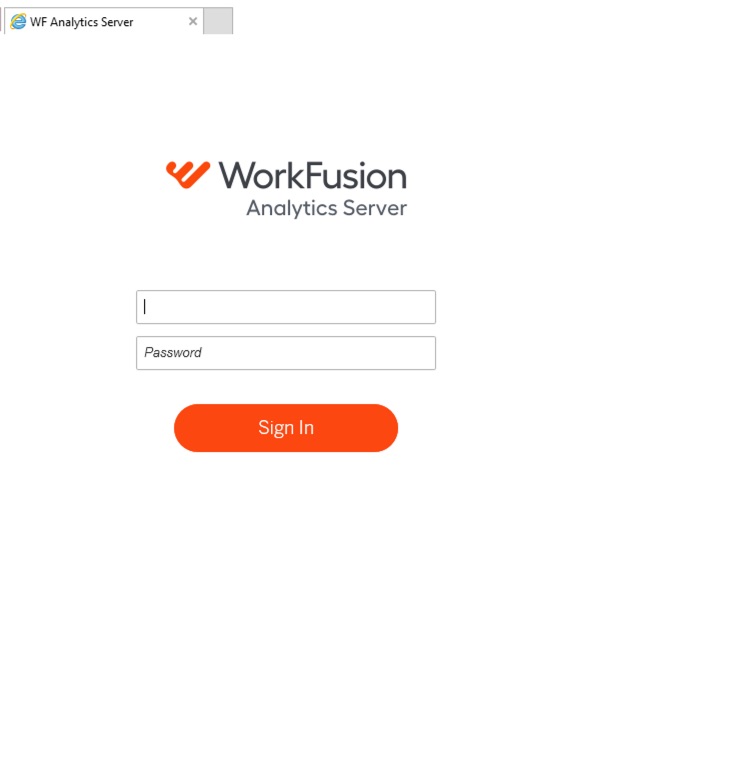
On the BI server, in a browser, go to https://localhost to check that the default page opens.
Install WorkFusion Analytics Desktop
important
If you are installing Analytics Desktop to a local PC, copy the Analytics installer from the Analytics server to your machine before performing the following steps.
To install the Analytics Desktop:
On your server or PC, start the Command Prompt (not PowerShell) and go to the WorkfusionAnalyticsDesktop directory in the unpacked installation package.
Run the installation batch file install_desktop.bat with the specified installation directory:
$ install_desktop.bat INSTALL_DIR
# For example: install_desktop.bat C:\workfusion\WorkFusionDesktop
Click the WorkFusion Analytics Desktop shortcut to start the application, and then enter the license key.
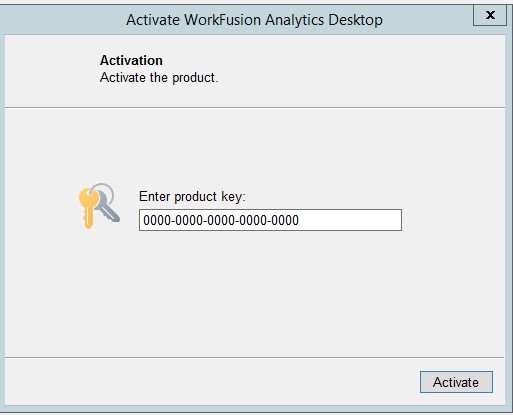
For more information on Activation options, see Manage the WorkFusion Analytics license.
Install WorkFusion Analytics Filebeat
To install Filebeat:
Launch the New PowerShell ISE as Administrator.
Copy the following script and execute it on the BI server(s) in PowerShell.
Before the execution, remember to modify the lines in the section between
# TO FILL IN BY CUSTOMERand# =========================================according to your configuration.# INSTALL FILEBEAT # TO FILL IN BY CUSTOMER $install_dir = "c:\workfusion" # The value of "bi_install_dir" which you've set in config.yml during Linux servers installation. $int_hostnames = "<INT1 HOSTNAME>:4567" # in HA mode "<INT1 HOSTNAME>:4567,<INT2 HOSTNAME>:4567,<INT3 HOSTNAME>:4567" $bi_hostname = "<CURRENT BI SERVER HOSTNAME>" # ========================================= $package_dir = "${install_dir}\WorkFusionAnalyticsServer" $filebeat_dir = "${install_dir}\filebeat" if(!$(Test-Path -Path "${install_dir}\WorkFusionAnalyticsInstaller\Filebeat\inputs.d\input-WorkfusionAnalyticsServer.yml")) { Copy-Item "${install_dir}\WorkFusionAnalyticsInstaller\Filebeat\inputs.d\input-workfusion-analytics-server.yml" -Destination "${install_dir}\WorkFusionAnalyticsInstaller\Filebeat\inputs.d\input-WorkfusionAnalyticsServer.yml" } Write-Host "Installing Filebeat" cd "${install_dir}\WorkFusionAnalyticsInstaller\Filebeat" cmd.exe /c "install_filebeat.bat ${filebeat_dir} ${package_dir} ${bi_hostname} ${int_hostnames}" if(!$(Test-Path -Path "${filebeat_dir}\ca.crt")) { Copy-Item "${package_dir}\ca.crt" -Destination "${filebeat_dir}\ca.crt" } while(!$(Test-Path -Path "${filebeat_dir}\ca.crt")) { Read-Host -Prompt "ca.crt not found. Confirm that you've placed it to ${filebeat_dir} directory by pressing Enter key" } Start-Service filebeat Get-Service filebeat
note
If Filebeat starts with the error "setting ‘filebeat.registry_file’ has been removed", in filebeat.yml, remove the line: registry_file: registry_in.
Install WorkFusion Analytics Metricbeat
To install Metricbeat:
Launch the New PowerShell ISE as Administrator.
Copy the following script and execute it on the BI server(s) in PowerShell.
Before the execution, remember to modify the lines in the section between
# TO FILL IN BY CUSTOMERand# =========================================according to your configuration.# INSTALL METRICBEAT # TO FILL IN BY CUSTOMER $install_dir = "c:\workfusion" # The value of "bi_install_dir" which you've set in config.yml during Linux servers installation. $int_hostnames = "<INT1 HOSTNAME>:4569" # in HA mode "<INT1 HOSTNAME>:4569,<INT2 HOSTNAME>:4569,<INT3 HOSTNAME>:4569" $bi_hostname = "<CURRENT BI SERVER HOSTNAME>" # ========================================= $package_dir = "${install_dir}\WorkFusionAnalyticsServer" $metricbeat_dir = "${install_dir}\metricbeat" Write-Host "Installing metricbeat" cd "${install_dir}\WorkFusionAnalyticsInstaller\metricbeat" cmd.exe /c "install_metricbeat.bat ${metricbeat_dir} ${package_dir} ${bi_hostname} ${int_hostnames}" if(!$(Test-Path -Path "${metricbeat_dir}\ca.crt")) { Copy-Item "${package_dir}\ca.crt" -Destination "${metricbeat_dir}\ca.crt" } while(!$(Test-Path -Path "${metricbeat_dir}\ca.crt")) { Read-Host -Prompt "ca.crt not found. Confirm that you've placed it to ${metricbeat_dir} directory by pressing Enter key" } Start-Service metricbeat Get-Service metricbeat
Deploy workbooks to WorkFusion Analytics Server
Prerequisites
- Microsoft Server 2008 R2 or newer is installed.
- WorkFusion Analytics Server 2018.3.2 or newer is installed. The WF Analytics version in the package is 2018.3.9.
- JScript execution from the command line (CMD) is allowed on the server.
note
JScript is required to execute workbook publishing scripts. If, for some reason (for example, due to security restrictions), JScript is disabled on the server, enable it temporarily during the installation, and then disable it again, if needed.
Deploy workbooks
To deploy workbooks:
Launch the New PowerShell ISE as Administrator.
Copy the following script and execute it on the BI server(s) in PowerShell.
See the script...
Before the execution, remember to modify the lines in the section between# TO FILL IN BY CUSTOMERand# =========================================according to your configuration.# INSTALL WORKBOOKS # TO FILL IN BY CUSTOMER $download_from = "<APP server hostname>:9999" $current_host = "<CURRENT BI SERVER HOSTNAME>" $current_site = "<SITE NAME>" # The first octet of workfusion_lb_hostname from hosts.yml # if workfusion_lb_hostname is "example-workfusion-lb1.workfusion.com", than $current_site = "example-workfusion-lb1" $install_dir = "c:\workfusion" # The value of "bi_install_dir" which you've set in config.yml during Linux servers installation. $workbooks_installer = "WorkFusionAnalyticsWorkbooks-<version>.zip" # Specify manually. Find the name of the installer in INSTALL_DIR/sources. For example, opt/workfusion/sources/WorkFusionAnalyticsWorkbooks-10.1.6.zip # ===================================== $tdeploy_home = "${install_dir}\tdeploy_home" $workbooks_config = "${tdeploy_home}\deploy\config" Write-Host "Creating tdeploy_home" New-Item -ItemType directory -Path $tdeploy_home -Force Write-Host "Downloading workbooks installer" $wc = New-Object net.webclient $wc.Downloadfile("http://${download_from}/sources/${workbooks_installer}", "${install_dir}\${workbooks_installer}") Write-Host "Unpacking Workbooks installer" Add-Type -assembly "system.io.compression.filesystem" [System.IO.Compression.ZipFile]::ExtractToDirectory("${install_dir}\${workbooks_installer}", "${install_dir}\WorkbooksInstaller") New-Item -ItemType directory -Path "${tdeploy_home}\install\" -Force Copy-Item "${install_dir}\WorkbooksInstaller\deploy-tools\*" -Destination "${tdeploy_home}\install\" -Recurse Write-Host "Executing install.cmd" cd "${tdeploy_home}\install" cmd.exe /c "install.cmd ${tdeploy_home}" Write-Host "Executing create_sitefolder.cmd" cd "${tdeploy_home}\deploy" cmd.exe /c "create_sitefolder.cmd ${current_site}" Write-Host "Downloading workbooks configs" $wc.Downloadfile("http://${download_from}/win_confs/bi_configs/${current_host}/config.${current_site}.cmd", "${workbooks_config}\config.${current_site}.cmd") $wc.Downloadfile("http://${download_from}/win_confs/bi_configs/${current_host}/import_users.csv", "${workbooks_config}\import_users.csv") Write-Host "Executing manage_server.cmd" cd "${tdeploy_home}\deploy" cmd.exe /c "manage_server.cmd ${current_site}" Write-Host "Copying dashboards and datasources" Copy-Item "${install_dir}\WorkbooksInstaller\dashboards\workbook\*" -Destination "${tdeploy_home}\deploy\to_deploy\${current_site}\dashboard\" -Recurse Copy-Item "${install_dir}\WorkbooksInstaller\dashboards\datasources\*" -Destination "${tdeploy_home}\deploy\to_deploy\${current_site}\datasource\" -Recurse Write-Host "Executing publish.cmd" cd "${tdeploy_home}\deploy" cmd.exe /c "publish.cmd ${current_site}"
Schedule Configuration
To configure schedules:
On the Analytics (BI) server, launch the New PowerShell ISE.
Copy and execute the following script in PowerShell ISE:
See the script...
Before the execution, remember to modify the lines in the section between# TO FILL IN BY CUSTOMERand# =========================================according to your configuration.Clear-Host [Net.ServicePointManager]::SecurityProtocol = [Net.SecurityProtocolType]::Tls12 # TO FILL IN BY CUSTOMER $bi_hostname = "" # hostname of current bi server from hosts.yml bi_hostnames $tableau_admin_user = "" # tableau_admin_user from config.yml $tableau_admin_pass = "" # tableau_admin_pass from config.yml $current_site = "" # The first octet of workfusion_lb_hostname from hosts.yml $tustAllcerts = $false # trust self signed certificates # ===================================== $tableau_api_version = "2.8" $signin_address = "https://${bi_hostname}/api/${tableau_api_version}/auth/signin" $schedules_address = "https://${bi_hostname}/api/${tableau_api_version}/schedules" $sites_address = "https://${bi_hostname}/api/${tableau_api_version}/sites" if($tustAllcerts) { add-type @" using System.Net; using System.Security.Cryptography.X509Certificates; public class TrustAllCertsPolicy : ICertificatePolicy { public bool CheckValidationResult( ServicePoint srvPoint, X509Certificate certificate, WebRequest request, int certificateProblem) { return true; } } "@ [System.Net.ServicePointManager]::CertificatePolicy = New-Object TrustAllCertsPolicy } $signin_body = @" <tsRequest> <credentials name="${tableau_admin_user}" password="${tableau_admin_pass}" > <site contentUrl="${current_site}" /> </credentials> </tsRequest> "@ $fifteen_min_schedule = @" <tsRequest> <schedule name="15min-schedule" priority="50" type="Extract" frequency="Hourly" executionOrder="Serial"> <frequencyDetails start="12:00:00" end="12:00:00"> <intervals> <interval minutes="15" /> </intervals> </frequencyDetails> </schedule> </tsRequest> "@ $aa_etl_fifteen_min_schedule = @" <tsRequest> <schedule name="aa-etl-15min-schedule" priority="10" type="Extract" frequency="Hourly" executionOrder="Serial"> <frequencyDetails start="12:00:00" end="12:00:00"> <intervals> <interval minutes="15" /> </intervals> </frequencyDetails> </schedule> </tsRequest> "@ $workbook_raw = @" <tsRequest> <task> <extractRefresh> <workbook id="{0}" /> </extractRefresh> </task> </tsRequest> "@ $datasource_raw = @" <tsRequest> <task> <extractRefresh> <datasource id="{0}" /> </extractRefresh> </task> </tsRequest> "@ Write-Host "Simulating TASK [bi_workbooks : Login into Tableau via api: POST ${signin_address}] ***" $signin_response = Invoke-WebRequest $signin_address -Body $signin_body -Method 'POST' -Headers @{'Accept' = 'application/json'} Write-Host "Simulating TASK [bi_workbooks : Save Tableau Access Token and Site id] ********************" $tableau_token = ($signin_response | ConvertFrom-Json).credentials.token $site_id = ($signin_response | ConvertFrom-Json).credentials.site.id Write-Host "Simulating TASK [bi_workbooks : List schedules: GET ${schedules_address}] ***" $list_schedules_response = Invoke-WebRequest $schedules_address ` -Method 'GET' ` -Headers @{'X-Tableau-Auth' = $tableau_token; 'Accept' = 'application/json'} Write-Host "Simulating TASK [bi_workbooks : Check if '15min-schedule' created] ************************" $schedule_exists = (($list_schedules_response | ConvertFrom-Json).schedules.schedule | where { $_.name -eq "15min-schedule" }) -ne $null Write-Host "Simulating TASK [bi_workbooks : Check if 'aa-etl-15min-schedule' created] ************************" $aa_etl_schedule_exists = (($list_schedules_response | ConvertFrom-Json).schedules.schedule | where { $_.name -eq "aa-etl-15min-schedule" }) -ne $null if(!$schedule_exists) { Write-Host "Simulating TASK [bi_workbooks : Create 15min Schedule named '15min-schedule': POST ${schedules_address}] ***" $create_schedule_response = Invoke-WebRequest $schedules_address ` -Body $fifteen_min_schedule ` -Method 'POST' ` -Headers @{'X-Tableau-Auth' = $tableau_token; 'Accept' = 'application/json'} } if(!$aa_etl_schedule_exists) { Write-Host "Simulating TASK [bi_workbooks : Create 15min Schedule named 'aa-etl-15min-schedule': POST ${schedules_address}] ***" $create_schedule_response = Invoke-WebRequest $schedules_address ` -Body $aa_etl_fifteen_min_schedule ` -Method 'POST' ` -Headers @{'X-Tableau-Auth' = $tableau_token; 'Accept' = 'application/json'} } Write-Host "Simulating List schedules: GET ${schedules_address}] ***" $list_schedules_response = Invoke-WebRequest $schedules_address ` -Method 'GET' ` -Headers @{'X-Tableau-Auth' = $tableau_token; 'Accept' = 'application/json'} Write-Host "Simulating TASK [bi_workbooks : set_fact: save '15min-schedule' schedule Id] **************" $schedule_id = (($list_schedules_response | ConvertFrom-Json).schedules.schedule | where { $_.name -eq "15min-schedule" }).id Write-Host "Simulating TASK [bi_workbooks : set_fact: save 'aa-etl-15min-schedule' schedule Id] **************" $aa_etl_schedule_id = (($list_schedules_response | ConvertFrom-Json).schedules.schedule | where { $_.name -eq "aa-etl-15min-schedule" }).id Write-Host "Simulating TASK [bi_workbooks : Query workbooks: GET ${sites_address}/${site_id}/workbooks] ***" $list_workbooks_response = Invoke-WebRequest "${sites_address}/${site_id}/workbooks" ` -Method 'GET' ` -Headers @{'X-Tableau-Auth' = $tableau_token; 'Accept' = 'application/json'} Write-Host "Simulating TASK [bi_workbooks : Assign 'aa-etl-15min-schedule' to workbooks: PUT ${sites_address}/${site_id}/schedules/${aa_etl_schedule_id}/workbooks] ***" ($list_workbooks_response | ConvertFrom-Json).workbooks.workbook | ForEach-Object -Process { if($_.project.name -eq $current_site) { $assign_schedule_response = Invoke-WebRequest "${sites_address}/${site_id}/schedules/${aa_etl_schedule_id}/workbooks" ` -Body ($workbook_raw -f $_.id) ` -Method 'PUT' ` -Headers @{'X-Tableau-Auth' = $tableau_token; 'Accept' = 'application/json'} } } Write-Host "Simulating TASK [bi_workbooks : Query datasources: GET ${sites_address}/${site_id}/datasources] ***" $list_datasources_response = Invoke-WebRequest "${sites_address}/${site_id}/datasources" ` -Method 'GET' ` -Headers @{'X-Tableau-Auth' = $tableau_token; 'Accept' = 'application/json'} Write-Host "Simulating TASK [bi_workbooks : Assign '15min-schedule' to datasources: PUT ${sites_address}/${site_id}/schedules/${schedule_id}/datasources] ***" ($list_datasources_response | ConvertFrom-Json).datasources.datasource | ForEach-Object -Process { if($_.project.name -eq $current_site) { $assign_schedule_response = Invoke-WebRequest "${sites_address}/${site_id}/schedules/${schedule_id}/datasources" ` -Body ($datasource_raw -f $_.id) ` -Method 'PUT' ` -Headers @{'X-Tableau-Auth' = $tableau_token; 'Accept' = 'application/json'} } }
Enable Analytics dashboard
To enable BI Analytics Server in Control Tower:
Install the Analytics server, as described earlier.
Deploy workbooks to the Analytics server, as described earlier.
Enable WorkFusion Analytics server on WorkFusion platform:
On the APP Server, check and configure the Vault secure properties file. The file must already be configured before the installation.
<!-- Set bi_lb_hostname of BI server -->
tableau.dashboard.host=https://bi-lb.example.com

<!-- Set login and password for connection to BI server -->
tableau.dashboard.username=tableau_user
tableau.dashboard.password=tableau_pass
Property Name Example Value Description Required for tableau.dashboard.hosthttps://bi-lb.example.com WorkFusion Analytics Server website URL for Dashboard WorkFusion Analytics Dashboard tableau.dashboard.usernametableau_user WorkFusion Analytics Server website username for Dashboard (was used in import_users.csv) WorkFusion Analytics Dashboard tableau.dashboard.passwordtableau_pass WorkFusion Analytics Server website password for Dashboard (was used in import_users.csv) WorkFusion Analytics Dashboard On the APP Server, restart the Workfusion service as the application user:
wfmanager restart workfusion
Run Analytics as database AD user
important
This section is only applicable for version 10.1.6.1 and only for the installation with database logins from Active Directory.
To run Analytics as AD user:
Go to the
BI_HOSTNAMEand in your browser, log in to Tableau at https:/localhost:wf_tableau_port asBI_USER.In the main menu, click Configuration > Security > Run As Service Account, and select User Account. Enter the domain username
mssql_dm_userand password.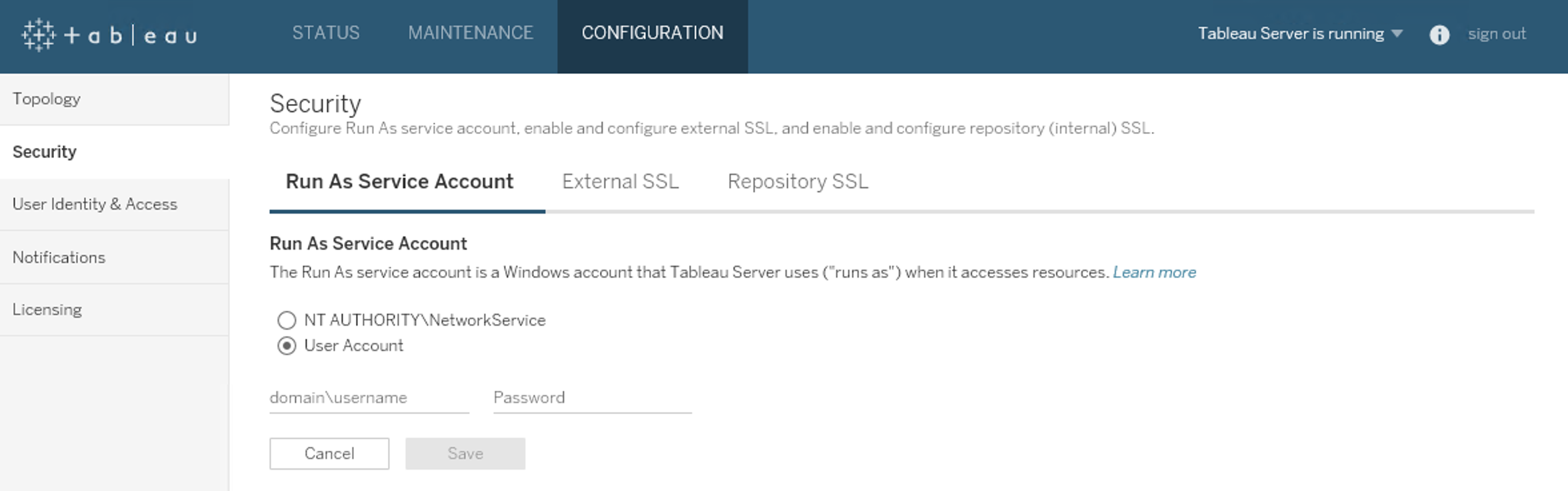
Сlick Save > Pending Changes > Apply Changes and Restart and wait until the restart process ends.
Stop standby Tableau server
important
For the high-availability installation only.
On the second Tableau server, run the following commands in Powershell as Administrator:
cd <bi_dir>\packages\bin.20183.19.0714.2346
.\tsm login -u .\<bi_user> -p <bi_pass>
.\tsm stop
Stopping service...
Job id is '4', timeout is 30 minutes.
Service stopped successfully.
Check installation
To check the installation:
In a browser, open URL https://host-workfusion-lb1.example-wf101.com to go to the APP instance. The following menu appears:
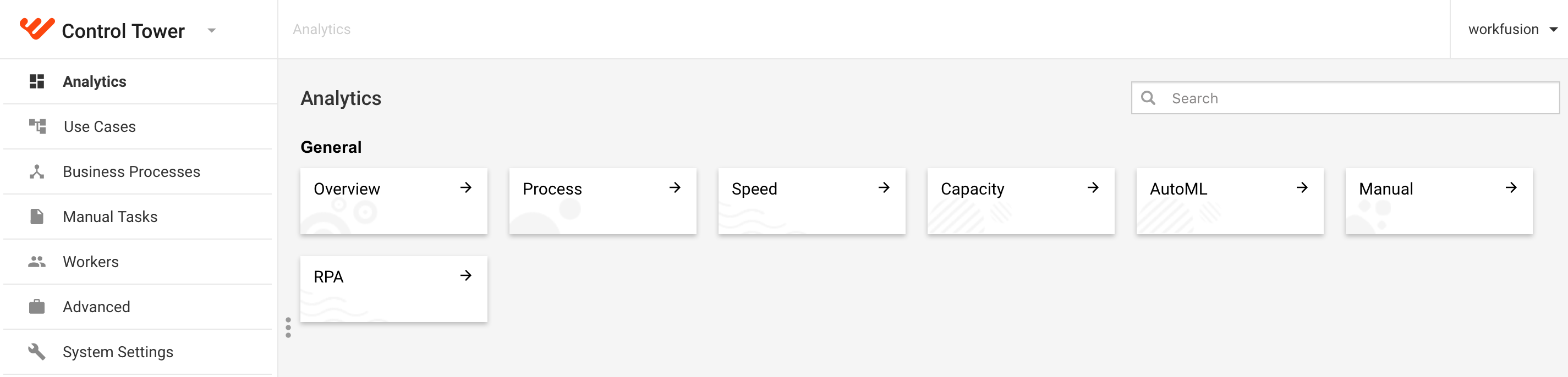
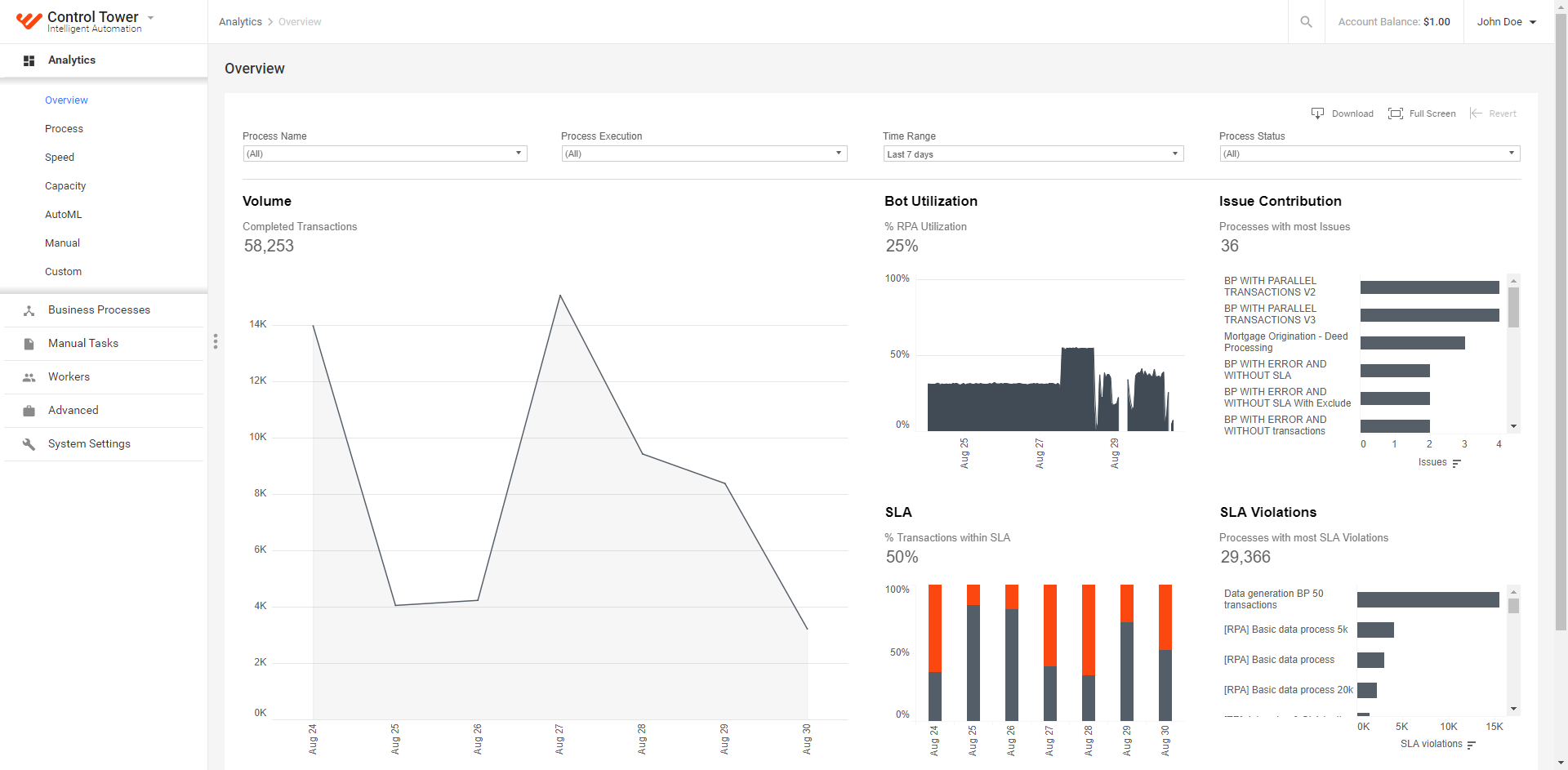
In the main menu, go to the Analytics group to check that the dashboard is displayed.