Manage Control Tower roles and permissions
In Control Tower, the Role Management page lists all roles available for the application users and allows managing associated permissions.
Assign permissions
The list of roles on the Role Management page is based on that of the wf-control-tower client in Keycloak. To assign permissions to the roles, follow the steps below:
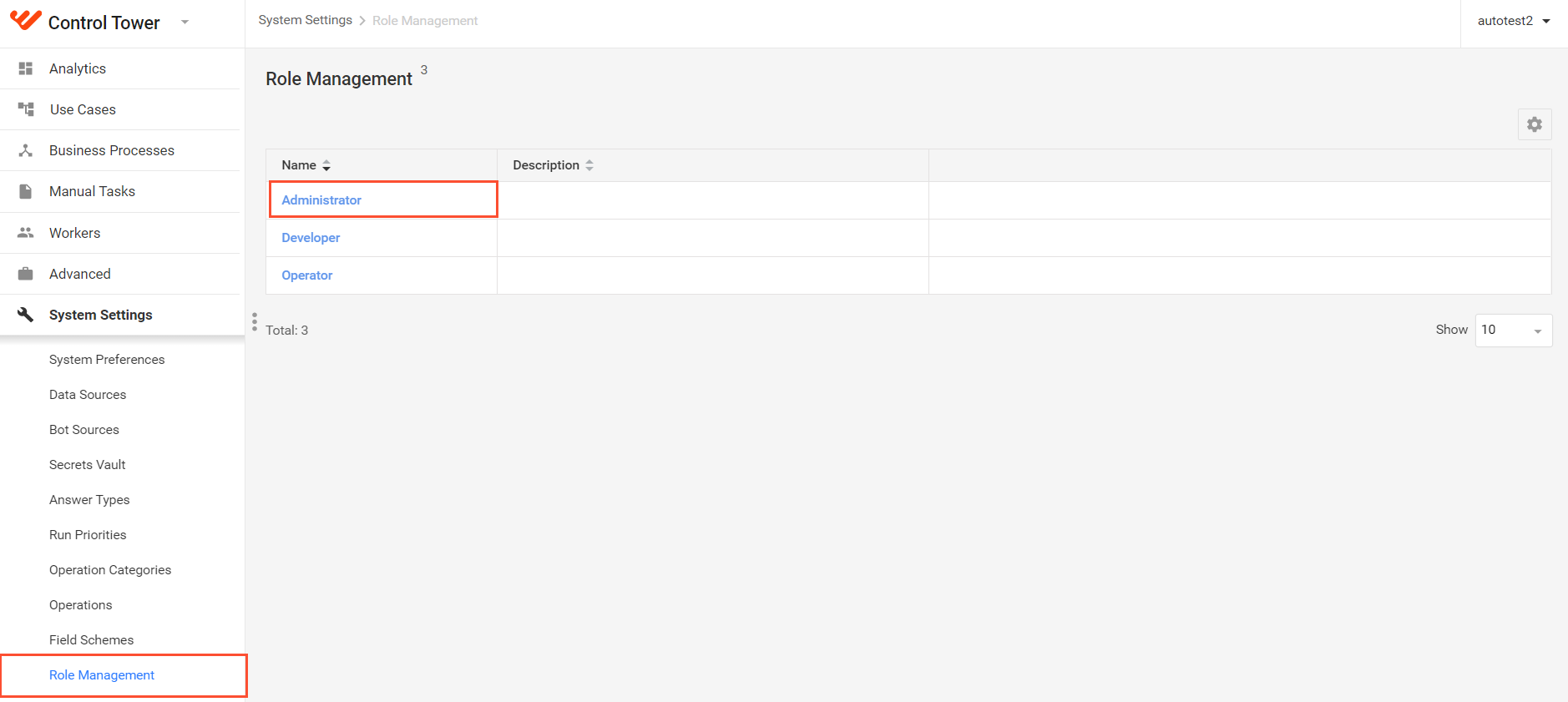
Go to System Settings > Role Management and click a role.
In the Select Role Permissions section, select permission checkboxes as required for the role.
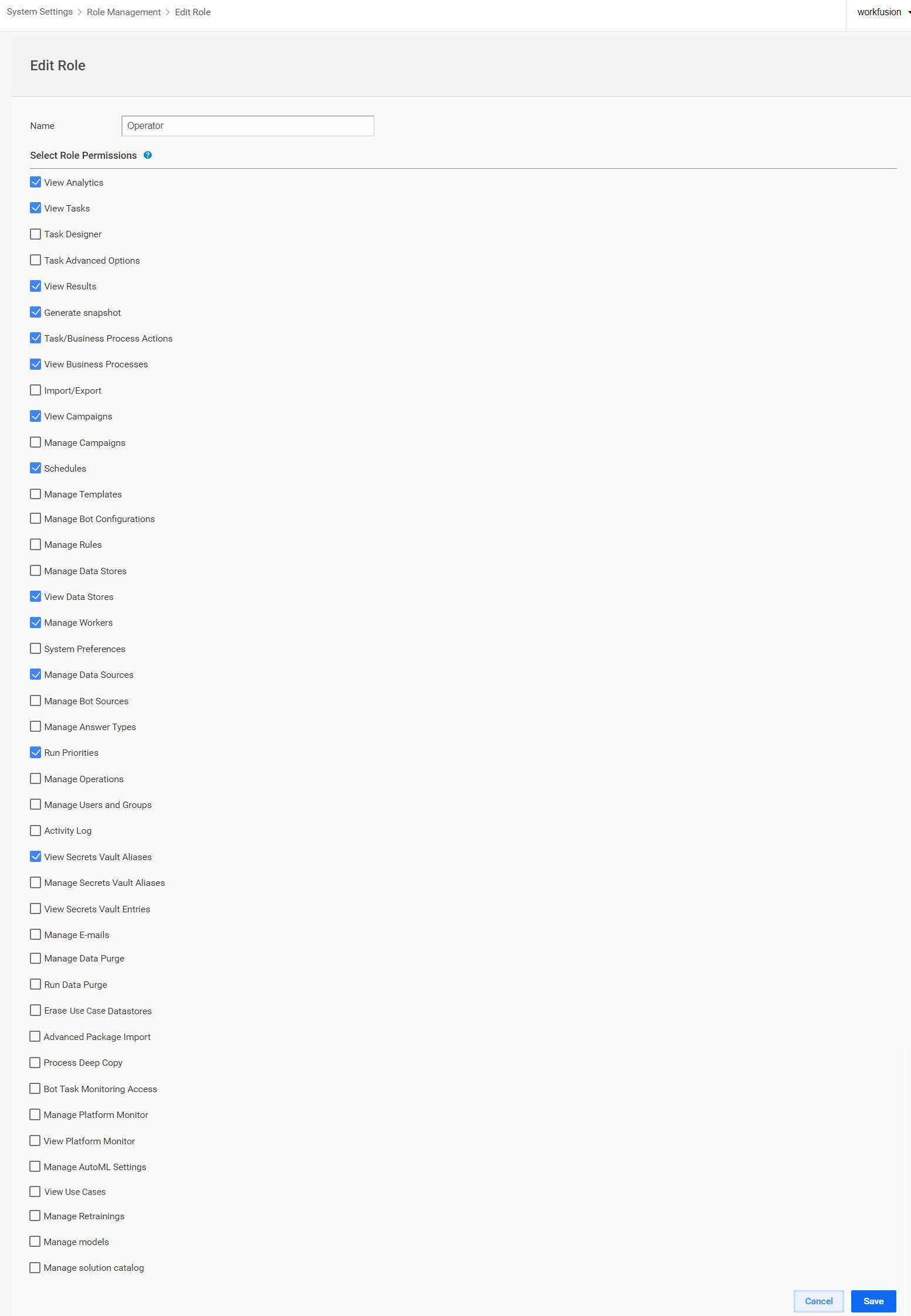
Click Save to save the changes.
Explore default roles' permissions
| Permissions or Roles | Administrator | Developer | Operator |
|---|---|---|---|
| View Analytics | ✓ | ✓ | ✓ |
| View Tasks | ✓ | ✓ | |
| Task Designer | ✓ | ✓ | |
| Task Advanced Options | ✓ | ✓ | |
| View Results | ✓ | ✓ | ✓ |
| Generate Snapshot | ✓ | ✓ | ✓ |
| Task or Business Process Actions | ✓ | ✓ | ✓ |
| View Business Processes | ✓ | ✓ | ✓ |
| Import or Export | ✓ | ✓ | |
| View Campaigns | ✓ | ✓ | ✓ |
| Manage Campaigns | ✓ | ✓ | |
| Schedules | ✓ | ✓ | ✓ |
| Manage Templates | ✓ | ✓ | |
| Manage Bot Configurations | ✓ | ✓ | |
| Manage Rules | ✓ | ✓ | |
| Manage Data Stores | ✓ | ✓ | |
| View Data Stores | ✓ | ✓ | ✓ |
| Manage Workers | ✓ | ✓ | ✓ |
| System Preferences | ✓ | ✓ | |
| Manage Data Sources | ✓ | ✓ | ✓ |
| Manage Bot Sources | ✓ | ✓ | |
| Manage Answer Types | ✓ | ✓ | |
| Run Priorities | ✓ | ✓ | ✓ |
| Manage Operations | ✓ | ✓ | |
| Manage Users and Groups | ✓ | ||
| Activity Log | ✓ | ||
| View Secrets Vault Aliases | ✓ | ✓ | ✓ |
| Manage Secrets Vault Aliases | ✓ | ||
| View Secrets Vault Entries | |||
| Manage E-mails | ✓ | ||
| Run Data Purge | ✓ | ✓ | |
| Manage Data Purge | ✓ | ||
| Erase Use Case Datastores | |||
| Advanced Package Import | ✓ | ✓ | |
| Process Deep Copy | ✓ | ✓ | |
| Bot Task Monitoring Access | ✓ | ✓ | |
| Manage Platform Monitor | ✓ | ✓ | |
| Manage AutoML Settings | ✓ | ✓ | |
| View Use Cases | ✓ | ✓ | |
| Manage Retrainings | ✓ | ✓ | |
| Manage models | |||
| Manage solution catalog | ✓ | ✓ |
Study permission descriptions
View Analytics
The Dashboards page provides a high-level performance overview for all Enterprise Edition components. It comprises different widgets (Speed, Capacity, and so on) to visualize statistics and events. By default, it is the first screen you see after logging into Intelligent Automation Cloud Enterprise.
Location: Dashboard
Relative path: /dashboard
View Tasks
The permission allows you to view all created Manual Tasks. To access the task list, go to the main Control Tower (CT) menu and select Manual Tasks > View All Tasks.
Location:
- Tasks
- BP
Relative paths:
/tasks/task/edit/{UUID}/task/new
Task Designer
The permission allows you to view, edit, and create Manual Tasks and Business Processes (BP).
Location:
- Tasks
- Business Processes
Relative paths:
/task/.../business-process/.../question/.../questions
Task Advanced Options
The permission allows you to modify the advanced options of a task.
View Results
The permission allows you to view Task or BP run results:
Location:
- Tasks
- Business Processes
Relative paths:
task/edit/{uuid}? actTab=RESULTS...business-process/edit/{uuid}?actTab=RESULTS...
Generate Snapshot
The permission allows you to generate snapshots for a non-draft BP instance.
Task or Business Process Actions
The permission allows you to copy, pause, stop, resume, delete tasks and BPs using the Actions menu.
Location:
- Tasks
- Business Processes
View Business Processes
The permission allows you to view all created Business Processes. For that, open the main CT menu and select Business Processes > View All.
Location: Business Processes
Relative path: /business-processes
Import or Export
The permission allows you to import and export task and BP runs, Operations, packages, templates, and so on. Without the permission, users cannot see the import and export functionality on CT pages and view the Packages tabs for tasks or BPs.
Location: All pages
Relative paths:
/campaigns/templates/bot-configs/questions/rules/rules-templates/operation-categories/operations
View Campaigns
The permission allows you to view Campaigns.
Location: Advanced
Relative path: /campaigns
Manage Campaigns
The permission allows you to manage Campaigns.
Location: Advanced
Relative path: /campaigns
Schedules
The permission allows you to start tasks and BPs according to a schedule.
Location: Advanced
Relative path: /schedules
Manage Templates
The permission allows you to create, edit, copy, and delete Templates. Templates enable reusing objects within Intelligent Automation Cloud Enterprise. Tasks, BPs, and Rules are based on Templates.
Location: Advanced
Relative path: /templates
Manage Bot Configurations
The permission allows you to create, edit, copy, and delete Bot Configs (Bot Tasks).
Location: Advanced
Relative path: /bot-configs
Manage Rules
The permission allows you to create, edit, delete, and copy rules and rule templates. To access the associated functionality, go to Campaigns > Rules, Campaigns > Rule Templates.
Location: Advanced
Relative paths:
/rules/rules-templates
Manage Data Stores
The permission allows you to create, edit, delete, and export Data Stores, Field Schemes, and Automation Training Sets.
The Data Stores module is a web interface for managing DB tables. You can use Data Stores to keep lookup tables for multi-value Answer options, save BP results, and make queries from Bot Configs and Rules.
Location:
- Business Processes
- System Settings
Relative paths:
/data-stores/training-sets/field-schemes
View Data Stores
The permission allows you to only access, view, and download Data Stores. However, you cannot delete or update them via the applications or API.
Location:
- Business Processes
- System Settings
Relative paths:
/data-stores/training-sets
Manage Workers
The permission allows you to view and manage:
Location: Workers
Relative paths:
/workers/workforces
System Preferences
The System Preferences page contains all the instance parameters:
The User Settings tab is available for any user.
Location: System Settings
Relative paths:
/account/filters
Manage Data Sources
Data Source is a mechanism that provides input data and configuration for your BPs and tasks. The input format is best suited for those Operations where data resides on an external source, such as SFTP Server.
Location: System Settings
Relative path: /data-sources
Manage Bot Sources
The permission allows you to manage Bot Sources.
Manage Answer Types
The Answer Types screen allows you to create and manage Answer Types within Intelligent Automation Cloud. Answer Types are used when designing Manual Tasks, setting up ETL Bots, and creating Field Schemes.
Location: System Settings
Relative path: /answer-types
Run Priorities
The permission allows you to create, edit, and delete Run Priorities.
Location: System Settings
Relative path: /run-priority
Manage Operations
Operations serve as the basis for both tasks and Bot Configurations. They describe the workflow of a particular Business Process, which makes it possible to use them as templates to create tasks based on that workflow.
Location: System Settings
Relative paths:
/operation-categories/operations
Manage Users and Groups
The permission allows you to manage all permissions for all user roles in Control Tower.
This permission does not allow you to edit user emails.
Location: System Settings
Activity Log
The permission allows you to use the Activity Log module.
Location: System Settings
Relative path: /activity-log
View Secrets Vault Aliases
The permission allows you to view aliases in Secrets Vault and use them in Business Processes.
Location: System Settings
Relative path: /secure-storage
Manage Secrets Vault Aliases
The permission allows to view aliases, create, update, and delete records in Secrets Vault.
Location: System Settings
Relative path: /secure-storage
View Secrets Vault Entries
This permission is available with the Manage Secrets Vault Aliases permission only. It provides access to view all entries in Secrets Vault if no filters are assigned to a user.
Location: System Settings
Relative path: /secure-storage
Manage E-mails
The permission allows you to edit user emails while creating or editing a user profile.
Location: System Settings
Relative path: /users
Manage Data Purge
The permission allows executing Data Purge configurations and viewing their list together with the status and execution information. The permission is available for the Developer and Admin roles.
Location: Advanced
Relative path: /account
Run Data Purge
The permission allows creating, updating, and deleting in addition to viewing and executing Data Purge configurations. The permission is available only for the Admin role.
Location: Advanced
Relative path: /account
Erase Use Case Datastores
The permission allows applying the drop-data-stores operation in Maven and calling the associated API endpoint to delete the entire Use Case Data Model. The dropping of the whole Data Model is dangerous and is recommended only in development environments. By default, the permission is disabled for all roles. For details, read Manage Data Model with Liquibase.
Advanced Package Import
The permission allows you to overwrite process versions with significant differences (steps added, deleted, or substituted). See Migrate packages of Tasks and Business Processes.
Location:
- Tasks
- Business Processes
Relative paths:
/business-processes/tasks
Process Deep Copy
The Deep Copy option creates a completely unlinked process instance where all steps are separated from the ones in the source BP. See Copy Business Process.
Location: Business Processes
Bot Task Monitoring Access
The permission allows you to access and monitor the following:
- Bot Tasks in execution, grouped by Bot Sources
- Records in execution and submitted but not started Records
- Thread dumps for Bot Tasks filtered by process UUID
- Bot Source metrics, such as active record threads, record queue size, executed record total
Location: REST API
Relative paths:
/api/v1/monitoring/bots/sources/api/v1/monitoring/bots/sources/{source-name}/api/v1/monitoring/bots/thread-dumps/api/v1/monitoring/bots/thread-dumps?businessProcessUuid={bp-uuid}
Manage Platform Monitor
The permission makes it possible to manage Platform Monitor objects, such as bots.
Relative path: /v1/jwt/redirect
Manage AutoML Settings
The permission allows you to view the Configure AutoML tab and configuration settings for Manual Task automation.
Location: Tasks
View Use Cases
The permission allows you to view Use Cases.
Location: Use Cases
Manage Retrainings
The permission allows you to manage AutoML model retraining.
Location: Use Cases
Manage models
The permission allows to view the AutoML menu and interact with its items to manage hyper models, trained models, and model training.
Location: AutoML
Manage solution catalog
The permission gives you access to the Solution catalog from where you can install and configure AI Agents. When the permission is enabled, you can see the Solution catalog button in the Control Tower UI.
By default, the permission is enabled for the Admin and Developer roles.
Location: Use Cases
Mind permission restrictions
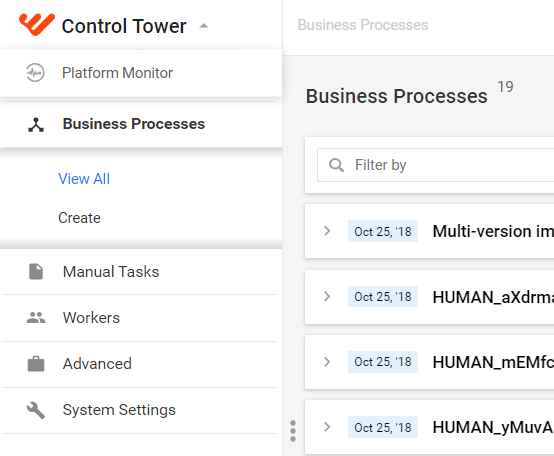
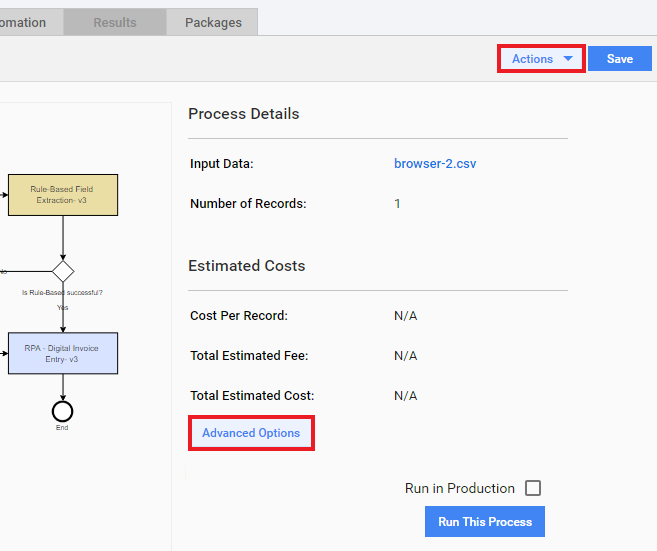
When a user has a role without appropriate permissions, the following restrictions can be applied in the user interface:
Main menu items are not displayed
Restricted permissions:

All permissions:
Action buttons and links are not displayed
Restricted permissions:
All permissions:
Explore known issues
- Impossible to delete a role assigned only to a group. No messages appear after the Delete Confirmation operation.