Work with Bot Manager
Bot Manager is an application installed on the Master Server and used to:
- Contain a cluster configuration
- Manage RPA Workers
- Maintain active RDP sessions
- Record videos of actions
- Collect analytics data
Get to know architecture
To see the interaction between RPA components, refer to RPA deployment.
The components act in the following way:
- Via an RDP connection, Bot Manager maintains active RDP sessions, enabling Bot Master to autostart and RPA Units to click through the active UI. That also allows Bot Manager to receive data from a Bot Agent, for example, fleet information, a Worker port, and so on.
- The Bot Manager UI allows sending commands to RPA Workers, viewing statistics, and tracking the number of RPA Units, servers, and processes. The communication is performed via the secured Nginx connection.
- Bot Manager gets data on RPA Unit statuses and performance from Bot Agent and transfers it to the MS SQL Server to be used by analytics.
- Bot Manager communicates with Secrets Vault to provide all RPA-related credentials. As soon as the credentials rotation is configured in Control Tower, new credentials are automatically applied to all RPA Units.
Access Bot Manager
To access the Bot Manager UI, log in to Control Tower and check that you have permissions to view and perform actions in Bot Manager:
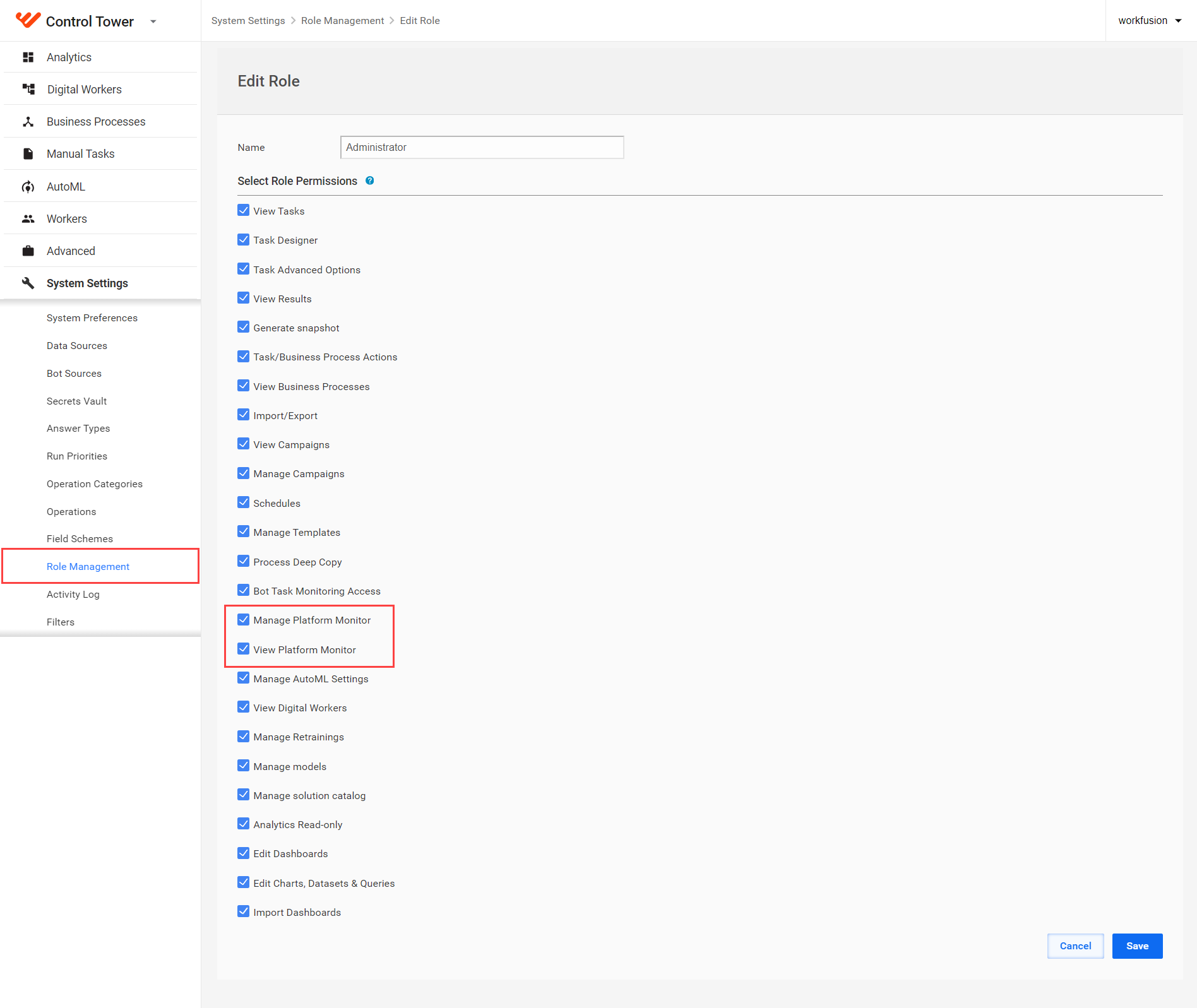
In Control Tower, go to System Settings > Role Management.
Select a user in the list or create a profile via the Create Role option. Make sure the following role permissions are selected: View Platform Monitor and Manage Platform Monitor.
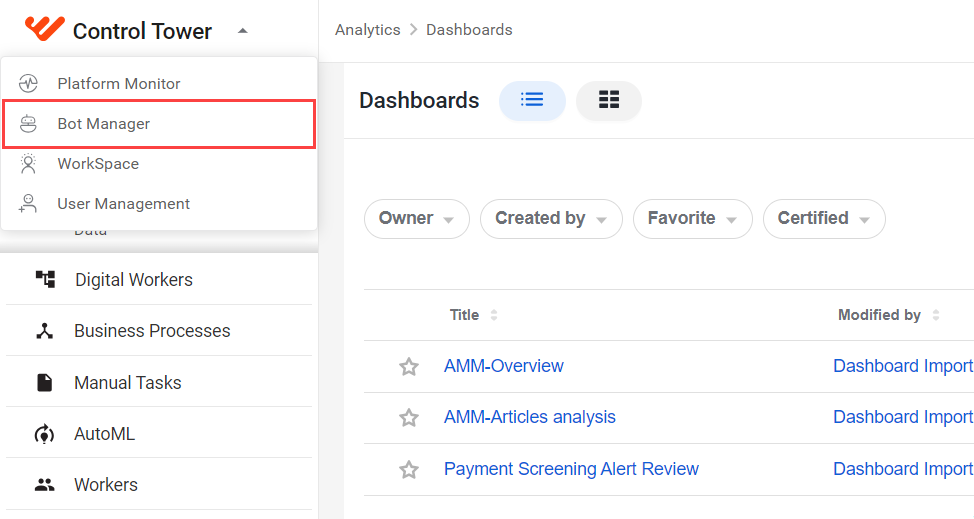
To open Bot Manager, click the dropdown in the upper left corner and select Bot Manager.
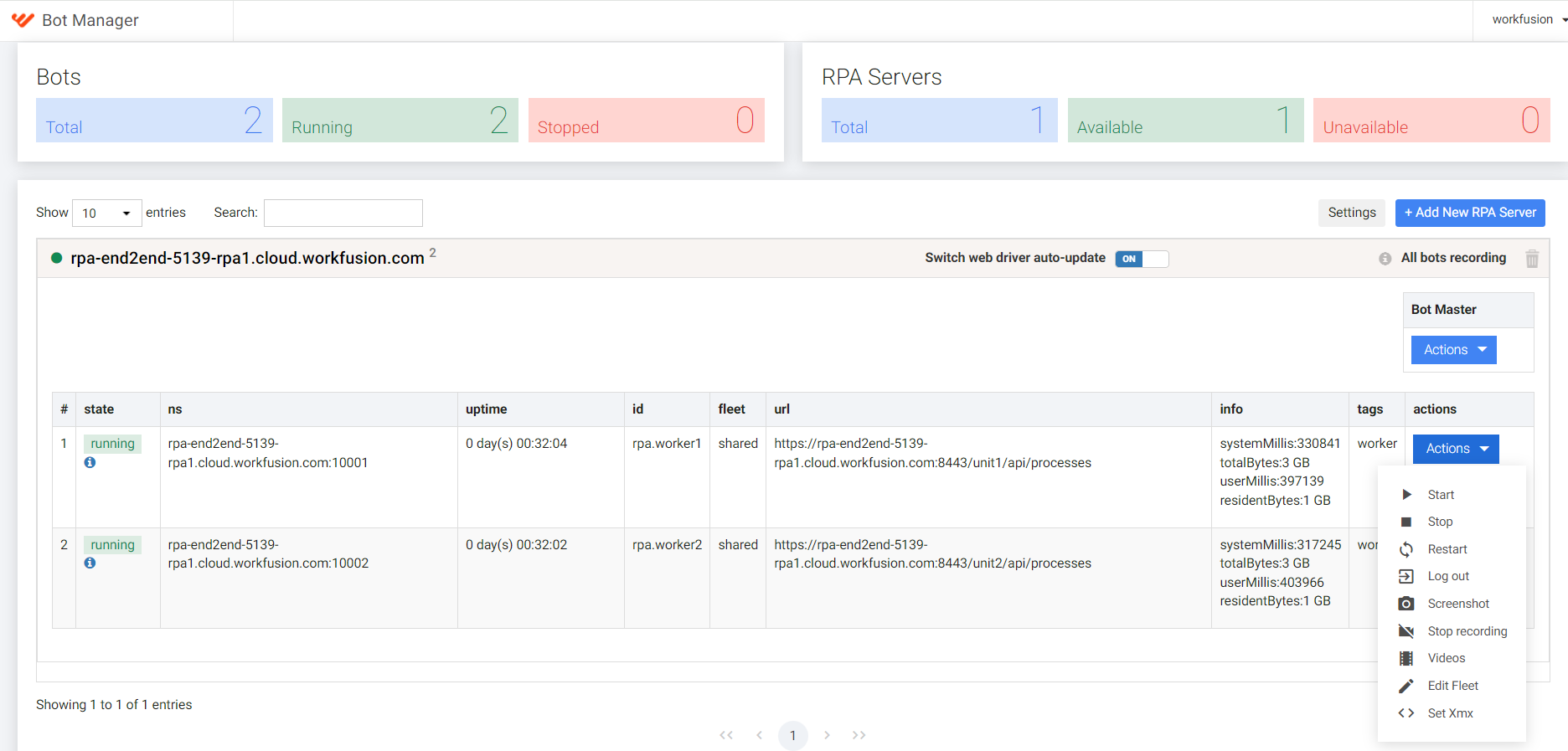
There are the following sections in the Bot Manager UI:
- Bots. Statistics for all RPA Units:
- Total
- Running
- Stopped
- RPA servers. Each RPA server has a list of managed processes:
- Total
- Available
- Unavailable
- Process metrics:
- state
- ns
- uptime
- id
- fleet
- url
- info
- tags
- RPA server actions:
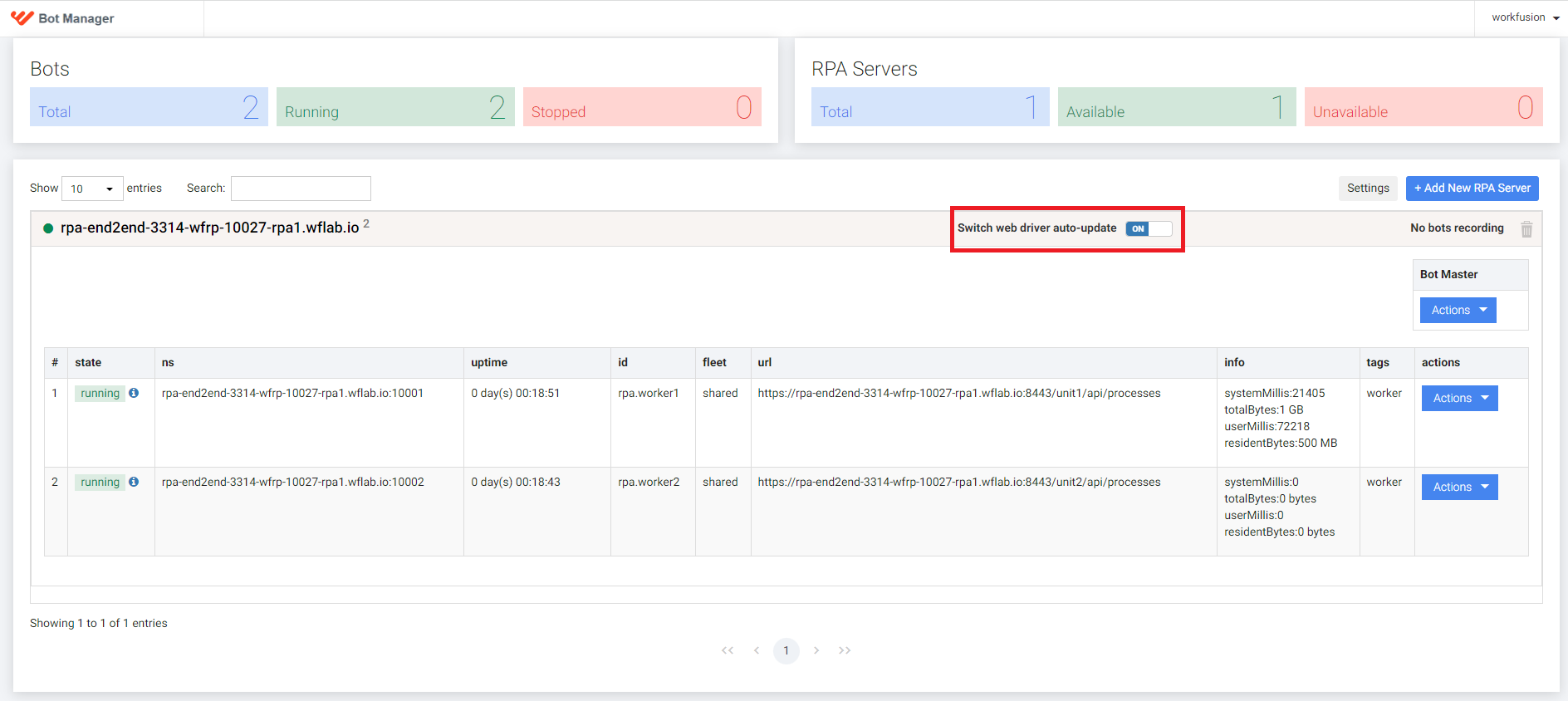
- Switch web driver auto-update: ON/OFF
- Start/Stop recording
- Videos
- RPA Worker actions:
- Start
- Stop
- Restart
- Log out
- Screenshot
- Start/Stop recording
- Videos
- Edit Fleet
- Set Xmx
Configure RPA server
Add RPA server
To add a new RPA machine, perform the following steps:
Click Add New RPA Server.
In the window that follows, enter the server hostname.
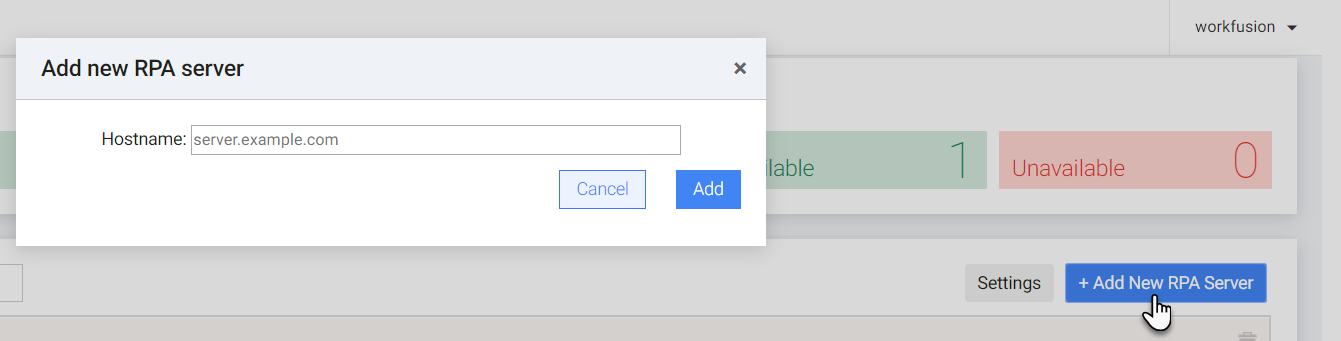
Click Add. The server appears in the list of RPA servers.
Switch web driver auto-update
You can enable automatic updates of browser driver software on your RPA server without stopping the environment. To do this, perform the following steps:
Switch the Switch web driver auto-update toggle on.
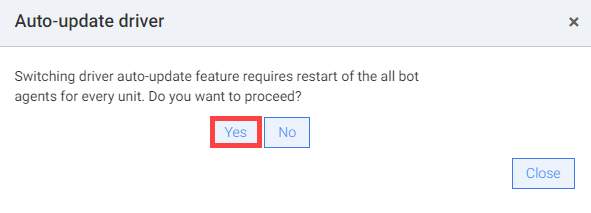
Restart the RPA infrastructure on the affected server. In the Auto-update driver window, click Yes to proceed with the restart.
To disable the web driver's automatic updates, switch the toggle off. For more details on the feature, see Update web drivers.
Set up RDP auto-reconnect
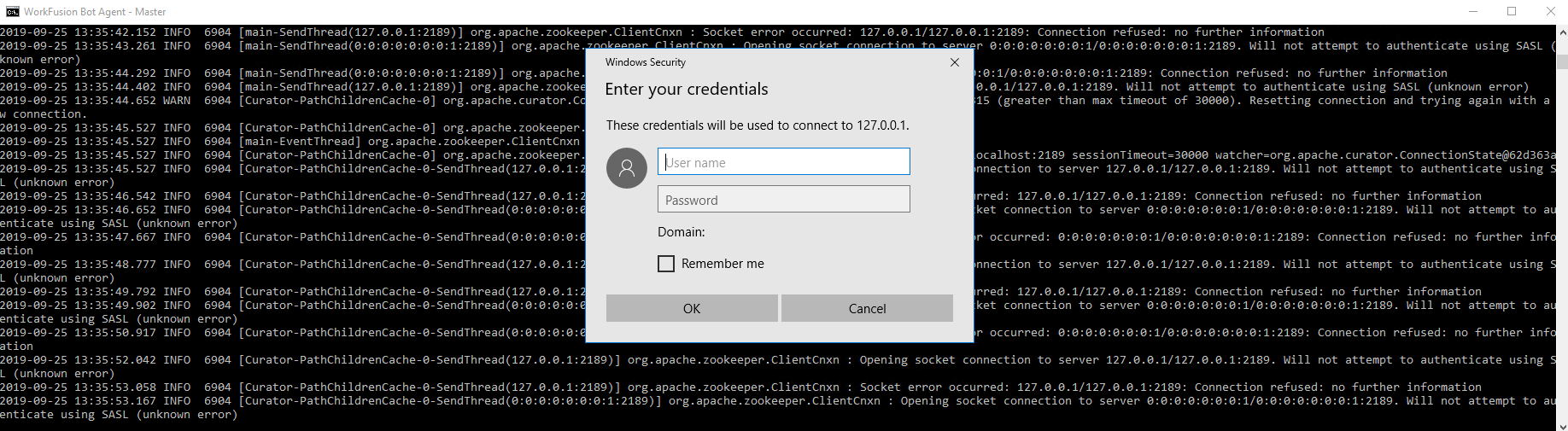
If you don't have a possibility to work with Windows Credential Manager, you cannot auto-reconnect, as Bot Agent Master cannot fill in credentials for auto-connect without typing them. As a result, when you start the RPA environment, you should connect to the Bot Agent Master session and fill in credentials manually to start each RPA Unit session.
If you don't set the auto-reconnect option as false, your RPA Unit tries to reconnect when starting an RDP session and cannot fill in credentials again. Thus, you get an exception.
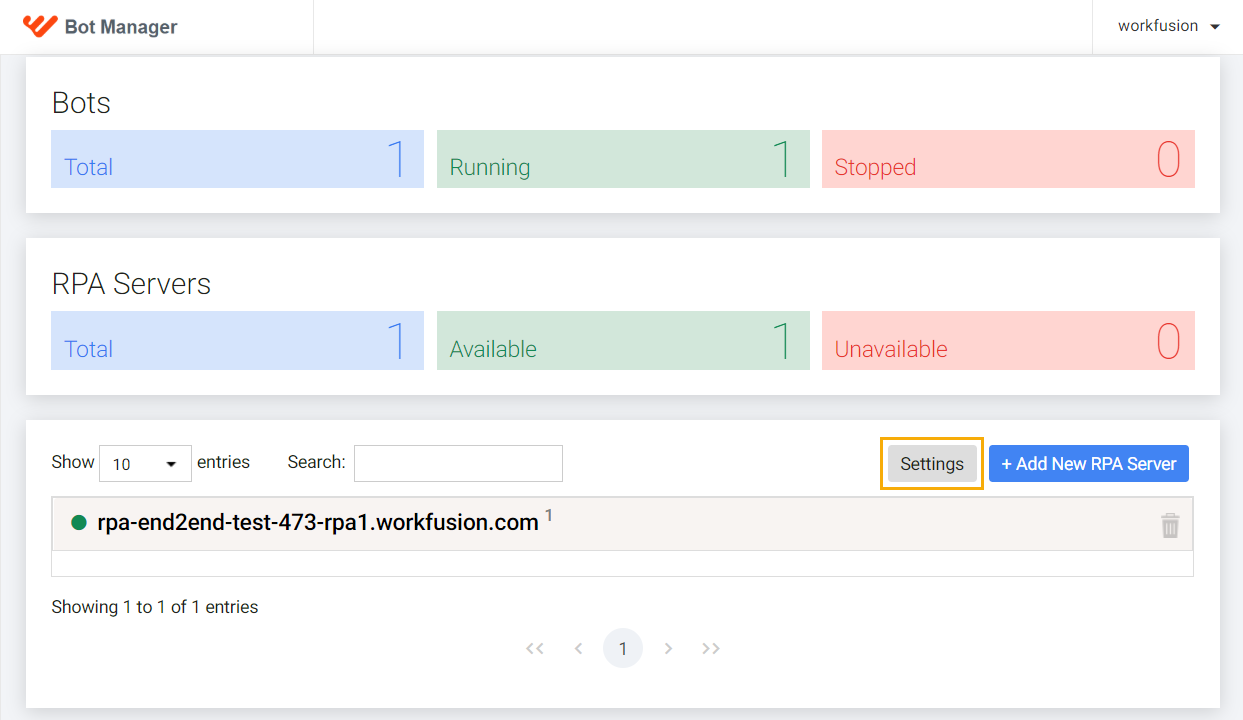
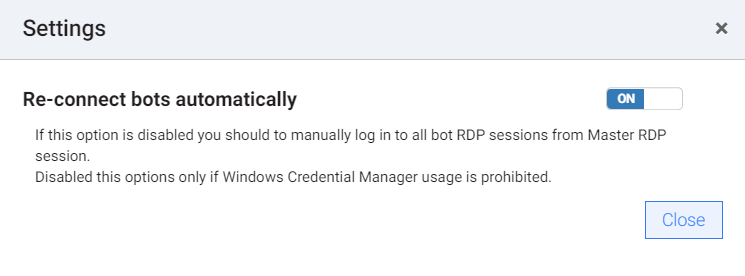
You can enable or disable the RDP Unit session auto-reconnect directly in the Bot Manager UI. To disable the auto-reconnect option, do as follows:
Click Settings.
Switch the Re-connect bots automatically toggle off.
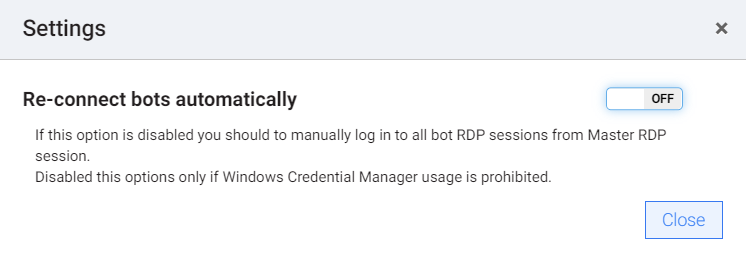
Connect to the Bot Agent Master session, fill in the RPA Unit credentials, and start Unit sessions.
To enable the auto-reconnect option, click Settings and switch the Re-connect bots automatically toggle on.
Remove RPA server
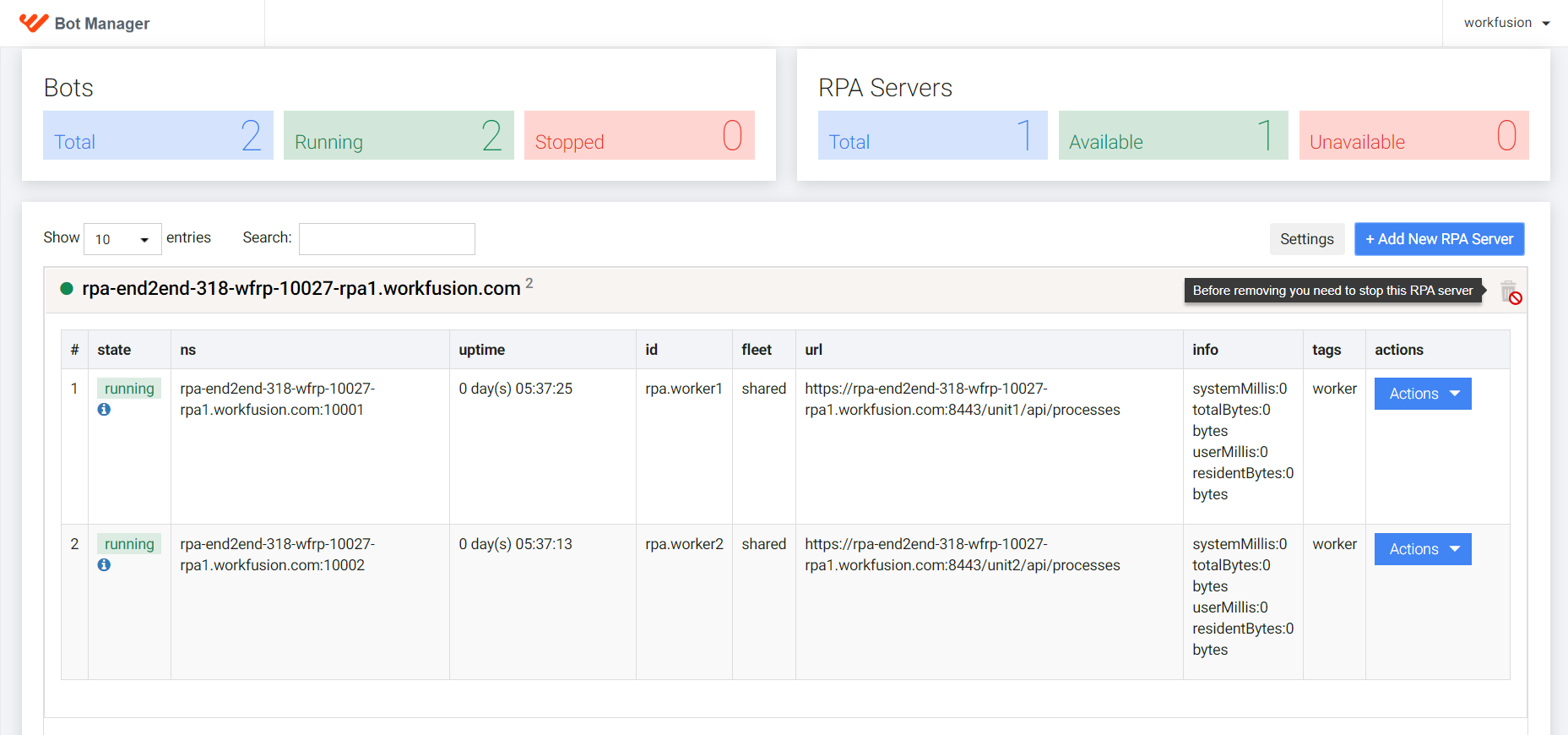
Make sure the RPA server you are going to delete has no processes running at the moment. Otherwise, the bucket button is unavailable. If you have any active processes, stop them manually. For that, select the server to expand and, in the Actions list, click Stop.
To remove an RPA machine, do as follows:
Click the bucket button next to it.
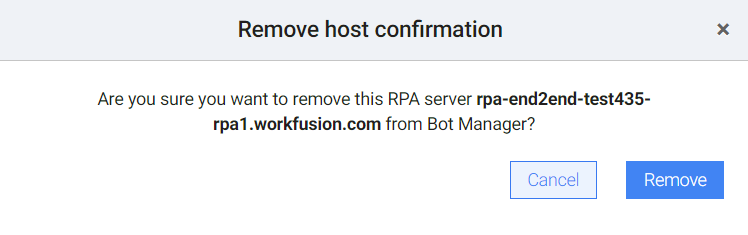
In the Remove host confirmation window, click Remove to confirm.
Configure RPA Worker
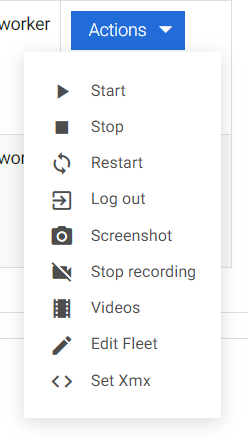
Each RPA server has a number of RPA instances. To run an action for a selected instance, click Actions next to it and choose a needed action.
| Action | Description |
|---|---|
| Start | Launches a selected process. |
| Stop | Stops a selected process. |
| Restart | Stops and starts a selected process again. |
| Log out | Executes the logout command. The RDP session closes, and all processes are stopped. |
| Screenshot | Takes a screenshot. Works for active RDP sessions only. |
| Start/Stop recording | Starts or stops video recording for an RPA Unit. |
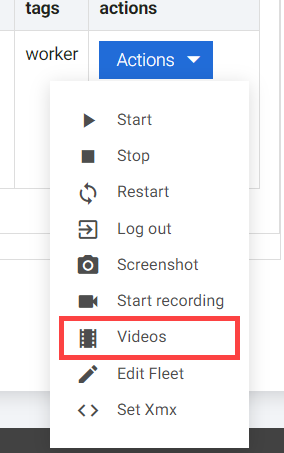
| Videos | Views the list of videos uploaded to S3 for the current Unit. |
| Edit fleet | Edits a fleet for an RPA Unit. |
| Set Xmx | Sets a maximum heap size value for an RPA Worker on the current Unit. |
Edit fleet
By default, each RPA Worker starts with the fleet defined on the RPA Server via the %RPAInstallDir%/bot-agent/conf/units/unit{unit_id} path:
fleet: shared
You can view the current fleet for each RPA Worker within the relevant section.
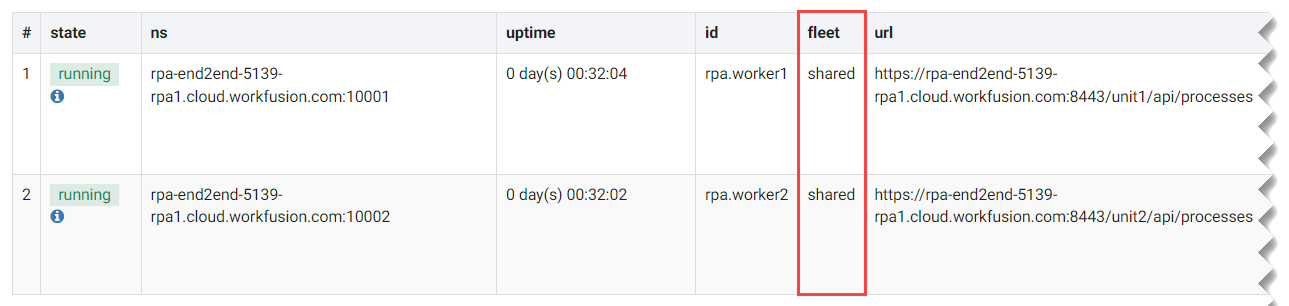
To edit a fleet for an RPA Unit, do as follows:
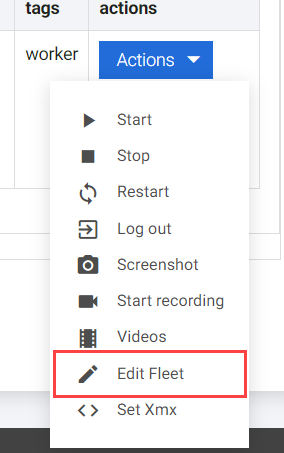
Select the server in the list to expand and view available options. Click Actions next to the needed instance and select the Edit Fleet action.
In the Edit Fleet window, select one of the options:
- Select existing: apply the already existing fleet.
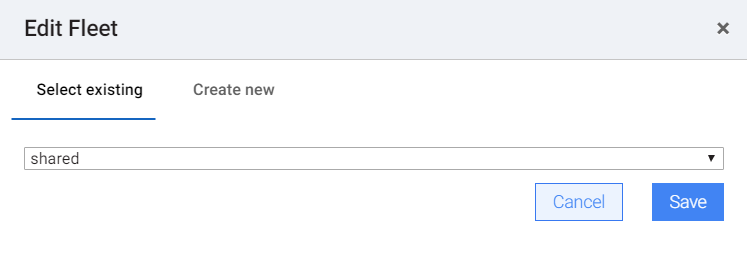
- Create new: apply a new fleet.
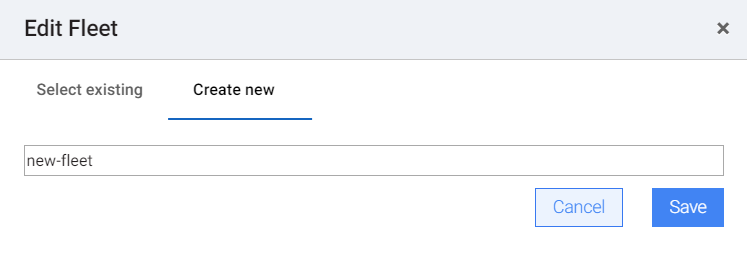
Select and enter the needed fleet value and click Save.
If the fleet updates successfully, the RPA Unit is restarted, with the pending update... value in the fleet column.

A new fleet value is displayed once the RPA Unit restarts, which can take several minutes. To see the updated fleet value, refresh the Bot Manager page.

Set Xmx value
You can specify the maximum heap size for RPA Workers on one RPA server so that they can process some large files. The default maximum heap size value is 1 GB. To change it, perform the following steps:
Select the server in the list to expand and view available options. Click Actions next to the needed instance and select the Set Xmx action.
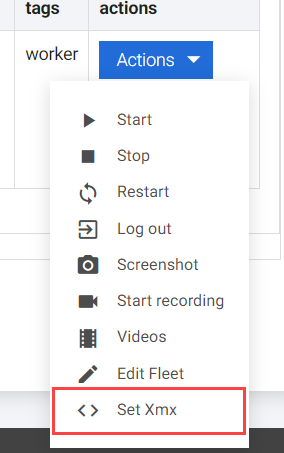
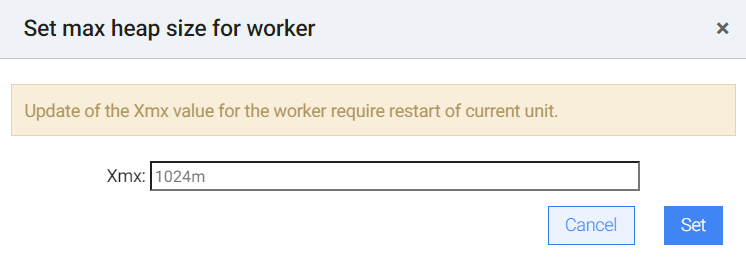
In the Set max heap size for worker window, specify the needed value and click Set. By default, 1024m (or 1 GB) is used.
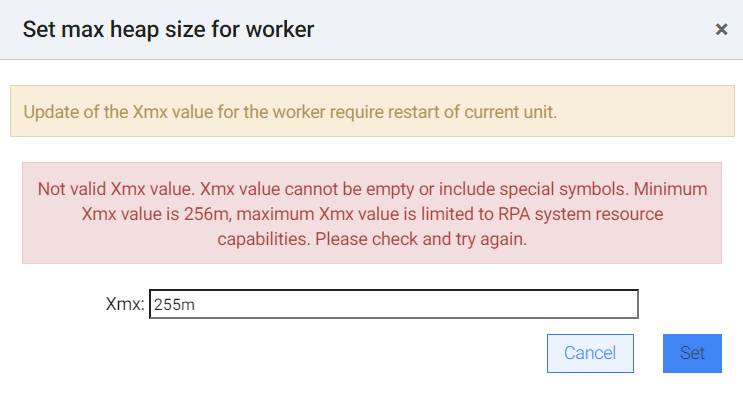
The value should not be less than 256m and should have the letter m (MB) at the end.
On setting a new Xmx value, the
rpa.<rpa_server_host>.unit<unit_id>.xmxZooKeeper node is updated or created.Restart the RPA Worker to apply the changes.
Alternatively, you can edit the -Xmx parameter in the worker.bat file located at the RPA/worker directory.
Record videos
You can record videos of actions currently performed on each RPA Unit screen. For more details, refer to Troubleshoot with RPA Unit screen video recording.
Start video recording
To start screen capturing on the Bot Master machine, follow the steps below:
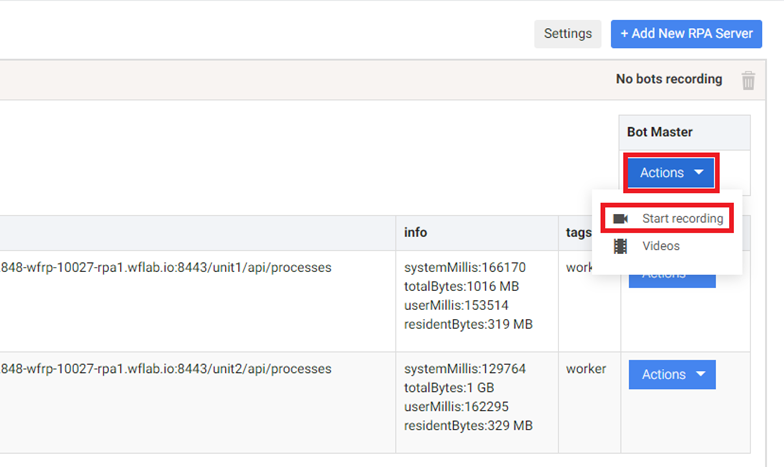
Click the Actions button under Bot Master and select Start recording.
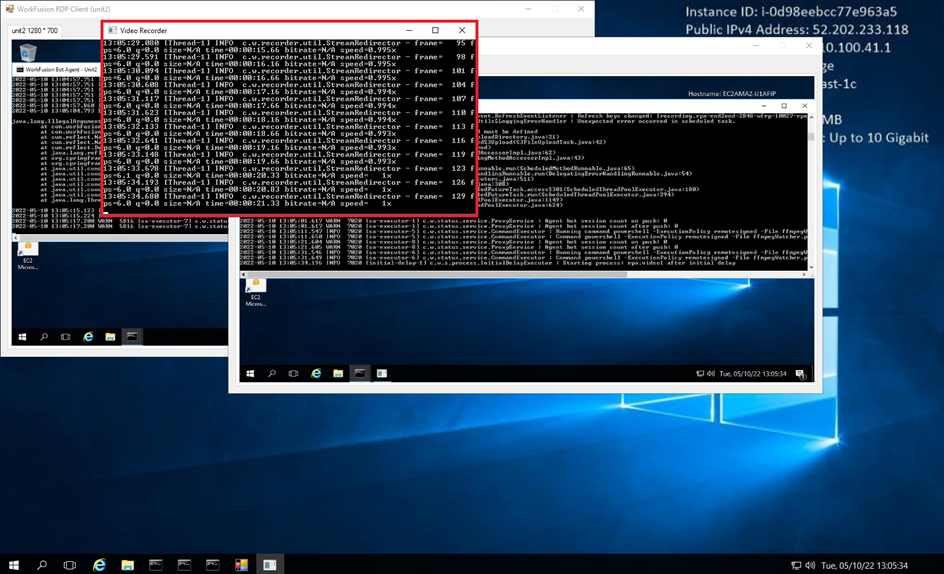
Connect to the Bot Master via RDP and check if the video recording process is displayed.
To start screen capturing on an RPA Unit machine, do as follows:
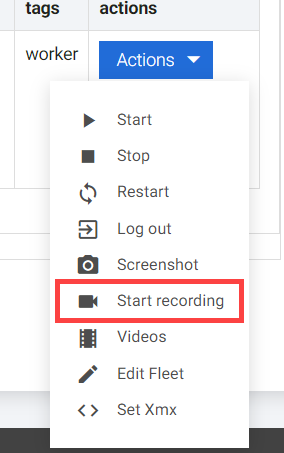
Click the Actions button next to the needed instance and select Start recording.
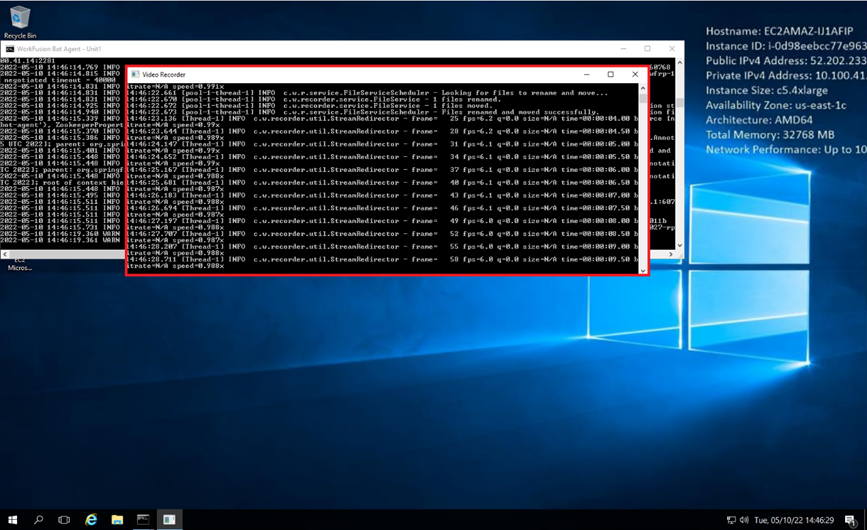
Connect to the RPA Unit via RDP and check if the video recording process is displayed.
Stop video recording
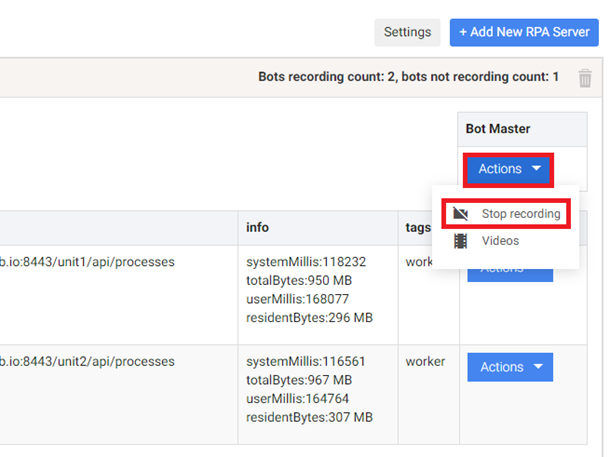
To stop the screen capturing on the Bot Master machine, click the Actions button under the Bot Master table and select Stop recording.
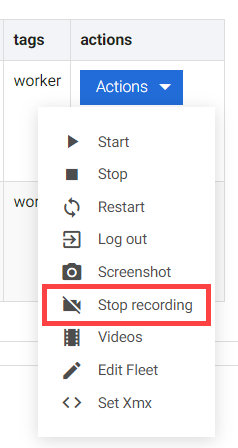
To stop the screen capturing on an RPA Unit machine, click the Actions button and select Stop recording.
Check video recording status
The current status of video recording processes is displayed next to the instance name:
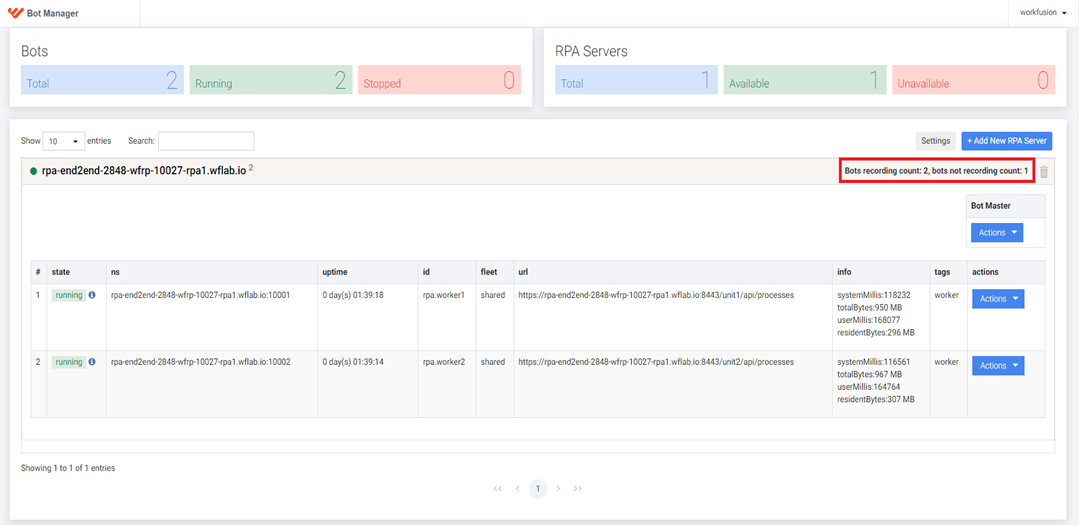
The video recording status label can have three values:
- All bots recording
- No bots recording
- Bots recording count: x, bots not recording count: y
Access recorded videos
You can view recorded videos for Bot Master and each RPA Unit separately:
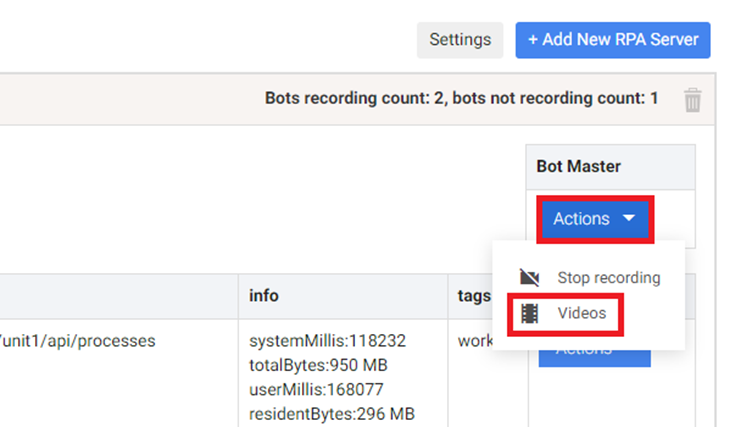
To access videos for Bot Master, click Actions under Bot Master and select the Videos option:
To access videos for a specified RPA Unit, click Actions next to the needed instance and select the Videos option:
The following popup appears with a list of recordings:
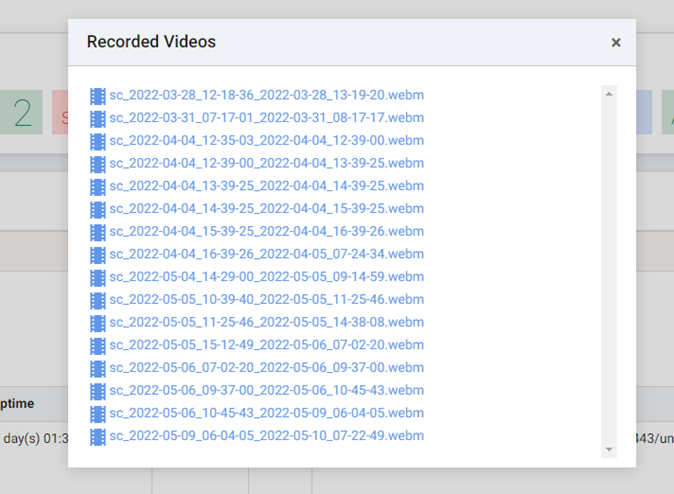
Each link redirects to the appropriate screen capture recording stored in an S3 bucket.
View statistics
Bot Manager collects statistics on RPA server and RPA Unit statuses and server performance and provides data storage for analytics.
Check RPA servers

| Statistics | Description |
|---|---|
| Total | All configured and available RPA servers |
| Available | RPA servers accessible through Bot Manager |
| Unavailable | Stopped or unavailable RPA servers |
Available RPA servers have the green indicator next to the server name, and those unavailable–the red one.
Check RPA Units

| Statistics | Description |
|---|---|
| Total | Amount of stopped and running RPA Unit processes |
| Running | Up and running RPA Unit processes; it doesn't matter if an RPA Unit is executing a task or not |
| Stopped | Crashed or manually stopped RPA Unit processes |
In case of any issues, look for troubleshooting tips in the following support guides: