Build SDLC with ODF 2
SDLC principles
Team SDLC
Delivery Pod SDLC looks as follows:
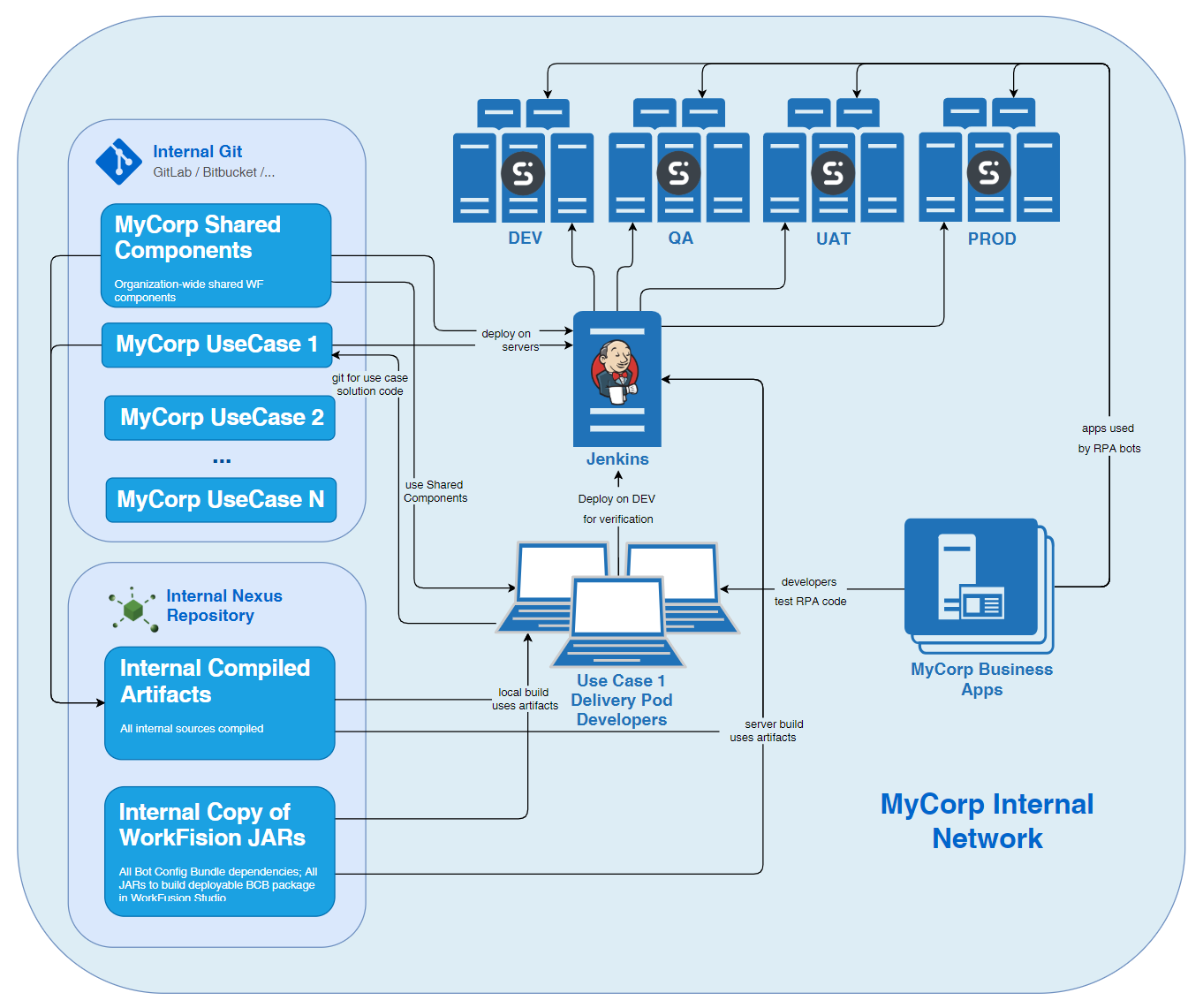
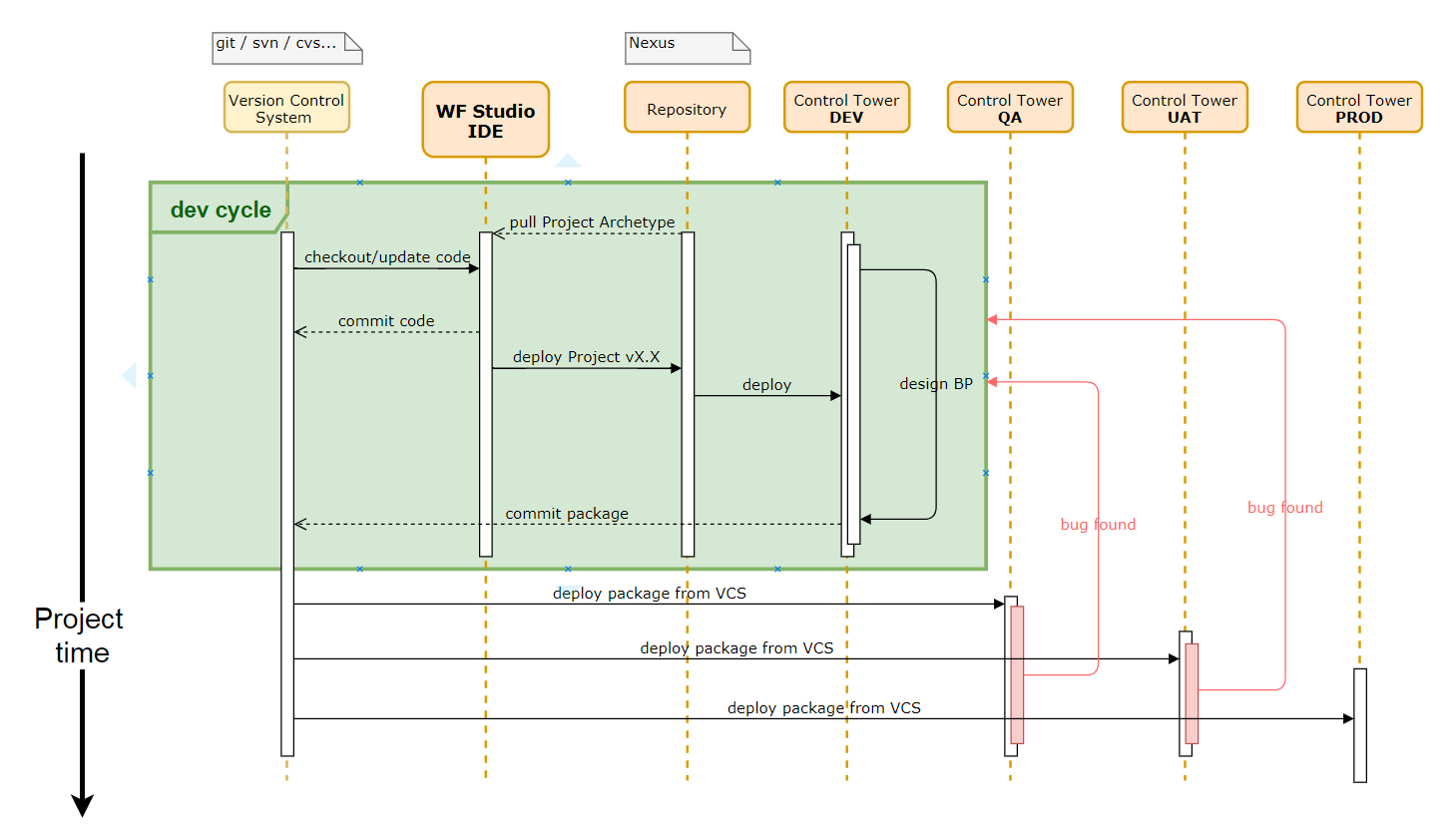
Key practices for Delivery Pods include:
- Release builds from tagged code.
- Auto-deploy builds from Git.
- Reuse components shared as JARs.
- Avoid any changes in Control Tower.
- Redeploy for any change or bug fix.
- Have access only to required Git repositories.
Multi-team SDLC
ODF 2 is designed for adoption by large companies where WorkFusion rolls out SAA programs. Regarding team structure, SAA offers two types of groups:
- Feature Pods
- Delivery Pods
ODF 2 enables effective shared code ownership within this team structure. It is critical to establish and follow well-defined processes, as they must align with the following requirements:
- Security. No organization-internal business solution code can be shared outside the organization.
- Contribution. It may be beneficial for the organization if WorkFusion accepts some company components or code features. This can save effort during version migrations and simplify or accelerate implementation.
- Permissions management. Internal repositories should be accessed by the organization's designated groups.
- Easy start and adoption. ODF 2 must be possible to learn and try before it is deployed to the company's VCS or repository.
Multi-team code ownership is organized as follows:
WorkFusion ODF 2 team:
- Evolves ODF 2 Core and Archetypes.
- Manages contributions and bug fixes.
- Documents and educates on ODF 2 usage.
- Supports adoption across organizations.
Feature Pod:
- First to adopt ODF 2.
- Creates reusable company components.
- Ensures teams follow consistent standards.
- Contributes back to ODF 2.
Delivery Pods:
- Deliver specific implementations.
- Share solution modules with other pods.
- Follow SDLC practices: code review, CI/CD pipelines, Scrum-based project management.
IT Operations:
- Copies WorkFusion and ODF 2 dependencies.
- Ensures smooth deployment and runtime support.
How to start new ODF 2-based project
Below are general steps that the project's technical team should follow when adopting ODF 2 for the fist time in their organization.
Prepare server environment
LEAD DEVELOPER | ARCHITECT | IT OPERATIONS
- Patch Control Tower with ODF 2 JAR.
- Roll out the deployment automation REST service into Control Tower.
- Add WorkFusion dependencies (from https://repository.workfusion.com) into the organization's local repository.
- Create the organization's local VCS (Git) repositories:
- Shareable with other teams (for Feature Pods)
- Non-shareable (for Delivery Pods)
- Set up developer access.
- Agree on and document naming conventions for repositories and modules to be followed by all teams.
Project setup
LEAD DEVELOPER | ARCHITECT
- Generate the initial Java project structure from the ODF 2 Simple Archetype.
- Generate all RPA modules (one per automated business application) and other shareable components.
- End up with a Maven project containing multiple Maven modules.
- Verify that the build is successful and can be deployed to server Control Tower.
- Push the project into the organization's local Git.
Implementation
ALL DEVELOPERS
- Each developer checks out the project from the organization's local Git.
- Project Lead Developers guide the team on where to place shareable vs. non-shareable code.
Release activities
RELEASE ENGINEER
- Create a tag in Git.
- Build a deployable package.
- Install all modules into the organization's local repository (Nexus).
- Deploy using the deployment automation REST service into server Control Tower.
Bug fixes in QA, UAT, or PROD
ALL DEVELOPERS | RELEASE ENGINEER
- Roll out a local project version from the Git tag of the build where the bug was found.
- Apply the fix.
- Create a tag in Git and follow the rest of the release activities.