Compare Search Engines
Search Engine is a framework for optimizing AutoML model parameters. WorkFusion offers three versions of the framework that you can choose from based on your purposes:
Search Engine 1.0
The Search Engine version applies a legacy approach used in the WorkFusion platform v9.x. For more information, refer to the 9.x documentation.
Search Engine 2.0
Available already in v 9.x versions, Search Engine 2.0 is aimed at speeding up the training process without degrading the model performance (quality).
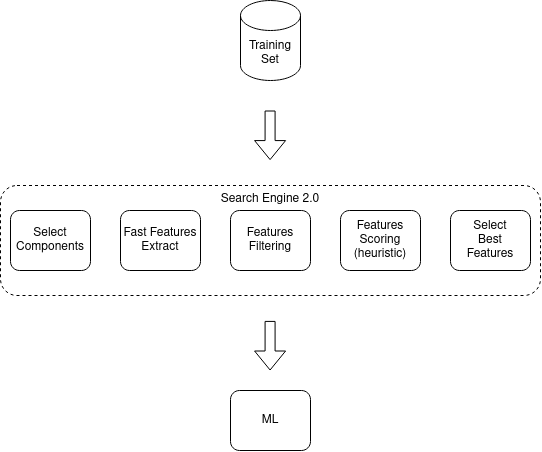
The legacy Search Engine 1.0 approach is time-consuming: first, you prepare a deep learning model, and then you use it to select the best set of model components, such as Annotators, Feature Extractors, Normalizers, and so on. Search Engine 2.0 implements the following improvements:
- An inner deep learning model is replaced with a set of steps enabling the selection of the best-fitting model components.
- Fast feature extraction.
- Statistics-based heuristic to score produced features and select the best ones.
Pros
Search Engine 2.0 provides the following benefits:
The training time is reduced from 2 hours to 15 min per field.
Model performance is improved.
The training time significantly depends on the training set size.
Cons
Search Engine 2.0 has the following limitations:
By default, only positive samples are used, which, in some cases, produces a lot of false positive results.
The large size of the feature space (millions of unique features) makes it difficult to use specific machine-learning algorithms, for example, kernel-based.
Search Engine 3.0
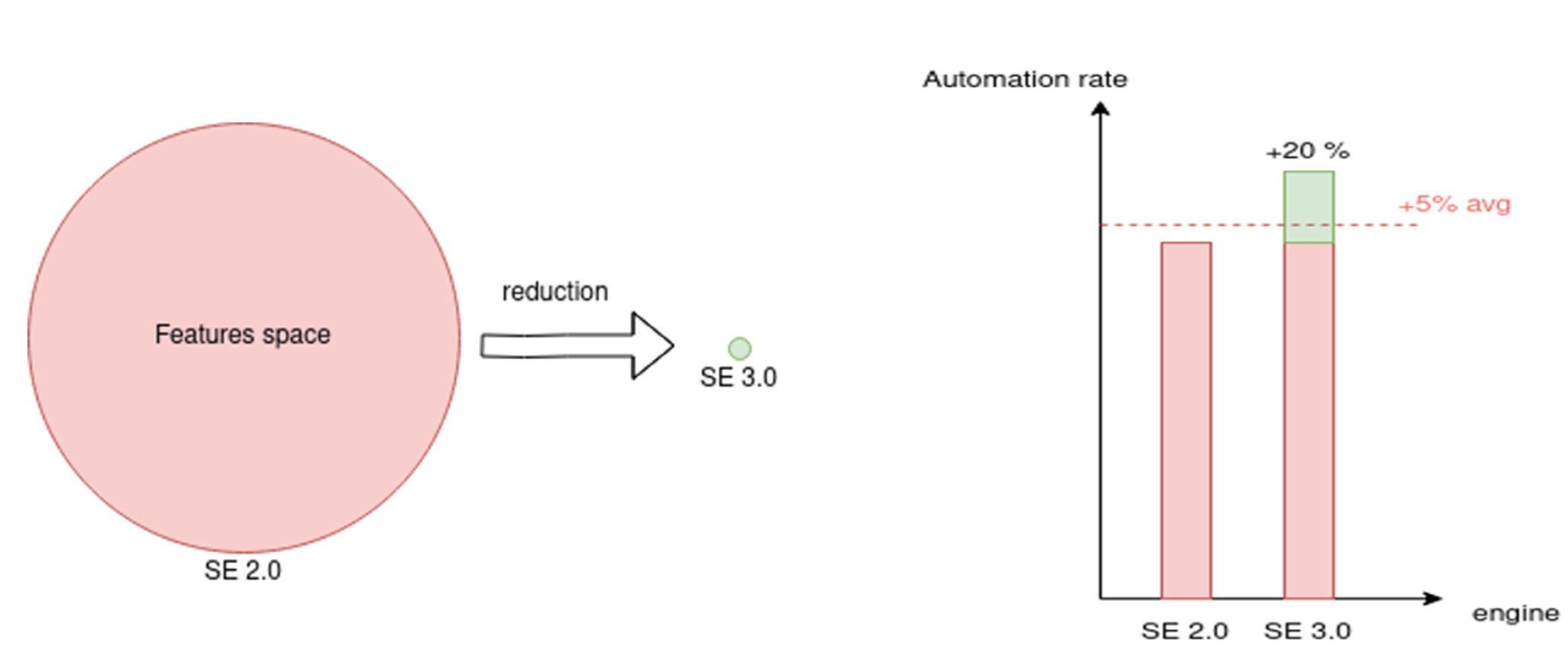
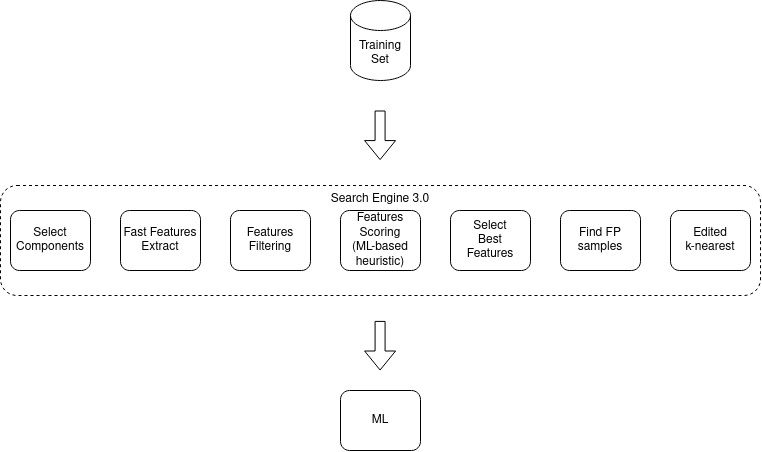
Search Engine 3.0 aims to reduce the amount of false positive results and decrease the size of the feature space. It implements the following improvements:
Statistics-based heuristic is replaced with ML-based one to score produced features and select the best ones.
A mechanism is added to analyze based on the edited k-nearest algorithm and exclude the samples that can potentially produce false positive results.
Pros
Search Engine 3.0 provides the following benefits:
Model performance (quality) is improved by 5% on average and by 20% maximum.
The feature space is reduced by 500 to 1,000 times, which allows using resource-intensive ML algorithms without significant impact on training or execution performance.
Cons
Search Engine 3.0 has the following limitations:
The training time is increased by 2 to 5 times.
Only Information Extraction models are supported.