Stakeholders
While implementing any project, you communicate and interact with a client, particularly with client stakeholders.
Stakeholders are individuals involved in the project execution or who will be affected by it. It is essential to reveal all the project stakeholders and consider their interests and influence. Any stakeholder identified plays the role of a source of the requirements, assumptions, or constraints.
Data Analysts perform analysis of stakeholders, which involves understanding their roles, responsibilities, and influence on the project. Additionally, stakeholder analysis is needed to identify appropriate stakeholders to capture requirements, approve project deliverables and scope, and accept the final solution. Stakeholders play a crucial role in project success and solution acceptance, so it is important to build good relationships with them, keep their trust in the solution, and communicate effectively.
Let's consider key stakeholders for the project.
Subject Matter Expert
A domain Subject Matter Expert (SME) is an individual with in-depth knowledge of the current business processes and rules related to the business need. These people are often end users of the solution, meaning their daily work will be transformed when the solution is applied. Indirect users of the solution, such as managers, process owners, consultants, and others, can also play the role of an SME.
The Data Analyst usually interacts with SMEs regarding requirements elicitation and validation and the data tagging process for data set collection. Two different groups of SMEs can be involved in these activities. For example, Managers and Team Leads help formulate requirements while the Ops team is involved in tagging. The Data Analyst should educate SMEs on tagging process, show them how to navigate in Workspace, clearly articulate tagging rules, set expectations, and communicate feedback regarding tagging results. Where needed, the Data Analyst spends some time assisting SMEs in understanding how the requirements are defined to build the entire process of requirements elicitation effectively.
SMEs' availability is critical for these activities. Their involvement should be planned in advance and communicated to clients. For tagging, the Data Analyst makes up a plan to arrange tagging, review activities, and identify the expected volumes of tagged documents and timelines for the defined team of SMEs involved in tagging.
SMEs are often involved in the review and approval of the scope and requirements. It is critical to build a good connection with them and make sure they understand the future solution's value and importance. It is necessary to communicate the difference between existing and future processes and highlight improvements in future work. Often, SMEs are not directly involved in the formal approval of the final solution, but have influence over the approvers and can play the role of advocate for the final solution.
End user
End users are stakeholders who directly interact with the solution. Often, these are SMEs involved in requirements gathering, but end users can also be employees who are entirely new to the solution. Where possible, it is essential to talk to them and understand their daily work's peculiarities and pain points. That can also be an additional source of business rules or constraints and can help the solution to bring more value with manual effort reduction, saving time, automation of repeated actions, and so on.
The Data Analyst should prepare a user guide for end users with instructions on how to work with Business Processes, use Workspace, change settings, and identify benefits. Knowledge transfer and demo sessions can also take place.
Sponsor
Sponsors are usually C-level managers who initiate digital transformation in their company. They are responsible for initiating the effort to define a business need and develop a solution to meet that need. They authorize work to be performed, control the budget for the initiative, and formally accept the solution.
The Data Analyst can be involved in a demo session for sponsors and should be prepared to explain the technology's key concepts, metrics, and automation benefits.
Regulator
Regulators are usually third-party vendors responsible for the definition and enforcement of standards. Standards can be those that the development team is required to follow, standards the solution must meet, or both. Regulators can enforce legislation, corporate governance standards, audit standards, or standards defined by organizational centers of competency. All such standards relevant to the solution should be considered as business rules or constraints to the solution. Standards can also be provided by suppliers who offer or consume products or services and might have contractual or moral rights, conditions, requirements, or SLAs that should be considered.
Information about stakeholders
To connect well with stakeholders and communicate effectively, you need to know additional information about stakeholders, including:
- Names and titles of stakeholders
- Stakeholder's responsibilities
- Location of stakeholders
- Their availability
- Description of stakeholder's influence and interest
- Stakeholder's authority level
Stakeholder's influence matrix
Stakeholders do not only provide requirements but also have their influence on the solution and can be impacted by the solution as well. These trends can be analyzed within the matrix approach that segregates stakeholders regarding their influence (strong or weak) and attitude towards the project (support or opposition).
To understand the position of a stakeholder in the matrix, consider the following items:
- Do they believe that the solution will benefit the organization?
- Will the benefits affect them directly?
- Do they believe that the project team can successfully deliver the solution?
- Are possible negative effects of the initiative on this stakeholder greater than the rewards?
- Is the organization hierarchical in nature rather than team-based?
- Did key project team members (including but not limited to the Data Analyst) build trusting relationships or were there prior failed projects or project phases involving those people?
Mind the following groups:
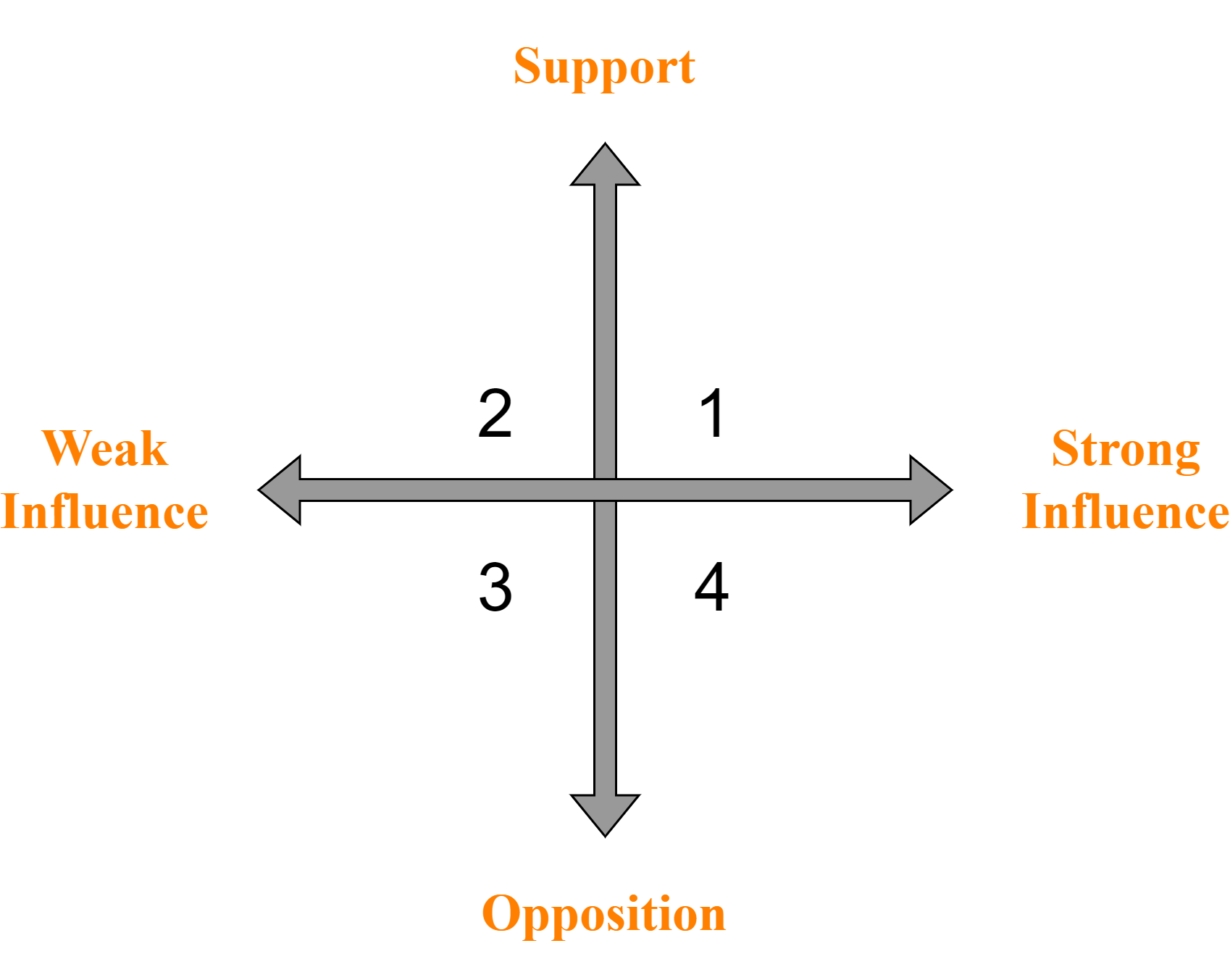
Strong support and influence. Members of this group are your major allies. You must ensure you actively address their needs and expectations and don't lose their confidence. Work closely with this group of stakeholders to ensure that they agree with and support the change.
Support and weak influence. This group of stakeholders does not influence the project directly. However, escalations from their side can cause additional noise and trouble. Make sure you keep them informed, involved, satisfied, and confident in the success of the project.
Negative attitude and weak influence. Monitor the interest and influence of this group of stakeholders to ensure it is not getting worse. Do not neglect their impact and opinion, and where possible, try to move them to group 2.
Negative attitude and strong influence. Keep an eye on the sentiment among such stakeholders. Where possible, try to neutralize the negative effect and opinion spread by this group, be ready to act proactively, and stay ahead by providing direct evidence of the project's value and success.
The Data Analyst should, as part of the stakeholder analysis, identify which stakeholders have sufficient authority to accept or reject the requirements at the validation stage and the final solution during the UAT phase.