Label documents in Tagging-over-Document Business Process
Overview
The Tagging over Document (TOD) Business Process (BP) allows users to label the original document to avoid facing OCR results.
Before: The user tagged the OCR result, which can differ from the original document, and struggled to find a proper value.
After: The user labels the original, taking no time to recognize the familiar document, its structure, the position, font, and font size of the required value.
Result: For classification models, the labeling speed increase is at least 50%, for extraction models: at least 30%. Labeling speed increase, combined with model training time reduction, decreases the time required to deliver an operation to the customer.
Demo
The TOD BP offers several workflows:
- Tag: select and label values, chunks of sentences, or entire table rows and columns.
- Search: find other occurrences of a specific value across the document.
- Evaluate: check the tagged values. Click the extracted value to jump to it even if the document has many pages.
Features
The out-of-the-box TOD Use Case is intended for the easy setup of the TOD BP. The Use Case utilizes preprocessed OCR XML output to:
- Split text into words.
- Calculate absolute coordinates of each symbol.
- Group them into words, lines, columns.
- Generate HTML where a tag over the original document corresponds to an OCRed text underneath.
According to the execution engine architecture, The BP has no limitations for the number of pages and records or the number of documents on any step. Note that each step must complete the processing of all records before moving to the next step.
Limitations
In Intelligent Automation Cloud, the TOD BP has the following limitations:
- The BP does not include a Manual Task and an ETL step.
- The BP does not support predefined autoselect OCR parameters.
- The BP supports OCR with basic or no authentication only. There is no OCR JWT authentication support.
- When tagging a document, including one token in two overlapping or exactly matching sections, the BP produces a resulting empty XML and should be avoided. However, it is possible to include a smaller tag inside the bigger one. For example, tag a City inside an Address.
Configure environment
- AutoML 10.0 or later.
- ImageMagick (Windows: v7.1.0, for example,
ImageMagick-7.1.0-17-Q16-x64-static.exe) and Ghostscript (Windows: v9.20) installed to perform a multi-page document split in the case when the TOD OCR type is used. - Global variables configured according to the Global variables section.
OCR REST API
The OCR BP implemented in AutoML extends the OCR API by retrieving a preprocessed document to use for labeling an IE Manual Task. It wasn't a difficulty before the users tagged an OCRed document. But if the users label the original document, there is a problem with the coordinates of recognized symbols.
The reason is that OCR performs internal preprocessing of a document regardless of the parameters, such as rotating, improving the quality, and so on. The coordinates of the recognized symbols relate to the internally preprocessed document and mismatch to the very original document. Hence, the users do not actually label original document, but the differences are so tiny that they do not notice them.
You can retrieve an OCR preprocessed document using the following methods:
POST /processDocumentor/submitImagewith thestorePreprocessedDoc=trueparametercurl
curl -s --form "file=@FILENAME" "http://ocr.hostname:8080/api/v1/cloud/processImage?correctSkew=true&xml:writeRecognitionVariants=false&profile=documentConversion&exportFormat=txt&language=English&storePreprocessedDoc=true"Response
<?xml version="1.0" encoding="UTF-8" standalone="yes"?><response><task id="5693d8f77b78005fcbbfbe84" message="OK" processEndTime="2016-01-11T16:32:00" processStartTime="2016-01-11T16:31:56" registrationTime="2016-01-11T16:32:28" resultUrl="http://ocr.hostname:8080/api/v1/cloud/download?taskId=5693d8f77b78005fcbbfbe84&result=1" resultUrl2="http://ocr.hostname:8080/api/v1/cloud/download?taskId=5693d8f77b78005fcbbfbe84&result=2" resultUrl3="http://ocr.hostname:8080/api/v1/cloud/download?taskId=5693d8f77b78005fcbbfbe84&result=3" statusChangeTime="2016-01-11T16:32:28" status="Completed"/></response>GET /download/preprocessedwith the following parameters:taskId: OCR task ID (returned from/processDocumentor/submitImage)page: the number of document pagescurl
curl -s --form "file=@FILENAME" "http://ocr.hostname:8080/api/v1/cloud/download/preprocessed?taskId=5693d8f77b78005fcbbfbe84&page=1"
Configure Data Stores
OCR cache Data Store
Cache storage is optional for TOD but highly recommended, as it allows to decrease requests to the OCR cluster. Create Data Store for OCR cache in Control Tower. The Data Store with the name you specified is created automatically if it doesn't exist. The most important Data Store parameters are as follows:
Parameter name | Description | Mandatory | Example |
|---|---|---|---|
ocr_json | Cached response from OCR | yes | |
key | Document hash | yes | 208682471691263be19a1fc0909d3efa |
ocr_type | OCR flow used in BP run | yes | tod |
export_format | List of formats used in BP | yes | xmlForCorrectedImage, xmlWithoutRecognitionVariants |
meta_info_json | Contains all required data for TOD Manual Task, including chars positions, preprocessed document URL, and so on. | yes | |
Global variables
Global Variables are used for the TOD global configuration. Specify the following parameters:
Parameter name | Description | Mandatory | Example |
|---|---|---|---|
convert_lib_path | Specify the path to the ImageMagick library if it was not added to PATH | no | |
| URL to OCR service with context path | yes | https://velcom-ocr1.workfusion.com/api/v1/cloud |
ocr_username | OCR username | no | <some_username> |
ocr_password | OCR password | no |
You can change the OCR engine version by changing the URL in global variables. For example, https://velcom-ocr1.workfusion.com/api/v1/cloud > https://velcom-ocr1.workfusion.com/api/v2/cloud (v1 > v2).
Configure Business Process
BP structure
The BP must include the following steps:

OCR settings
If the ETL settings step is inserted using drag-and-drop from the bot library to the right of the workflow field, the settings are rewritten for all BPs using this step. To avoid this, drag an empty Bot Task from the toolbar above the workflow field and define it using the OCR settings case as described below.
Add the OCR settings step to the BP before the out-of-the-box TOD BP:
On the Workflow tab, drag an empty bot step to the BP designer.
Double-click the Bot Task and select an ELT settings Use Case.
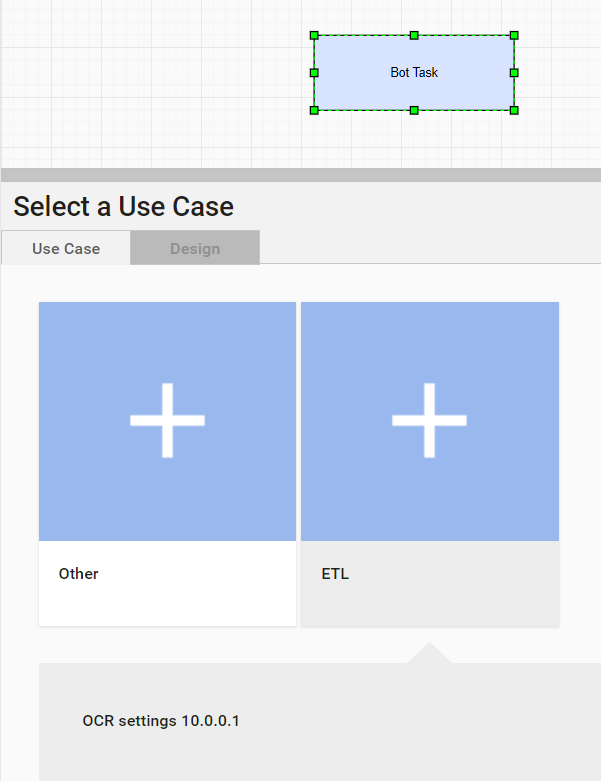
Specify OCR settings according to the instructions below:
| Setting | Description | Required | Example or Options |
|---|---|---|---|
| S3 bucket | S3 bucket for TOD and OCR results | yes | doc-upload |
| OCR Type | OCR flow for the BP specifies the OCR BP use mode | yes |
|
| Export Format | Specifies the storage format for the OCR result | yes |
|
| Document Language | no | English (default) | |
| Change DPI | DPI value for documents | no | from 50 to 400 |
| Invert image | no | true or false | |
| Discard Color Image | no | true or false | |
| Remove Color Objects | Remove color objects according to the selected option | no |
|
| Remove Color Objects Type | Remove color objects type | no |
|
| Custom Regions | Custom regions for OCR | no | <some-region> |
| Allowed Region Types | Allowed region types for OCR | no |
|
| Cache Data Store | OCR cache Data Store | no | ocr_cache_datastore described in the OCR cache Data Store section |
When the Enriched output OCR Type is selected, the Export Format field is hidden, and xmlWithoutRecognitionVariants, xmlForCorrectedImage are selected.
OCR workflow
To add the OCR Workflow step to your BP, perform the following actions:
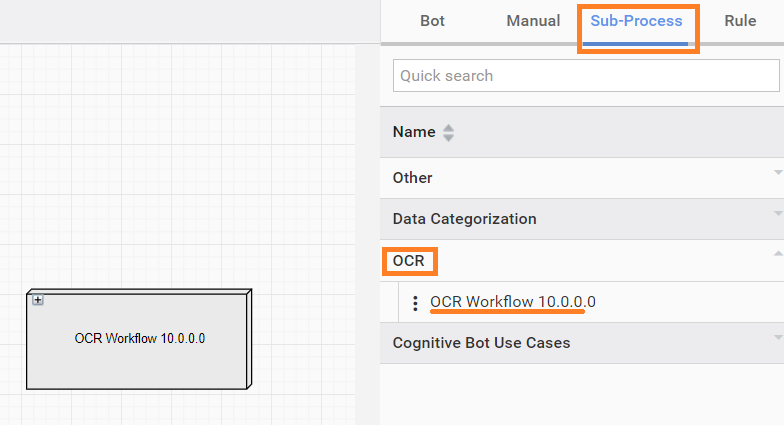
On the Workflow tab of your BP, select Sub-Process on the right.
Expand the OCR section and select OCR Worklow.
Drag and drop the OCR Workflow step to the left on the BP Structure field.
Manual Task
To label documents after recognition, add Information Extraction Manual Task to the BP after the out-of-the-box TOD step.
The IE Manual Task is generic and accepts both old and new formats. It displays XML or the original document based on the input format and includes an original document if the input file refers to the corresponding JSON. Otherwise, the information extraction task works with any document type as previously.
For more details on the input format, refer to Input.
TOD answer
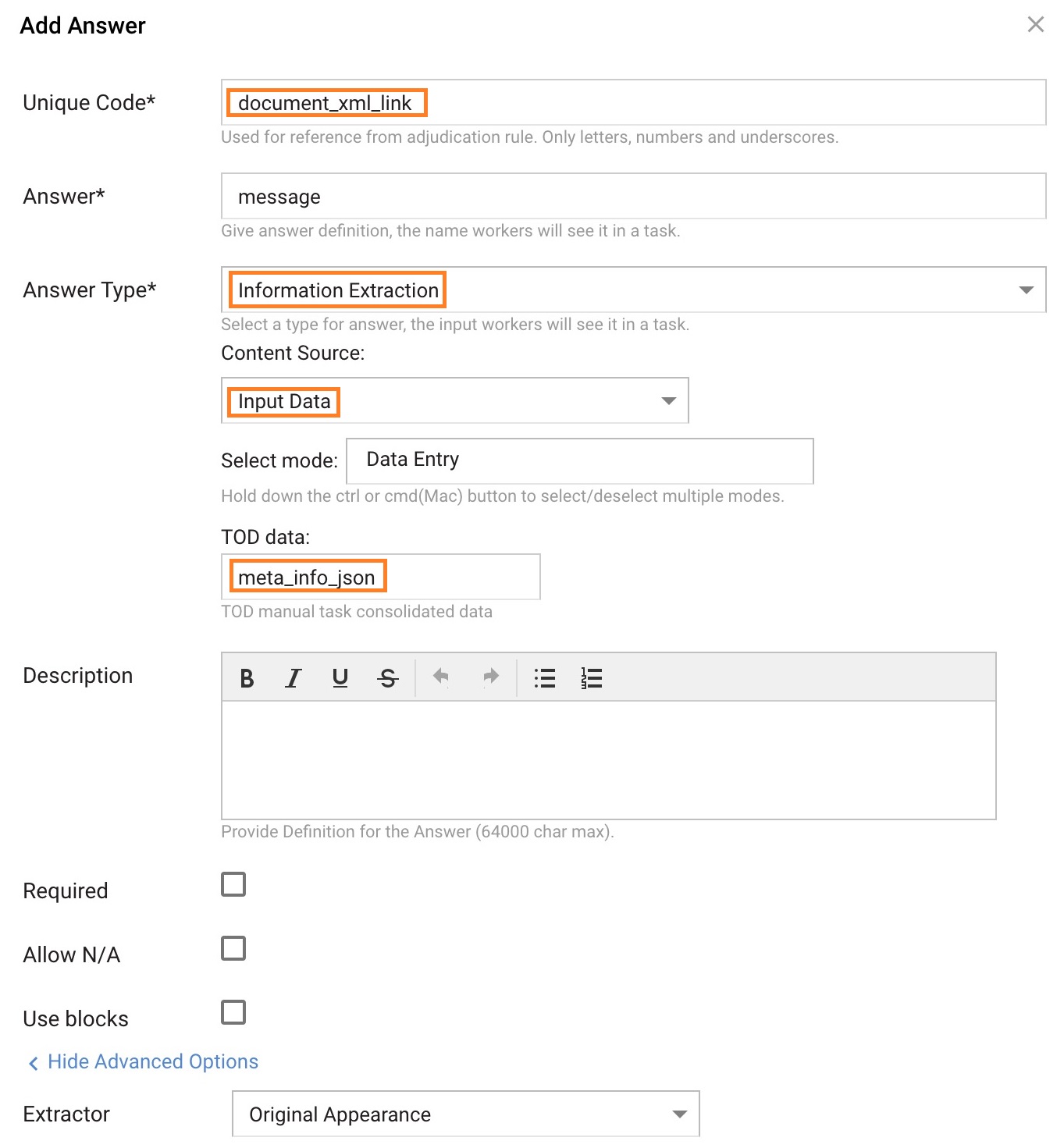
Configure TOD Answer in the following way:
- Unique Code:
document_xml_link(default) or mapped to a column containing XML or link to XML from the previous steps. - Answer Type: Information Extraction.
- Content Source: Input Data.
- TOD data:
meta_info_json(default) or mapped to a column containing JSON from OCR.
The following Unique code values are not allowed:
blockformattinglinepparprerectregiontdtexttrdocumentseparatorpageregionrecttextregionlineformattingtextparblocktextptext|plinerectrectendcellrowstarttablethsec-documentsec-headerdocumenttypesequencedescriptiontextfilenamebr
To learn more, see Create IE Answers.
Input
Input data must contain original_document_url.
Input file content sample
original_document_url
https://vision-automl-db1.workfusion.com:8443/doc-upload/d1ceba.tif
https://vision-automl-db1.workfusion.com:8443/doc-upload/b5ytx.tif
https://vision-automl-db1.workfusion.com:8443/doc-upload/p4exv.tif
https://vision-automl-db1.workfusion.com:8443/doc-upload/6ng9y.tif
https://vision-automl-db1.workfusion.com:8443/doc-upload/j7ter.tif
Output
The TOD OCR BP produces meta_info_json in case the Enriched output flow is selected in the OCR settings. Below is a sample of the meta_info_json structure:
meta_info_json
{
 "pages": "https://vision-s3.workfusion.com:9000/doc-upload/tod/images/preprocessed/links/4e5d19df-b421-4638-8eee-0b723df92438.json",
 "ocrXmlUrl": "https://vision-s3.workfusion.com:9000/doc-upload/6b674b22-6825-4383-8e37-adea5e6bf54d/39203488-1102-4a5f-acc0-de0d347e9716/1916260-xmlWithoutRecognitionVariants.xml",
 "imageUrl": "https://bep-vision-db1.workfusion.com/doc-upload/1916260.pdf"
}
pages: a link to a JSON document containing an array of links to characters recognized on a specific page of the document and the preprocessed image URLpages
[{
    "imgUrl": "https://vision-s3.workfusion.com:9000/doc-upload/tod/images/preprocessed/5694ad66-66c1-4129-848c-9b3e3b66b2ac.png",
    "charsUrl": "https://vision-s3.workfusion.com:9000/doc-upload/tod/images/preprocessed/1-d50e6d9a-5b1b-4887-820b-6280130fadbc.json"
},
 ...
]charsUrlcontent:chars
[{
    "r": "657",
    "b": "80",
    "t": "39",
    "char": "I",
    "l": "652",
    "wordStart": true
}, {
    "r": "699",
    "b": "80",
    "t": "39",
    "char": "N",
    "l": "667"
},
 ...
]ocrXmlUrl: OCR result in the Export Format.imageUrl: original document.
Add certificates
The out-of-the-box TOD BP works in all environments. In the case of untrusted certificates, download the SSL DB server certificate and add it to the trusted list. Otherwise, you cannot access the document image in a TOD Manual Task in Workspace.