Overview
What you need to install Work.AI
The full installation path of the Product consists of the following steps:
- Deploy the required amount of servers and tell WorkFusion engineers whether you are going to use the high-availability (HA) feature or not.
- Prepare disks and mount shared directories.
- Configure your load balancer (for high-availability setup only).
- Create the "workfusion" database on your MS SQL server and populate it with the required logins, usernames, and passwords.
- Create Linux and Windows users on the servers.
- Prepare a list of DNS names of the required network components.
- On each deployed server, open the required ports.
- Prepare the certificates.
- Prepare servers for the installation.
- Check that you have prepared the environment for the installation correctly with our checker.
- Install Work.AI.
If you need our assistance in installation, after you prepare the environment according to hardware and OS requirements, we kindly ask you to download the archive with checklists, complete them all, and send the checklists to us.
Installation options
You can install Work.AI in two different ways:
The simplest and recommended way, when the installation of all components is performed from a single server. It is the best option if your company's policies allow SSH connection from any server to all others.
The traditional way, when the installation of each component is performed on the corresponding server. Select this installation method if the security policies restrict SSH connection between servers or Windows Remote Management (WinRM) to run management scripts remotely.
There is also the mixed way of installation if:
- You can connect from one server to all others via SSH.
- You are not allowed to use Windows Remote Management (WinRM).
In this case, use the standard way to install all Linux components and then the multipoint one when it comes down to the setup of Windows servers.
HAProxy is always installed on the Master server, even if you are not planning to run Work.AI in the HA mode.
Deployment diagram
The diagram below describes the interaction between components.
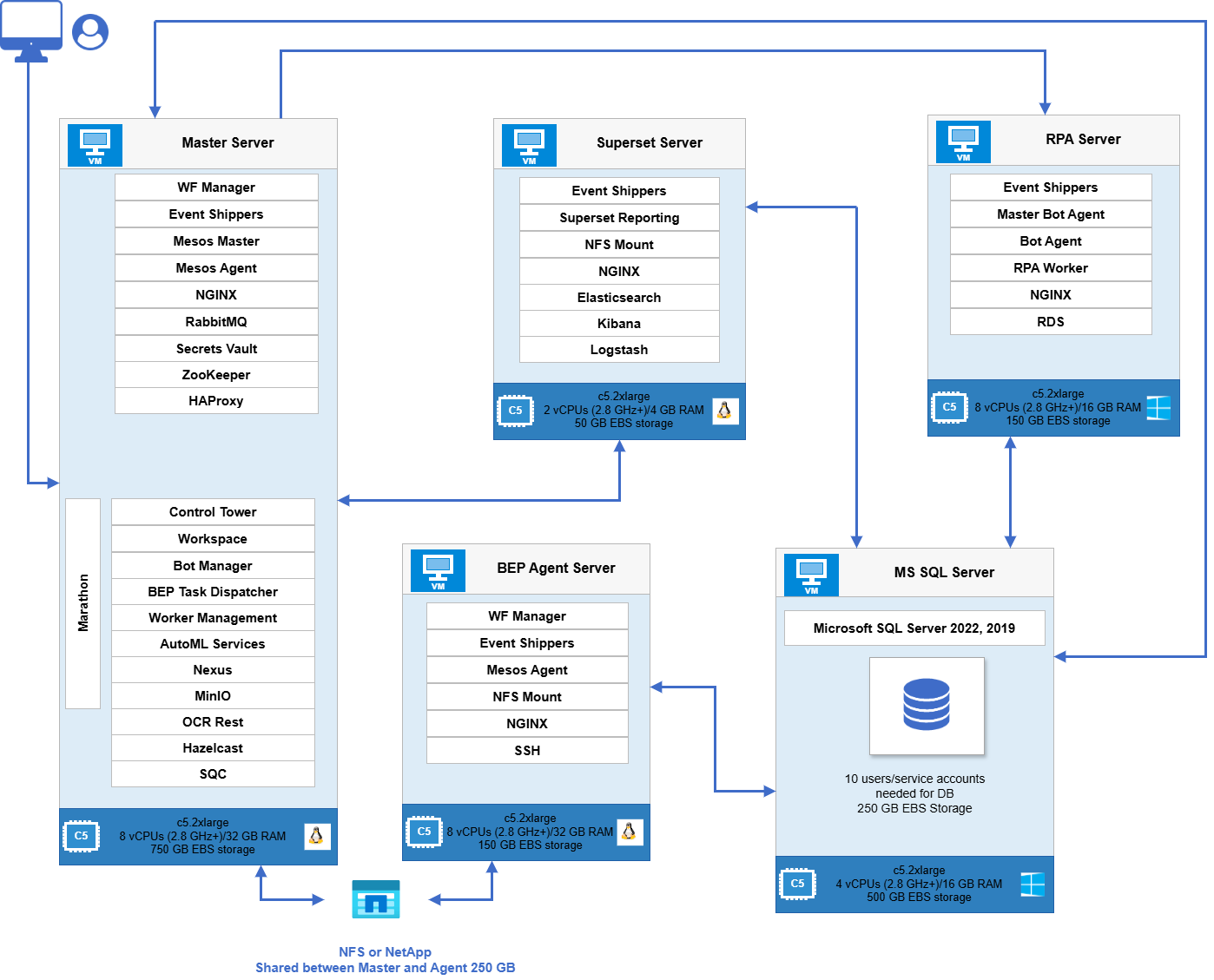
The RPA Server is only required if you plan to use the RPA functionality.
For the HA architecture, see the High availability topic.
In case of issues during installation, read the Troubleshoot installation issues guide.