Add and configure Model and Dataset steps in Business Process
The Model steps (previously, AutoML Bridge) enable integrating and executing a Machine Learning (ML) model or model-related operations in a Business Process (BP). In addition to the legacy Execute AutoML Model (AutoML Bridge) step, Work.AI offers the following no-code Model steps:
Classification allows the execution of classification models.
Image Processing enables the model to work with images.
Information Extraction supports the execution of information extraction models.
You can find available Model steps in Workflow Designer on the Bot tab under the Models category.
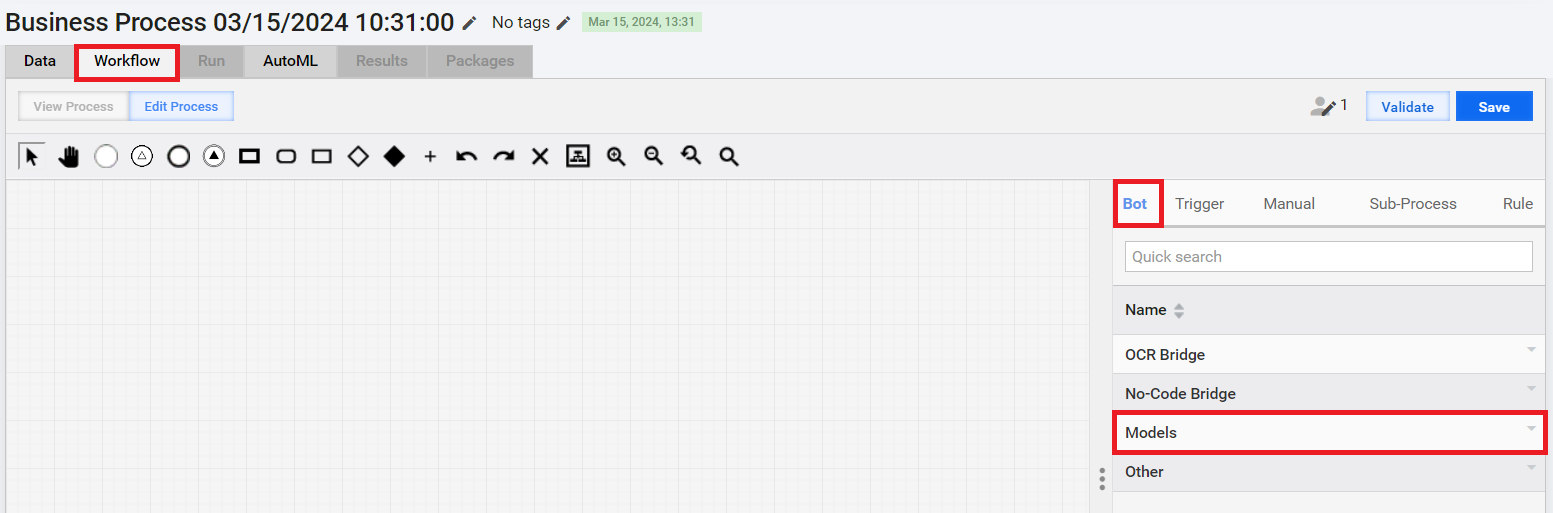
The Models category also includes the following steps for model-related operations:
The Dataset step allows you to create datasets from the model's or Manual Task's output and retrain models using the created datasets to improve performance.
The OCR step enables you to set and apply specific OCR settings, for instance, change the OCR provider. If you include a separate OCR step in a BP, no OCRing is applied at the model step. For details on the no-code OCR step, see Configure OCR step and OCR providers.
Implementation details
Mind the following implementation details about the Model and Dataset steps:
- The Classification, Image Processing, and Information Extraction steps are implemented over the ETL Bot Config type (see Advanced settings).
- The Model steps process one document per model.
- After correct data is prepared, it is sent to a Model step, and then you get a result—this is the internal Control Tower (CT) logic. You cannot influence the logic.
- Model steps support Bot Sources and stateless execution.
Step input and output
Model steps
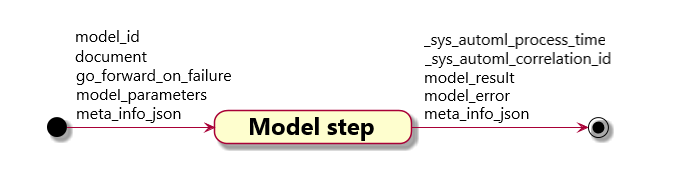
Input
The following table lists input parameters for the Classification, Image Processing, Information Extraction steps.
| Parameter in the interface | Code | Description |
|---|---|---|
| Meta Info | meta_info_json | The parameter is optional. It represents the document-specific metadata from the preceding OCR or model step (for instance, extracted labels). The parameter is essential for integrating the Manual Task step into a schema-based BP. |
| Model ID | model_id | The value is required. Specify the unique identifier of the model you want to use for processing. You can set the value in the current configuration or use the one from the preceding step. The input value from the preceding step has priority. |
| Model parameters | model_parameters | The parameters are not required. Specify them to fine-tune the model's execution. You can set the value in the current configuration or use the one from the preceding step. The input value from the preceding step has priority. |
| Processed document | document | The parameter contains the path to the document for processing by the model. The input value always comes from the preceding step. |
| When the step fails | go_forward_on_failure | Specify the action to be done if the failure result is received. If you choose Complete the step and move to the next one with an error (set the value to Yes) and the failure answer is received, the step is completed, and an error message is sent to the next step. You can set the value in the current configuration or use the one from the preceding step. The input value from the preceding step has priority. |
Output
The output for the Classification, Image Processing, Information Extraction steps includes the data for the specified step input as well as the data for the following parameters:
| Parameter | Description |
|---|---|
meta_info_json | The parameter is optional. It represents the document-specific metadata received as the step's input data plus the model's output (for instance, extracted labels). If no metadata was received as input, the parameter is created at the output and populated only with the model's data. |
model_error | Error information if the task process fails, whereas the step itself shouldn't fail on such task result. |
model_result | The raw model answer if the task process is successful. |
_sys_automl_process_time | The step processing time counted as the sum of the time to create the input + time to send the task to processing + time it took a Worker to process the task + the time to get the result in CT. |
sys_automl_correlation_id | The correlation ID for tracing the task. |
You can use the step output as input for subsequent steps.
Dataset step
Input
The table below lists the input parameters for the Dataset step:
| Parameter in the interface | Code | Description |
|---|---|---|
| Dataset ID | dataset_id | Specify the unique identifier of the dataset you want to use for processing. You can choose a dataset from the drop-down list, and the identifier will automatically appear in the corresponding field. |
| Document | document | The parameter contains the path to the source document used in the dataset. The input value always comes from the preceding step. |
| Document Meta Info | meta_info_json | The parameter contains the output from the preceding Model, Manual Task, or OCR steps for the dataset's source document. |
| When the step fails | go_forward_on_failure | Specify the action to be done if the failure result is received. If you choose Complete the step and move to the next one with an error (set the value to Yes) and the failure answer is received, the step is completed, and an error message is sent to the next step. You can set the value in the current configuration or use the one from the preceding step. The input value from the preceding step has priority. |
Output
The following table includes the parameters received as the output for dataset steps:
| Parameter | Description |
|---|---|
_sys_dataset_process_time | The parameter includes system data corresponding to the step's execution time. |
dataset_observation_id | The parameter contains the ID of the specific dataset document. |
Add and configure no-code Model or Dataset step
To integrate a Model or Dataset step into a BP, do as follows:
Add a required step to the Workflow Designer canvas. You can do it in one of the following ways:
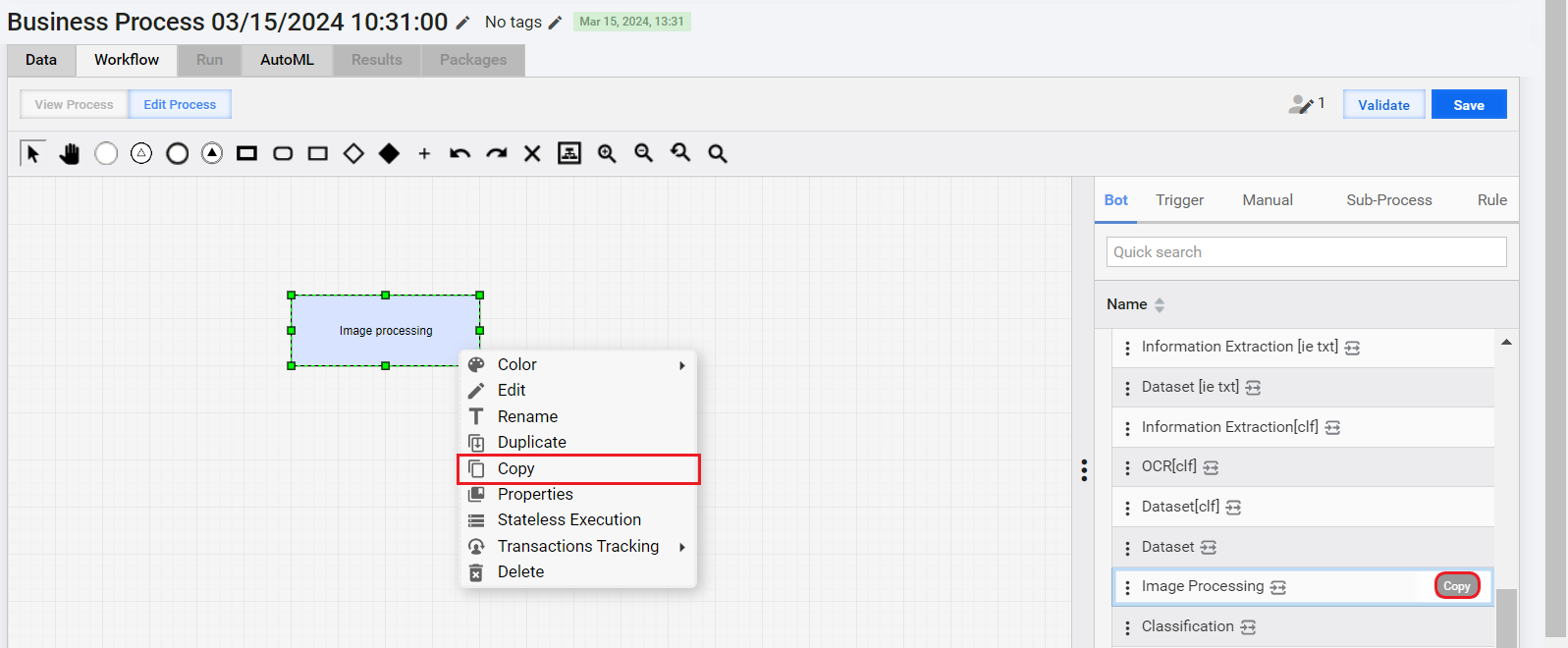
Copy an existing step. Double-click the step in the flow and select Copy from the context menu or hover over it on the right panel and click Copy. As a result, you create an independent Model step instance: the changes you make in the copy are not synchronized with the source.
 tip
tipYou can also Duplicate the step from the context menu. In this case, any changes in the duplicate are synchronized with the source step.
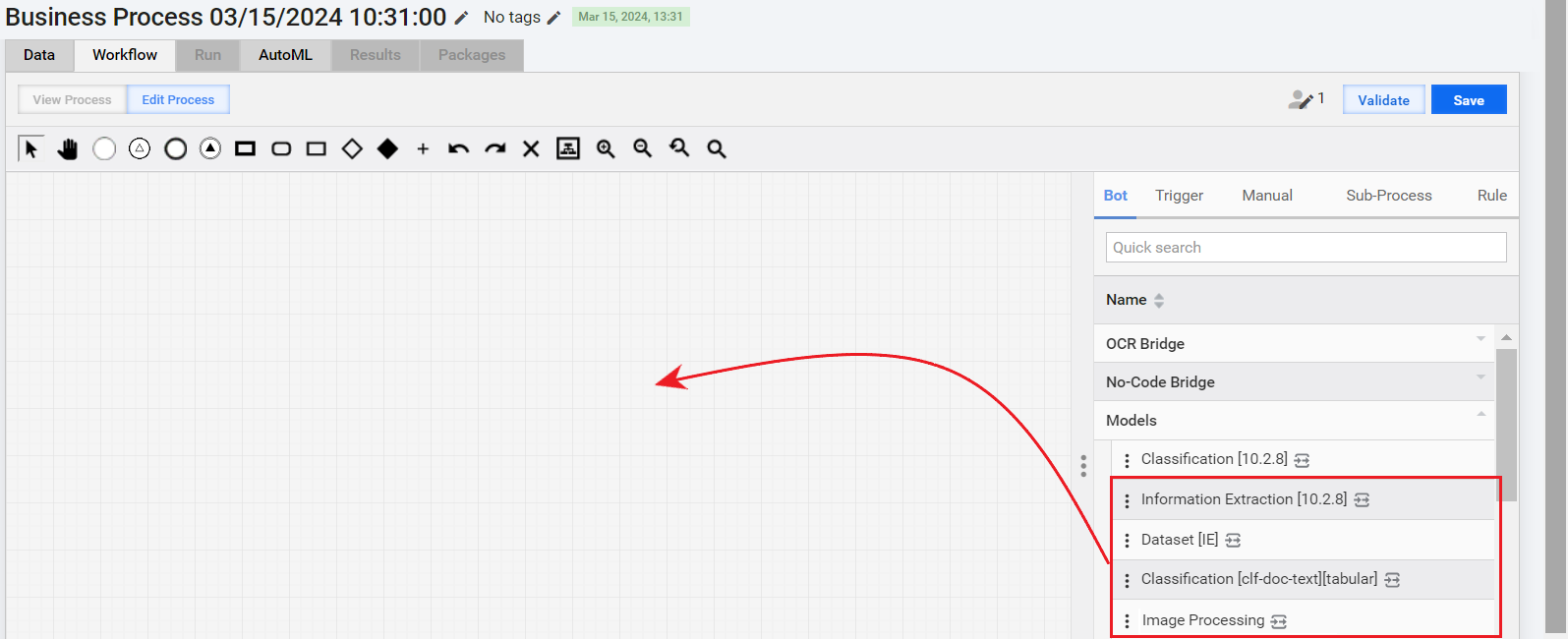
Reuse an existing step. Drag a Model or Dataset step from the Bot panel on the right to the canvas. In this case, any changes you make to the step are applied across all Business Processes where the same step is included.
To open the step's configuration panel (if needed), double-click it. On the Design tab, configure the settings. For parameter details, see Input.
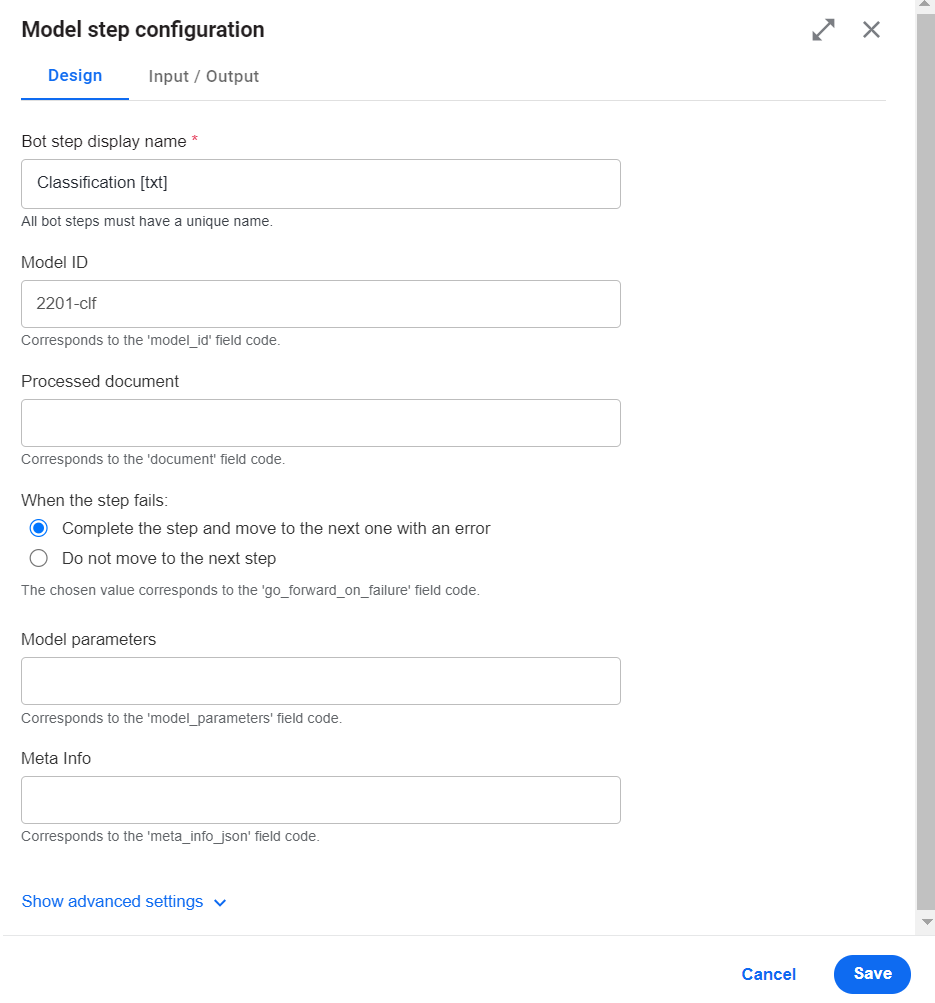
Navigate to the Input / Output tab. The input and output contracts are prepopulated for you. For remapping instructions, see the guide.
Click Save to save the step settings.
Alternatively, you can create the same BP using a legacy Execute AutoML Model step. The setup sequence for the step is similar to the one described below.
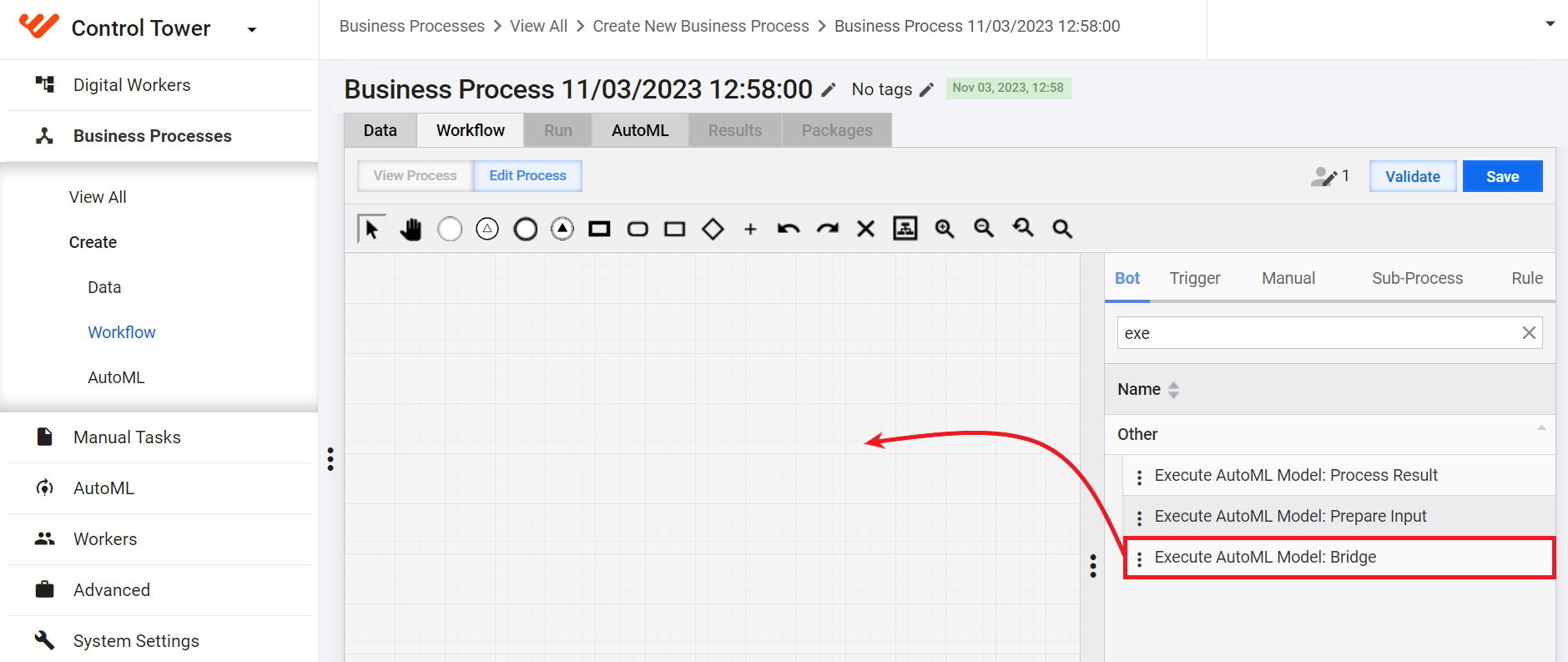
To set your Java Native Worker to work with Model step data, it is recommended to use the respective dependency from the WorkFusion's repository:
<groupId>com.workfusion.spa</groupId>
<artifactId>bridge-step-contracts</artifactId>
Using the library facilitates the implementation and reduces the time to production for such solutions.
Set up multi-model step
The Model and Execute AutoML Model steps do not support the multi-model flow. If you plan to process a document using several models, create a BP where a document is processed in several steps (in parallel or one by one).
See sample use case
For a complete tutorial on creating an information extraction sequence from Model steps, see the guide.
To address the issues related to Model steps in a Business Process, read the following support guides:
Investigate Business Process performance degradation if you notice the BP has become slower
Investigate non-operational Business Process if the BP will not work
Investigate non-operational platform if the issues are associated with a malfunction of some platform component