Classification
WorkFusion AutoML models provide an ability to automatically classify texts by analyzing its parts (tokens) and their combinations (features).
Binary сlassification
Binary classification is the task of classifying the elements of a given set into two groups, predicting to which group each of them belongs to.
Examples:
- Dividend announcements: define if a given text is related to dividends or not
- Sentiment analysis: analyze if tweets are positive or negative
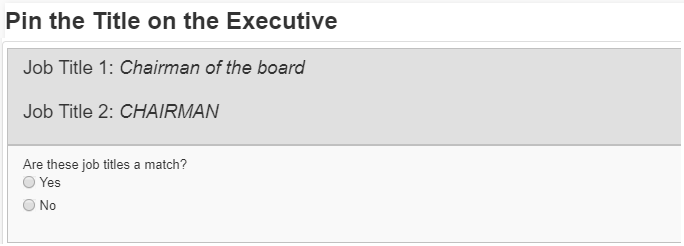
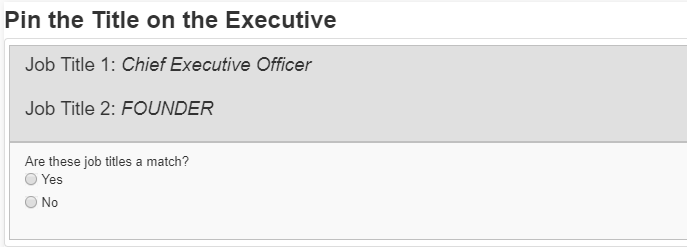
- Title classification: compare two titles of a person and tell whether they match or not
Manual Tasks for binary classification
Binary classification can be done by human workers in WorkFusion:
- You provide a set of texts as a source.
- Workers need to read and analyze the text and select one of two options (typically, from a radio button group): Yes or No (Valid or Invalid, Spam or Not Spam).
- Source texts and results (worker answers) are submitted to the WorkFusion AutoML component, and binary classification ML models are trained on the data.
Sample Manual Task 1
Sample Manual Task 2
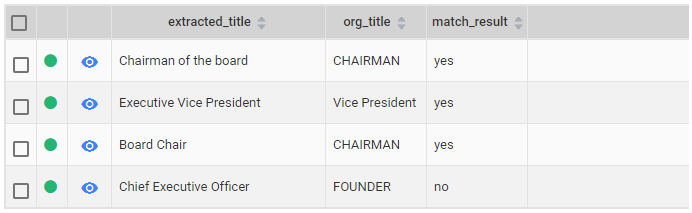
Results
Results are stored in a separate column (in the figure below, the match_result column):
Depending on your business problem, you might be more interested in a model that performs well for a specific subset of these metrics. For example, two business applications might have very different requirements for their ML models:
One application might need to be extremely sure about the positive predictions actually being positive (high precision) and be able to afford to misclassify some positive examples as negative (moderate recall).
Another application might need to correctly predict as many positive examples as possible (high recall) and will accept some negative examples being misclassified as positive (moderate precision).
Multi-class classification
Multi-class classification is very similar to the binary classification. The only difference is that you need to classify the elements of a given set into more than two groups.
Examples:
- Product description: define which product a given text describes: computers, food, clothes, books
- Text style classification: identify the style of a given text: romance, thriller, adventure, and so on
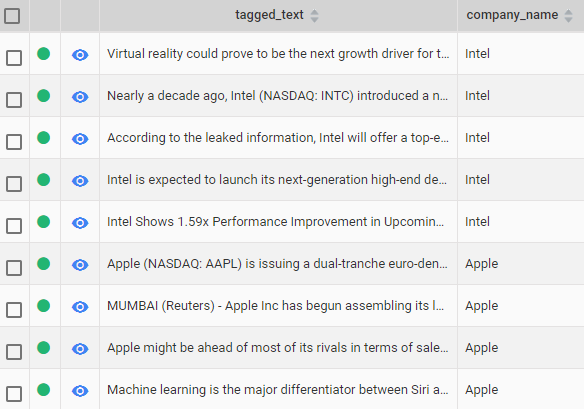
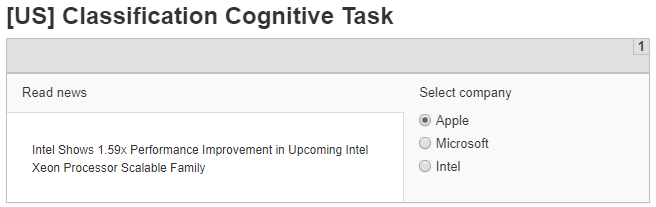
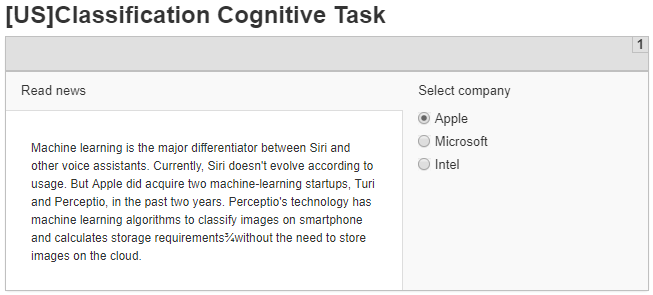
- Company news: match given news to one of the companies in the list: Apple, Microsoft, or Intel
Manual Tasks for multi-class classification
Sample Manual Task 1
Sample Manual Task 2
Results
Results are stored in a separate column (in the figure below, the company_name column):