Requirements management
The requirements management knowledge area implies that requirements are managed and maintained throughout a project. It is paramount that the Data Analyst understands the requirements' lifecycle and knows how to manage requirements. This process identifies tasks that should be performed to keep requirements up-to-date, accurate, and consistent.
Creation and management of requirements imply the following tasks:
- Planning of work with requirements
- Development of requirements
- Communication of requirements
- Managing requirements (updating, estimation, prioritization, and so on).
Planning
The Data Analyst should determine the activities required to capture requirements, how those activities are carried out, who is involved in the activities, what effort is required, and how long the activities take. Planning of work with requirements doesn't require a formal plan with a set of all long-term activities but should help answer the following questions:
- What activities should be performed and when?
- What are the prerequisites to start?
- What is the timeline for the activities?
- What is the expected output?
For example, the Data Analyst identifies that a series of Q&A sessions with SMEs and a demo of the current process are required. The prerequisites for these tasks are documentation study, which takes two days, and review of machine learning documents, which takes two additional days. All activities should take two weeks, and the output will be a BRD document to approve with a client.
Identification of these tasks and conditions helps to arrange everything properly for requirements development, communicate dependencies (for example, SMEs availability) to a client in advance, and make sure this procedure is not an undefined process but a process with deliverables.
Development
The requirements development produces most of deliverables and has four stages:
- Elicitation
- Analysis
- Specification
- Validation
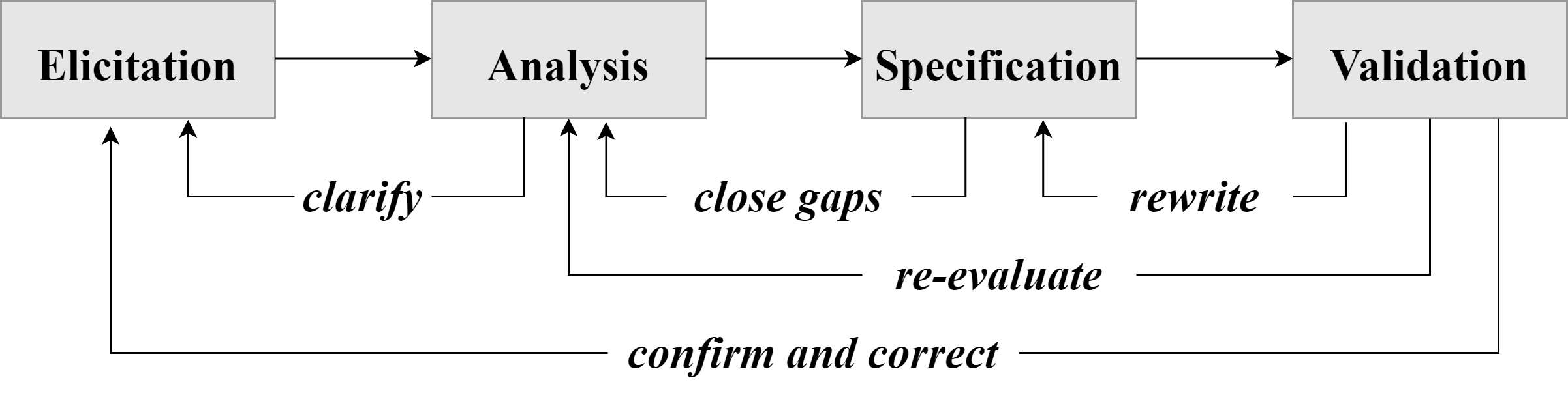
Elicitation of the requirements means stakeholders' expectations, suggestions, business rules revealed and implied, technical conditions turn into clearly stated, non-contradictory and prioritized requirements that make up the solution scope. You can carry out elicitation in the form of various techniques: interviews, workshops, document and interface analysis, brainstorming sessions, process observation, requirements prototyping, and so on.
When factual data is collected, the Data Analyst analyzes these requirements to determine if they are sufficient to propose the solution and if there are any discrepancies or constraints for particular requirements. Where needed, the Data Analyst invokes additional clarification from stakeholders.
Analyzed requirements should be specified and stored in written format. While capturing the requirements, you can reveal new gaps that you should clarify with stakeholders. Afterward, you make corresponding updates to the documentation. Additional requirements revealed or changes identified should be analyzed, captured, and confirmed within the same process.
Validate finalized requirements with a client for their quality, completeness, and correctness. Requirements that do not meet quality standards must be revised. The final check in the form of a formal sign-off by stakeholders should confirm that all the information needed for further work is captured. The approval should be recorded electronically, for example, in an email thread with all the interested parties copied.
A formal sign-off is essential for requirements' baselining, meaning that the project scope is fixed and identified for the particular project duration and all future changes. Subsequent changes to the requirements should follow the change control process, which means they should be recorded, tracked, compared to the baselined state and estimated. That will help control and prioritize project changes and avoid scope creep.
Management
Managing requirements usually involves tracing requirements, prioritization, and keeping them up-to-date.
The task of tracing requirements means the Data Analyst needs to analyze and maintain the relationships between requirements, designs, and solution components on different levels. This task ensures that requirements and designs are in sync with each other. To ensure that, the Data Analyst compares each prepared requirements model (textual or graphical) against other prepared models.
Mind to check that there are no missing elements mentioned in one model and skipped in other models. Also, referencing should be checked, meaning the same component is referenced in the same way in all models. You should resolve all discrepancies and capture all process triggers, rules, and outcomes in all variations.
Prioritize requirements according to their value, urgency, and associated risks to ensure that delivery is done on the most important ones at any given time.