View architecture
Layers of intelligence
Tara applies three levels of intelligence to transaction alerts. The three levels illustrate how the Tara AI Agent is used to clear false positives received with the input data alerts. The purpose of the clearance is to significantly reduce the number of false positive results.
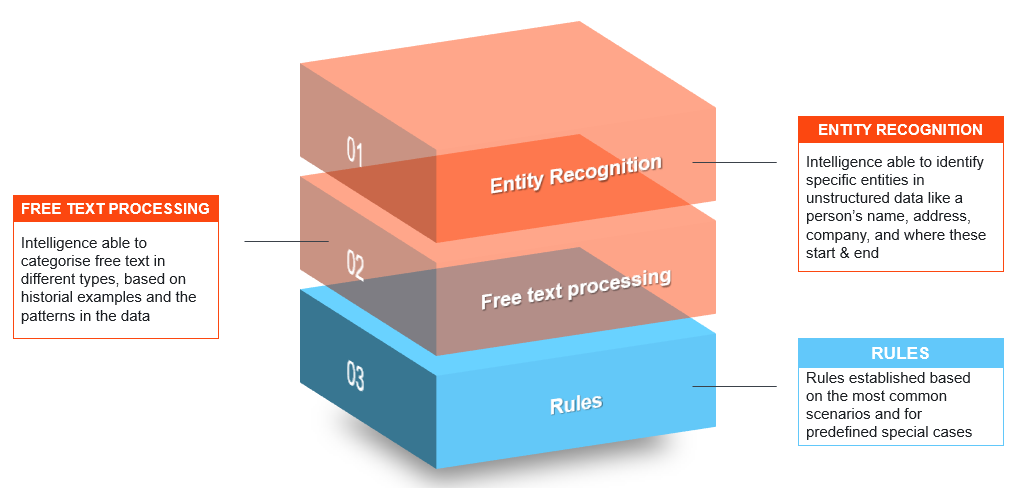
Entity recognition
Tara can extract the following entities:
- Country
- Location
- Individual
- Company
- Type
If some particular word can denote, for example, a company, a location, and an individual simultaneously, Tara analyzes the context and defines the correct meaning of the word.
For example, the word "Casablanca" can stand for:
- Company: Casablanca Fan Company, a ceiling fan company
- Location: Casablanca, Havana, a suburb of Havana, Cuba
- Individual: David Casablanca, professional soccer player
The final decision is made by comparing the extracted values, the entity type, and the model confidence.
Free text processing
Using unsupervised learning algorithms, the model processes free text excerpts and divides the available data into a finite number of classes.
Rules
The layer embraces business and functional rules. All the rules are configurable in the AI Agent interface or within the rule engine. For more details, see the articles below:
Components
The architecture includes several Work.AI components for the PSS Business Process.
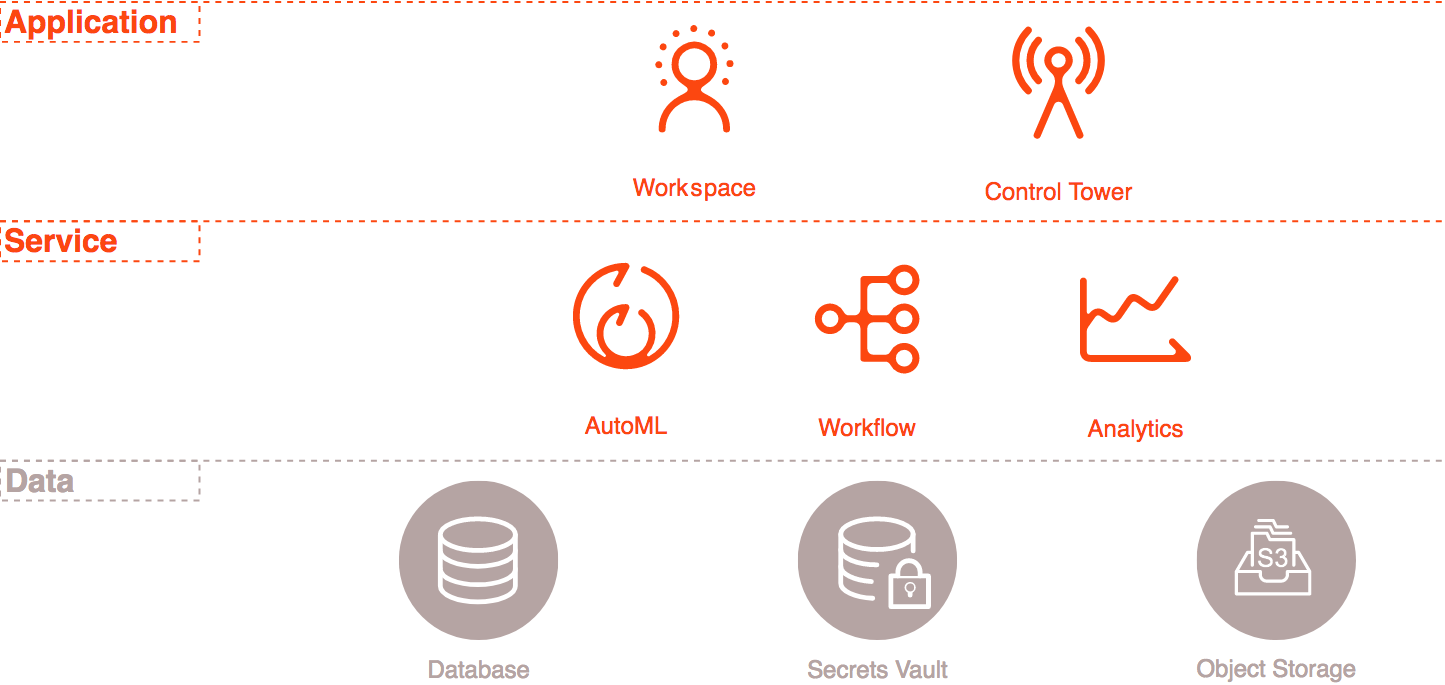
Workspace
Related components: Control Tower, Object Storage
Covered functionality: Tara does not use the Manual Task functionality. You view results directly in your systems, such as FircoSoft.
Control Tower
Related components: Workspace, Workflow, AutoML, Data Storage
Covered functionality:
- Managing automation processes
- Creating and editing workflows using GUI tools
- Running and monitoring automations
- Handling input and output data
- Managing users and roles
- Configuring system settings
- Applying the standard built-in API
AutoML
Related components: Control Tower, Data Storage
Covered functionality:
- Using a prebuilt Python model defined in the configuration
- Computing predictions for unseen input data
- Visualizing prediction quality
- Making adjudication using human-readable narratives
The PSS Python model does not require training. You can configure a model using a set of rules and decision matrix.
Workflow
Related components: Control Tower, Workspace, AutoML
Covered functionality: an automation process is executed according to the process definition created in Control Tower. The execution is handled by the AutoML capabilities.
Analytics
Related components: Control Tower
Covered functionality: reporting dashboards
Database
Related components: Control Tower, Workspace, Analytics
Covered functionality: storing designed automation implementations
Secrets Vault
Related components: Control Tower
Covered functionality: storing authentication data for the Work.AI intercomponent interactions
Object Storage
Related components: Workflow, AutoML
Covered functionality: storing AutoML models and generated reports. The files are stored on the MinIO server. The released bundles are saved in the AWS S3 storage.