
Glossary
A
A/B testing
A legacy term meaning a procedure used to test a selected version of your automated Business Process and determine the outcome of making changes to the automation.
Acceptable Quality Level (AQL)
The maximum percent of non-conforming items (or the maximum number of non-conformities per 100 items) considered for inspection purposes as a satisfying process means.
AQL = 1 - Model Accuracy Threshold / 100%
Learn more about AQL.
Access Control List (ACL)
A user management principle introduced in 10.2 that allows Business Processes data in Control Tower and assignment data in WorkSpace to be securely restricted only to defined users or user groups. The users and user groups are configured in the User Management service.
Actions library
A collection of all actions used to create a recording in the RPA Recorder. The actions are grouped based on the manipulations they perform (for example, the Excel action group enables automating Excel manipulations).
Learn more about the Actions library.
Adverse Media Monitoring (AMM)
AMM is another name for the Evan Digital Worker (formerly a skill of the Digital Worker Evelyn). Otherwise alo known as Negative News Screening, it is a process that evaluates a person's involvement and inherent risk concerning money laundering, fraud, organized crime, and terrorism. It can be a crucial part of the Know Your Customer and Anti-Money Laundering processes.
Adverse Media Screening (AMS)
Another term for Adverse Media Monitoring. It can be used interchangeably or to describe the act of performing an Adverse Media check versus an ongoing monitoring tool, service, or process.
Analytics
A WorkFusion capability and a reporting tool in Intelligent Automation Cloud that presents configurable and actionable business and operational analytics for Business and IT personas.
In the Analytics capability, the following sub-capabilities are defined:
- Dashboards: use out-of-the-box, custom, and Digital Worker dashboards to get a high-level overview of the most important KPIs across the ecosystem for IT and Business personas.
- Reporting: leverage reporting capabilities, including customization, sharing, and scheduling.
- SLA: track the SLA compliance of automation flows.
- Capacity planning: understand the utilization of components and infrastructure to figure out actual capacity and plan for scale.
- Drill down: select a specific metric, KPI, or insight from a dashboard or a report and navigate one level deeper to additional insights required for analysis.
- Governance: use dashboard data for reporting to governance bodies.
- What-if: predict the behavior of a Business Process or pre-trained bot by changing the parameters and assessing forecasted results. For instance: "What would happen if I a do A, B, and C, or change the parameres to X, Y or Z."
- Explainability: interpret the key insights and advanced technical or scientific processes in a business-friendly, understandable, and actionable way.
- Mobile: work with reports, dashboard alerts, and other analytics capabilities on mobile devices, preferably through native support.
- ROI tracker: understand the automation's Return On Investment (ROI) through improved STP, decreased processing time, increased volume of processed data, and other metrics.
- Alerts: configure alerts for business and IT users to be distributed across multiple channels, for example, Name Screening Alert Review.
Analytics Server
The term is applicable for Tableau-based analytics only. A component of the Tableau-based analytics where dashboards are published and from where Control Tower takes them to display at its Analytics page.
Analytics Server user
A user who has access to the WorkFusion Analytics Server web application.
Anonymity-enhanced cryptocurrency (AEC)
Often offered as part of a virtual asset or a service from a virtual asset service provider. Can increase the risk of money laundering and other financial crimes.
Anti-Money Laundering (AML)
A set of laws, regulations, and procedures intended to prevent criminals from disguising illegally obtained funds as legitimate income.
Application Programming Interface (API)
An alternative to RPA for system integration that allows data transmission via a standardized protocol. See the complete list of WorkFusion APIs in the API section.
Archetype
A project template for further configuration that allows creating custom extensions for machine learning models. AutoML SDK provides Maven project archetypes for classification and information extraction. The Archetypes enable ML Engineers to get prototypes up and running quickly.
Learn more about Archetypes.
Architecture
One of the WorkFusion platform capabilities that contains the following sub-capabilities:
- Footprint: the hardware and software of the platform (TCO, used third-party services, and so on).
- Deployment: deploy the platform quickly in different setups (on-premise, cloud, hybrid, and so on).
- Technical operating environment: work in different operating environments, such as RedHat, CentOS, Docker, and so on.
- Scalability: scale the infrastructure and processing power to expand without manual intervention.
- Configuration management: manage the platform configuration, including the workflows accessible for different IT personas.
- HA/DR: ensure an agreed level of operational performance (for example, uptime) for a sustained period.
- CI/CD: supported continuous integration and continuous delivery.
- PaaS deployment: platform can be provided as a service, fully or partially. For example, OCR is provided as a managed service in the cloud.
- Logging/Monitoring: pre-packaged and configurable logging and monitoring for IT personas.
Also, see IA Cloud architecture.
Article
In terms of the Adverse Media Monitoring Digital Worker, it is a single piece returned from a performed Internet search.
Article Risk Category
A numeric score with a value from 0 to 1 given by the ML model to a single piece, indicating the risk associated with the search entity based on the article content. Depending on preset thresholds, scores are grouped into High-, Medium-, and Low-Risk categories.
Asset Bundle
Formerly, BP bundle package. It is a structure comprising a Business Process and its supporting resources, such as AutoML models, Bot Configs, templates, and so on. Asset Bundles can represent either a complete Business Process or portable resources. It is intended for easy asset transfer between environments.
Assignment
An object representing a Manual Task in WorkSpace.
When a worker opens an assignment, nobody else can open this assignment until it is completed, expired, or their processing time is over. When a worker skips an assignment, the assignment is available for other workers.
Automatic Quality Control (AutoQC)
AutoQC refers to the use of statistical methods in monitoring and maintaining the quality of services. In a Cognitive Bot workflow, the AutoQC sub-process chooses the optimally cost-effective combination of cognitive bots and people that consistently deliver at or over the acceptable quality level.
Learn more about AutoQC.
Automation Orchestration
One of the WorkFusion platform capabilities that refers to the orchestration of different technologies (API, connectors, AutoML, RPA, and so on) to drive end-to-end automation to achieve efficiency and business agility.
The sub-capabilities are as follows:
- Workflow: a server application orchestrating automation processes based on process definitions from Control Tower.
- HITL: support of human-in-the-loop experience with work queues, assignments, and so on.
- Multi-bot: orchestrate collaborative work of multiple botswithin the same Digital Worker flow (possibly bots across various vendors).
- Recovery: ability to fully recover a Business Process and continue working without any loss of data after a failure.
- Multilingual: ability to interact with different sources or workers in different languages.
Automation rate
A metric in Digital Worker analytics that reflects:
How many correct results a model found relative to cumulative correct results in a case of classification.
How successfully and correctly field values were extracted in case of extraction.
Automation Studio
A set of cloud and desktop tools for Business Users and Automation Engineers and one of the WorkFusion platform capabilities.
Functions: design of the business processes and manual tasks, training of the pre-trained Bots, libraries of pre-packaged components, and actual coding for the most advanced cases.
Automation Studio contains the following sub-capabilities:
- Recorder—the WorkFusion Studio component used to automate web, desktop, and mainframe applications in a natural macro-like way without any coding or scripting
- IDE—desktop environment and frameworks for developers (coding business processes and bot steps)
- Bot Training—configuration, management, and training of the pre-trained bots
- Certification—education, Automation Academy
- Library—pre-trained bots, pre-built templates, generic models, and pre-packaged components
- Surface Automation—RPA for Desktop, Citrix, Web, anything non-API
- Task Designer—UI designer for creating Manual Tasks that employ the human-in-the-loop (HITL) approach
- Workflow Designer—UI designer for creating Business Processes (combinations of Manual Tasks, Bot Tasks, etc.)
AutoML
A proprietary WorkFusion technology for Intelligent Automation. AutoML applies the Human-in-the-Loop approach and AutoML Search Engine to automatically find the best automation method for a specific Digital Worker.
AutoML Bridge
The AutoML Bridge step enables the AutoML model execution within automation workflows in Control Tower.
Learn more about the AutoML Bridge step.
AutoML covered or covering concept
A designation used in AutoML SDK API that defines the relationship between elements in a document. This concept helps find all the parts inside or outside the processed element. The covered/covering relationship is used in the configuration of AutoML SDK Feature Extractors.
For example, for each word token in a sentence, the sentence is a covering element. For a sentence token, each word is a covered token.
AutoML element
Elements are units created while documents pass through the AutoML SDK pipeline and used in content analysis. They are represented as tokens, tables, sentences, pages, Named Entities, or Entity Boundary Elements.
Some elements are created based on tags from manual labeling, while others result from the analysis of words, phrases, named entities in unstructured content.
AutoML feature
A property of an element under evaluation. Generally, a Feature is a simple question with a Yes/No answer used by the AutoML algorithm to predict which tokens should be tagged as correct answers.
Learn more about Features.
AutoML model
A combination of AutoML SDK components, such as algorithms and their parameters, Annotators, Feature Extractors, Pre- and Post-Processors.
A model can be built from an Archetype or created from scratch. The model can include either an AutoML Search Engine configuration or a fixed configuration. Once the model is configured, the ML Engineer can proceed with model training.
Learn more about AutoML models.
AutoML SDK
A WorkFusion Java framework for creating and extending machine learning models for any information extraction or classification case.
Learn more about AutoML SDK.
AutoML SDK artifact
A Spring Boot application that contains the code of an AutoML model.
AutoML SDK components
Configurable parts of the AutoML SDK framework. AutoML SDK consists of the following components:
- Parser
- Annotator
- Feature Extractors
- Algorithms
- Post-Processors
Each component is responsible for a specific task. The exact combination of components depends on the Digital Worker and document structure. For an information extraction task, the choice of components depends on the field type (date, amount, address), field location in the document, and so on. Going through the components pipeline, the AutoML SDK framework delivers a ready-to-use trained model.
Learn more about AutoML components.
AutoML SDK pipeline
A sequence of steps to fit a model to a dataset. A pipeline is defined within the model configuration and can consist of any combination of AutoML SDK components.
Typically, components have the following order within the AutoML SDK pipeline: Parser, Annotator, Feature Extractors, Algorithms, Post-processing.
For each step in a pipeline, there can be several components of a specific type. For example, two annotators are configured to extract the Date field from specific sentences in a document: first, to create Sentence elements and, second, to create a Named Entity of the Date type.
AutoML Search Engine
A framework for identifying an optimal set of components, such as Annotators, Feature Extractors, Post-Processors, algorithms, and their parameters to train a model. The search for the optimal set of components involves a series of model experiments. If AutoML Search is used in the configuration, each experiment involves systematically varying one or more components and examining the effect on the result.
Learn more about AutoML Search Engine.
AutoML Search Engine configuration
A process of defining dimensions of components and their combination. For example, a model can have several declared annotators, but only a particular combination of them gives the best result.
AutoML Search Engine dimensions
A strategy for component selection within AutoML Search Engine. For example, define whether the BaseKeywordsInElementFE feature extractor is optional or required in the AutoML SDK configuration.
AutoML token
The smallest elementary element of a document, usually a word separated by spaces or other special characters. Tokens are produced by the Tokenizer component. Tokens are further used for content analysis in the AutoML SDK pipeline.
Automatic Quality Control (AutoQC)
Refers to the use of statistical methods in the monitoring and maintaining the quality of products and services.
Learn more about AutoQC.
B
Bank Secrecy Act (BSA)
The Bank Secrecy Act (BSA) establishes program, record-keeping, and reporting requirements for national banks, federal savings associations, federal branches, and agencies of foreign banks. The BSA was amended to incorporate the provisions of the USA PATRIOT Act that requires every bank to adopt a customer identification program as part of its BSA compliance program.
Learn more about Bank Secrecy Act.
Batch
A collection of items from which a sample is taken to decide on its conformance to the acceptance inspection. A batch should include items of the same type, size, and so on that were produced under the same conditions and at the same time.
The batch size is the number of items in a batch. Mind that the sample size is the number of items to be chosen randomly from a batch.
Learn more about the batch size.
BEP Agent
A resource on which BEP Workers perform.
BEP Master
A server with a number of services that orchestrates Workers performing tasks from Control Tower, routes them to a queue, prioritizes them, allocates resources on Agents, and invokes Workers to perform a specific task on an Agent.
BEP Task Dispatcher
Task Dispatcher Service (TDS) is a component of BEP ensuring that the system allocates equivalent processing resources to each step of each Business Process and maintains a constant load of BEP Workers within the task execution environment.
Learn more about task distribution in BEP.
BEP Worker
A job that is invoked by the BEP Master and is executed on a BEP Agent. A BEP Worker processes a task and returns its results to Control Tower.
Learn more about BEP Workers.
BEP Worker Profile
A client type that sends tasks to BEP. These can be Control Tower, AutoML training, AutoML execution.
BEP Worker task
A piece of work to be completed by a BEP Worker on behalf of a client application (Control Tower, AutoML Service, OCR). Task execution results are to be sent back to the client application.
Block Size
The number of Records a Worker gets in each task. The default value is 1.
Bot Agent
An application that starts an RPA Worker.
Bot Config
An XML configuration written using the WebHarvest library and executed for each Record separately.
Bot Config Bundle (BCB)
A bundled Java library containing a Bot Config and a Java code reference that can be used in this Bot Config. Previously known as Machine Config Bundle.
Bot Execution Platform (BEP)
The BEP platform enables a horizontally scalable, predictable, and fault-tolerant system. It delivers on-demand automation with scalability and resilience designed specifically for the enterprise level. The three immediate benefits are as follows:
- Dynamical resource allocation based on the task load. This results in better utilization of hardware available for other tasks.
- Worker isolation. One failed task is returned to the task queue to be automatically processed later and does not affect the overall Control Tower stability.
- Distinct Control Tower and execution platform separation. The platform exposes an API for cluster execution, orchestration, monitoring, and analytics.
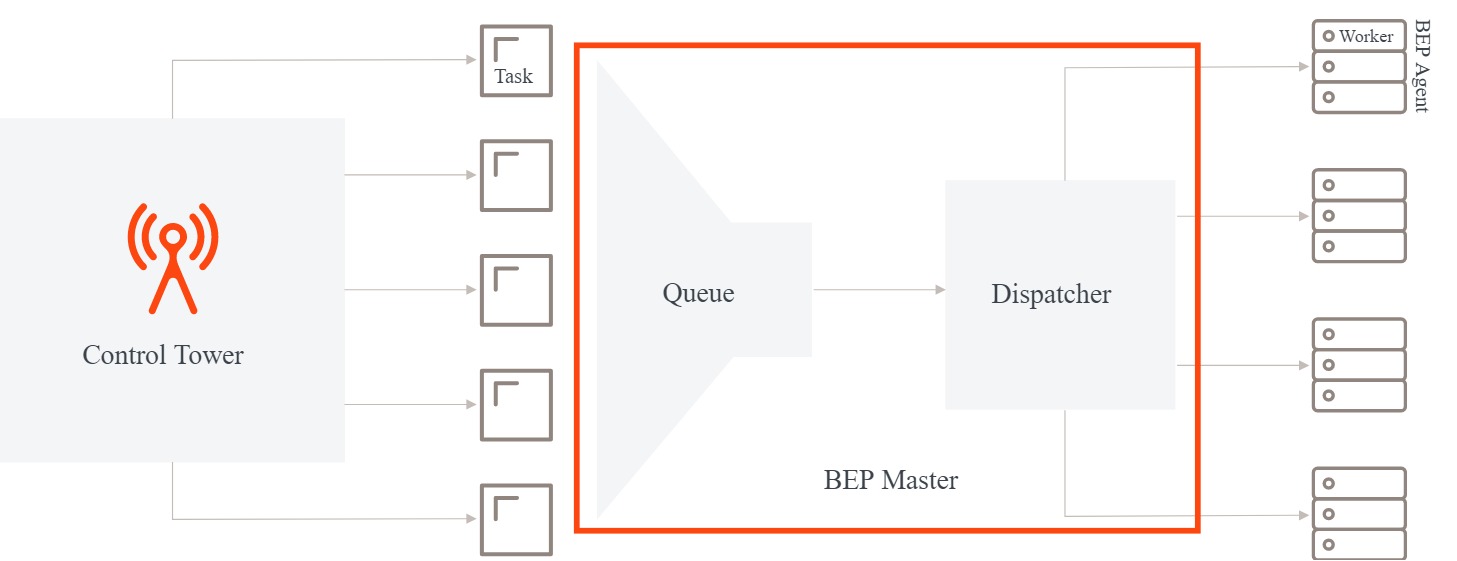
Control Tower sends Tasks to BEP. BEP Master arranges tasks in a queue, and BEP Task Dispatcher dynamically allocates Agent servers' resources, invoking Workers to perform each task. After the task is completed, its results are returned to Control Tower. If the task failed, it is returned to the queue.
Learn more about BEP components.
Bot Fleet
Also, fleet. An RPA Queue or a group of bots used to distribute Bot Tasks based on their business purpose.
Learn more about fleets.
Bot Master
A console master session on the RPA Server.
Bot Source
A routing mechanism that contains infrastructure restrictions and defines the execution flow for Bot Tasks.
Learn more about Bot Sources.
Bot step
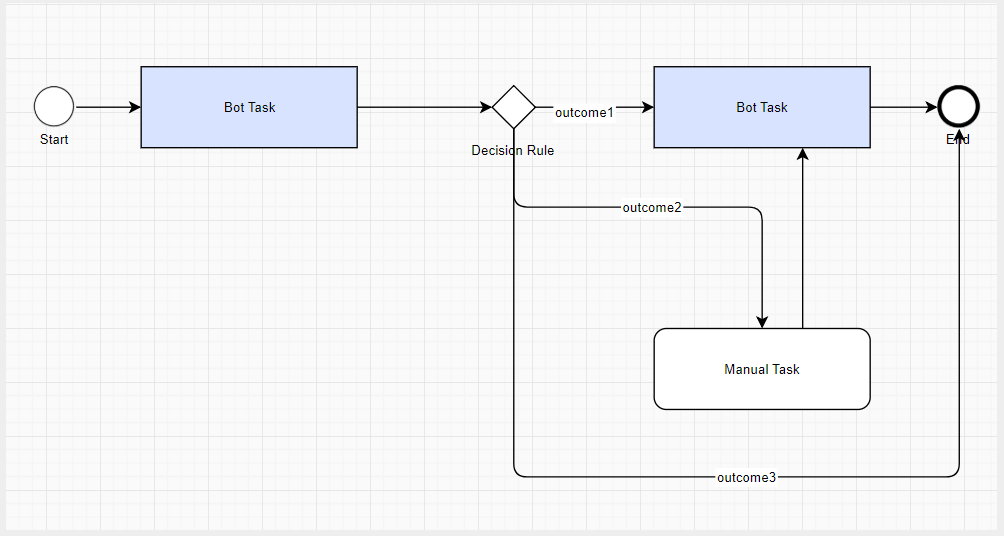
Also, Bot Task. A unique step of a Business Process (blue rectangle on the diagram below). The bot step is linked to a particular Bot Config.
Bot Task
Also, see bot step. A task completed by some type of computer automation (data parsing, extraction, transformation, loading). Bot Tasks can exist only as a Business Process step.
Examples: address parsing, determining the width and height of an image, interacting with your API or repository or filtering content that is not compliant with specific criteria.
Bot Unit
An RPA entity that runs a particular Bot Task. Contains the following Java applications: a Bot Agent and RPA Worker.
Builder
A part of the http://form.io framework that allows building forms. Use to build components for a Digital Worker configuration.
View the Builder tool.
Business Process (BP)
A combination of connected Manual Tasks, Bot Tasks, or nested processes handled by a user-defined flow. The BP Designer allows you to orchestrate the flow of Manual and Bot Tasks.
A BP task can utilize the data generated by previously completed tasks or the data from the input file. A BP has one input data file enriched and modified by the results of each task.
C
Capabilities
The IA Cloud Enterprise platform features described as groups of capabilities sourced from analyst reports, competitive research, and real client tasks. The following capabilities are defined:
- Discovery
- Automation Studio
- Pre-trained bots
- Document Intelligence
- Analytics
- Automation Orchestration
- Trust and Security
- Integration
- Architecture
Classification
An AutoML task of predicting the class of one or more items. There are two types of classification:
- Binary classification: classify elements into two groups.
- Multi-class classification: classify elements into two or more groups.
Learn more about statistical classification.
Cognitive Bot
A smart software robot with the applied AutoML technology that allows for automating Manual Tasks completed by users in WorkSpace.
A Cognitive Bot learns from user answers, thus gradually becoming faster and more accurate. When ready and enabled, Intelligent Automation Cloud starts routing Manual Tasks to the Cognitive Bot, which reduces the amount of manual work or eliminates it altogether.
Cognitive Bot workflow
An operation used in Intelligent Automation Cloud to train and execute machine learning models.
Composability
Owing to complexity, lack of agility, and long deployment timelines of best practice assessment tools, many enterprises are adopting a composable approach to process automation. They are trying to build automation capabilities as components that can be reused across multiple processes, deployed faster, and changed easily. Responding to this trend, vendors are increasingly adding capabilities to enable development of reusable components that can be composed to build new solutions rapidly.
Confusion Matrix
A tabular visualization of the classification algorithm performance, showing predicted values or categories against actual ones. Used as part of Digital Worker analytics, the matrix helps identify issues in a Business Process and understand model quality, verifying how many cases were classified correctly.
Connection user
A WF Analytics Server user whose credentials are used for the Analytics-to-Control Tower integration. One of the five WF Analytics Server users.
Contracts
Introduced in v10.2.8, a step contract defines the input and output of a Business Process element, such as a bot step, connector, Manual Task, AutoML bridge step, and so on. Two types of contracts are available: input and output ones.
Learn about step contracts.
Contract mapping
Introduced in v10.2.8, the feature makes it possible to create and modify the contracts defining the input and output to Business Process elements. Leveraging the mapping feature, you can reuse a step logic for another step that expects the same data but under different names.
Learn about contract mapping.
Control Tower (CT)
The administrator and developer access point for the Intelligent Automation Cloud software resources. In Control Tower, you can create, configure and execute Business Processes.
Learn more about Control Tower.
Countering Financing of Terrorism (CFT)
Countering the Financing of Terrorism or Combating Terrorist Financing (CFT) is a mandatory requirement for corporate and financial organizations. Following CFT compliance means investigating and analyzing all the sources that could be used to fund individuals and groups to acquire various ideological, political, or terrorist goals.
Often referred to as AML or CFT compliance.
Crowd
A group of workers in WorkSpace that suits a set of pre-defined requirements.
Learn more about workers and crowds.
Custom queue
A custom queue is a dynamic queue with assignments filtered using specific business attributes.
Learn more about custom queues.
Customer Due Diligence
A term that describes the policies, procedures, and processes that enable a financial institution (such as a bank) to comply with regulatory requirements, including monitoring for and reporting suspicious activity.
The objective of Customer Due Diligence (CDD) is to enable banks and other institutions to understand the nature and purpose of a customer relationship that may include understanding the types of transactions in which a customer is likely to engage. These processes assist the bank in determining when transactions are potentially suspicious and are required.
Higher risk customers may be subject to Enhanced Due Diligence (EDD).
Customer Identification Program
A program requiring that financial institutions, such as banks, take the appropriate steps to verify the identity, suitability, and risks of maintaining a business relationship with a customer. The Customer Identification Program (CIP) involves confirming that the customer is who they are and typically flags them for standard Customer or Enhanced Due Diligence.
Customer Lifecycle Management
It can be used in one of the following meanings:
A system used to manage customers
Processes used to manage a customer throughout their relationship with a company or a service.
Cycle Time
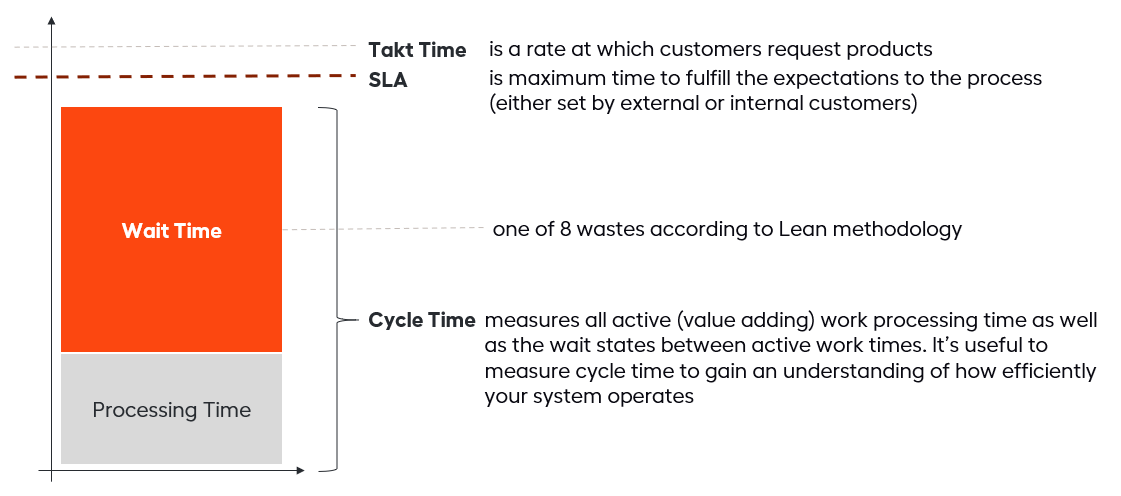
The time needed to process a single unit of work, for example, a single task or a process step, including both value-adding and non-value-adding activities. It consists of the Waiting Time in the backlog and Processing Time by a human or a bot. In some cases, when defects or downtimes occur, Cycle Time will also be affected by them.
D
Datamart
Introduced in IA Cloud Enterprise v10.2, Datamart 2.0 is a new approach to managing Business Process data. It is intended to enable you to build custom Analytics for any use case through a pre-defined set of extensible components. Datamart 2.0 includes:
- A standard schema for Data Stores
- Out-of-the-box ETL for loading data into the centralized data warehouse
- A set of pre-defined data views for dashboards
Learn more about Datamarts from the Extendable Data Model guide.
Data Purge
A feature that enables removing obsolete data related to the execution of a Business Process based on pre-defined settings. Starting from 10.2.8, Data Purge configurations are renamed into data management configurations.
Learn more about Data Purge.
Data Source
A mechanism providing input data and configuration for your Business Processes and tasks. It is best suited for those cases where the data resides on an external source, such as an SFTP server or Amazon S3 Cloud.
Data Store
A web interface for managing database tables in WorkFusion. You can use Data Stores to save Business Process results or query Data Stores from Bot Configs.
Learn more about Data Stores.
Dataset
A container for documents and all related meta-information used for model training and testing.
Starting from v10.2.5, you can work with model datasets in the Control Tower interface. Two dataset types are available: tabular and document ones. Learn more about the dataset UI.
Dashboard
A reporting mechanism in Control Tower that aggregates and displays metrics and key performance indicators (KPIs). WorkFusion Analytics features the following out-of-the-box dashboards:
- Overview
- Process
- Speed
- Capacity
- AutoML
- Manual
- RPA
In addition to the main supported dashboards, WorkFusion Analytics can include Digital Worker and custom dashboards. Digital Worker dashboards comprise visualizations for pre-packaged Digital Workers if any.
Learn more about the Analytics dashboards.
Designated Non-Financial Businesses and Professions (DNFBP)
A classification used by the Financial Action Task Force (FATF) denoting non-financial sector businesses that pose a money-laundering and terrorism-financing threat.
Examples include casinos, real estate agents, precious metal and precious stone dealers, lawyers, notaries, other independent professionals, accountants, and trust company service providers.
They are likely to be the weakest link in the chain to crack when it comes to introducing cash proceeds from tainted and dubious sources into the financial system. While banks and financial institutions are strictly regulated and monitored, in most markets, similar standards do not exist for DNFBP members.
Digital Worker
Also known as an AI Agent, it is highly skilled and experienced AI-enabled Digital Workforce that enables organizations to be more productive, with a better employee experience and improved customer satisfaction.
For now, WorkFusion offers the following Digital Workers (AI Agents):
Evelyn is the Digital Worker for Name Sanctions and PEP Screening Alert Review with a mission to protect the organization from sanctioned or risky client relationships by reviewing alerts for screened organizations and associated individuals.
Evan is the Digital Worker for Adverse Media Monitoring. Evan searches through vast amounts of potential negative news articles and clears away the noise from false positive alerts while prioritizing potential areas of risk.
Tara is the Transaction Screening Analyst that reviews sanctions alerts in real time to protect organizations from processing payments from sanctioned organizations and individuals.
Kayla is the Digital Worker for Perpetual KYC (pKYC) Refresh trained to keep tabs on customers across an ecosystem of systems and sources–simplifying KYC refresh, finding true material risks, and enabling financial institutions to transition from periodic KYC to a perpetual KYC review.
Isaac the AI Agent for Transaction Monitoring (TM) Alert Review that automates transaction monitoring level one alert review by investigating and evaluating unusual transactions generated from surveillance monitoring systems.
Digital Worker analytics
A reporting mechanism that aggregates and displays metrics to measure the impact of pre-packaged Digital Workers on the customer's business processes.
Discovery
One of the WorkFusion platform capabilities enabling to identify business processes you can automate and the value you can realize with WorkFusion automation. The following sub-capabilities are defined:
- Digital Worker Navigation: navigation across industry use cases addressed with the pre-packaged or custom solutions
- Digital Worker Evaluation: evaluation of pre-packaged solutions quickly and easily
- Desktop Analytics: tracking and displaying data from people working within a process to enable further automation opportunities
- Process mining: analysis of actions captured from the operations specialists to identify repeatable processes that are subject to automation
- Process documentation: definition of a Business Process in a language understandable for business users
Document Intelligence
Using machines to read documents, includes OCR and tools for automatically fixing skewed documents, reducing noise, and parsing to prepare for use by a machine learning model.
The WorkFusion Document Intelligence capability refers to the following sub-capabilities:
- OCR: Optical Character Recognition (OCR) converts image-based formats (for example, PDF, TIFF) to text
- Classification: ML-based capabilities that allow classifying various unstructured documents automatically, optionally bringing the human in the loop
- Extraction: ML-based capabilities that allow extracting data from various unstructured documents automatically, optionally bringing the human in the loop
- NLP: capability to understand the natural language to match, classify, or extract data in a structured way
- Multilingual: ability to interact with different source languages
- Computer Vision: capability to understand images (for example, checkmarks or barcodes) and video and pull structured insights from there
- Handwriting: capability to understand the handwriting
E
Elasticsearch
Elasticsearch is a distributed, full-text search engine with an HTTP web interface and schema-free JSON documents. The product is designed for indexing logs and system metrics and provides scalable and near real-time search capabilities. Elasticsearch enables you to search and filter specific messages in selected logs.
End-to-end Processing Time
The time required to process a single request from its creation to closure.
Enhanced Due Diligence
An additional set of due diligence activities performed on "high risk" entities such as PEP.
Enterprise RPA Server
A Windows server containing several Bot Units.
ETL bot
A feature enabling users to easily configure and re-configure automated Business Process steps without editing the code. An ETL Bot comprises:
- A UI form with easy-to-configure parameters
- Additional Groovy or XML code you require to prepare variables for subsequent steps
Event-based communication
A mechanism when an event (such as an entity changed or updated) in one automation flow or step within a flow triggers another event in another automation flow or step.
Explainability
A concept that a machine learning model and its output can be explained so that a human being can understand it at an acceptable level.
Learn more about explainability.
Extended model
A model configuration copied from a generic model configuration and enriched with custom components.
F
F1
A measure of the model accuracy, calculated based on the Precision and Recall metrics.
Learn more about the F1 Score.
Field Scheme
A feature in Control Tower enables defining the table structure and the column data format for a Data Store.
FIFO
FIFO (first in, first out) is the strategy to prioritize the processing of WorkSpace task records, where the oldest (first) entry is processed first. Record priority and order are determined based on the record date (primary parameter) and ranking (secondary parameter). The strategy is employed for custom sorting of assignments.
Learn more about FIFO.
Financial Action Task Force (FATF)
Financial Action Task Force (FATF) is an inter-governmental body that makes policies for preventing and mitigating money laundering, terrorist financing, and other related threats that impact the efficacy of the global financial system.
They have developed 40 Recommendations that are the international standard for developing and implementing AML or CTF and the policy on the proliferation of mass destruction weapons (WMD policy) worldwide. These recommendations are periodically revised to ensure that they remain up to date and relevant.
The money laundering regulations of most countries are based on the FATF's 40 Recommendations for developing and implementing AML and CTF policies.
Fixed configuration
An AutoML model configuration with a strictly pre-defined set of components but without an AutoML Search Engine configuration. If a fixed configuration is used for a model, the model's training involves running a single experiment.
G
Generic model
An out-of-the-box machine learning model designed to process semi-structured documents. There are two types of generic models for specific tasks:
Generic models can be used to process invoices, claims, emails, and other documents.
Global variables
Variables intended to store common values used in different BPs to avoid hard-coding the values in Bot Tasks. In a global variable, you can store URLs, parameters, strings, modes, and timings. All global variables are kept in the Global Variables Data Store available via Control Tower at Data Stores > Global Variables.
Learn more about Global variables.
Gold data
A file containing correct Answers to all Questions that you intend to qualify workers on. A gold data file has an additional column with a gold_ header prefix for each Answer in a task.
For example, if your Manual Task contains Unique Codes, such as invoice_number and vendor_name, gold data should have additional columns with the gold_invoice_number and gold_vendor_name headers. The columns should include correct Answers.
Gold data is no longer used for qualification starting from 10.2.4.
Gold file
A structured file that contains alert IDs from sanction screening systems. The file is used as an input file for a Business Process and is aimed to check the performance and quality of the Name Screening Digital Worker.
Grouping model
Grouping is a mechanism, enabling developers to combine existing or new models into one artifact. The main goal is to reduce the number of Workers and minimize the start time on the cluster.
For details, refer to the Grouping models article.
H
HAProxy
HAProxy is free, open-source software that provides a high availability load balancer and proxy server for spreading requests across multiple servers.
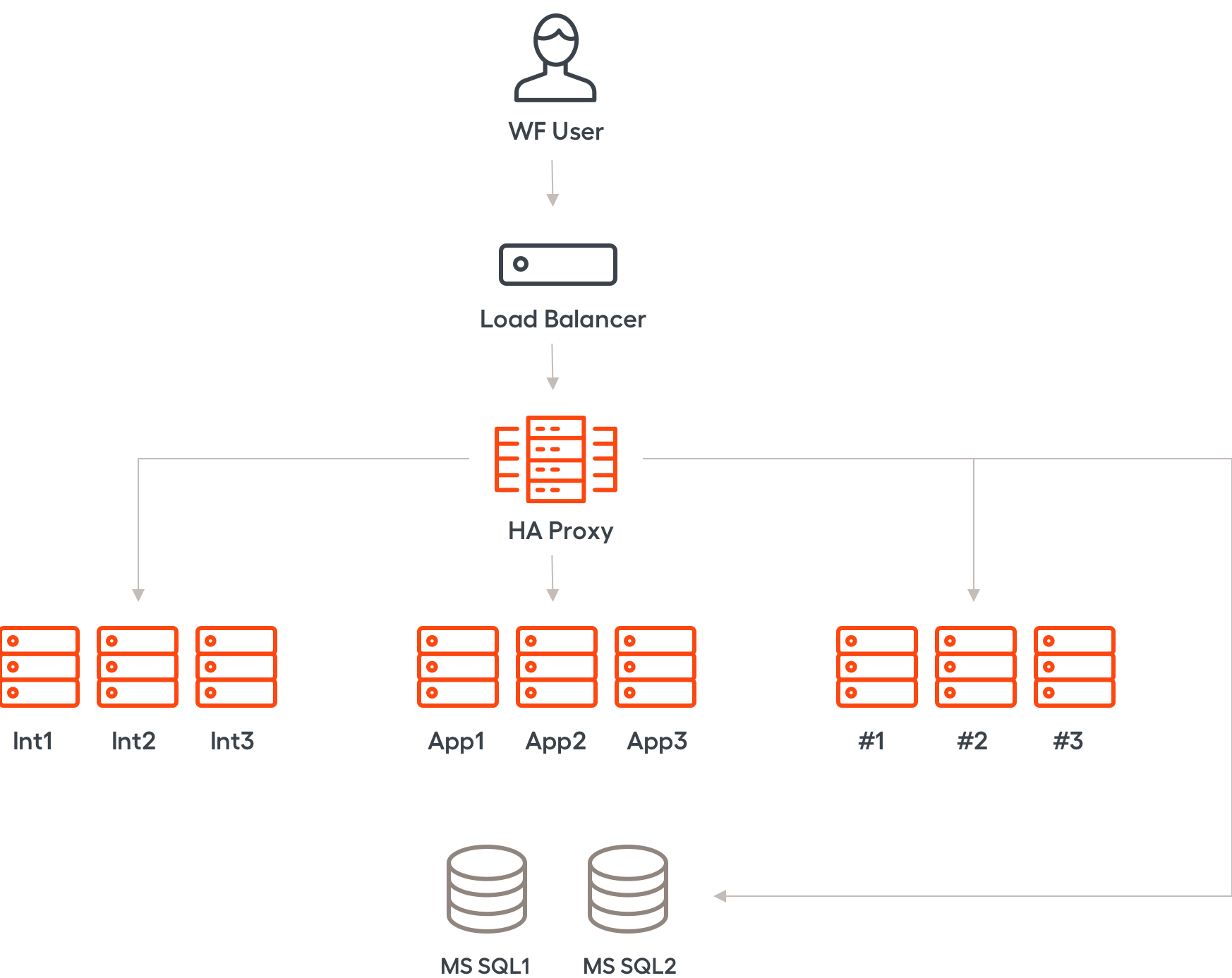
HAProxy processes incoming task requests by identifying the server containing the relevant service and routing the particular request to the appropriate server. The servers include Master servers, BEP Agent servers, RPA servers, and BI servers.
Also see:
Hazelcast
Hazelcast is an open-source, in-memory data grid that allows horizontal scaling of processing power and available storage by providing in-memory access to frequently used data. WorkFusion uses these techniques to reduce the query load on databases and improve the speed of accessing frequently used data.
High availability
High availability (HA) is the ability of a system to be continuously operational for an extended period of time. Its aim is zero data loss and a maximum of 10 minutes of service downtime, after which it must be fully restored. IA Cloud Enterprise supports HA through all components.
To take advantage of the high availability feature, provide several emergency servers for each system component of the Intelligent Automation Cloud. In case of a component's failure, this allows the system to automatically switch to a "healthy" machine and continue its operation with minimum or zero downtime and data loss. All your data is stored on a shared file system or a mounted NAS. Thus, it is always available.
The load balancer component must be installed on the customer's side to provide services and distribute traffic among them.
Also see:
Human-in-the-loop
Human-in-the-loop, or HITL, is an automation model that requires human interaction. WorkFusion uses HITL to execute manual steps within an RPA model. HITL allows the user to change the outcome of an event or process. It also enables you to identify the problems and requirements that may not be identified easily by other simulation means.
Hybrid model
This is an ensemble model type containing the routing logic. For details, refer to the Hybrid models article.
Hyper model
A model configuration along with a set of dependencies required for training. Starting from v10.2.5, hyper models are also named pipelines.
I
IA Cloud architecture
For a detailed description of the IA Cloud architecture, read the IA Cloud component overview topic.
Information extraction
An machine learning task of extracting structured information or key facts from unstructured and semi-structured documents. For example, extracting financial data from invoices, claims, and other financial documents.
Inspection type
There are three types of inspection associated with performing AutoQC:
- Normal inspection is used at the start of the inspection activity.
- Tightened inspection is used when the vendor's recent quality history has deteriorated (acceptance criteria are more stringent than under routine inspection).
- Reduced inspection is used when the vendor's recent quality history has been exceptionally good (sample sizes are usually smaller than under routine inspection).
Learn more about Inspection types.
Instructions
The explanatory part of a legacy Manual Task intended to provide initial data, the task goal, steps to complete, and examples.
Learn more about Instructions.
Integration
One of the WorkFusion platform capabilities that refers to:
- REST API: API coverage of the platform that allows clients and partners to integrate the platform with third parties, build custom solutions, UIs, and own workflows based on the generic platform
- Connectors: pre-packaged connectors for data import and export, for example, import from SAP
- Enterprise PAM: integration to the Privileged Access Management platforms where clients can manage user and API access to essential, business-critical, and sensitive workflows and data
- Conversational bots: integration with chatbots in real time
- Monitoring: integration with external monitoring platforms
- Decision engines: integration with third-party rule engines
- PaaS AI: integration to Platform-as-a-Service AI and ML platforms
Intelligent Automation Cloud (IA Cloud)
WorkFusion's flagship software product for executing and developing Digital Workers. Refer to the Installation guide to learn more about IA Cloud installation and configuration.
Identity Verification
A process to verify identity through automated steps of extracting, mapping, and comparing information on the identity.
J
Jupyter
A server-client application that allows you to combine rich text elements—such as figures, charts, links, equations—with real-time code execution.
Also see Install Jupyter Notebook.
K
Keycloak
Introduced in v10.2, Keycloak is open-source software that facilitates Single Sign-On (SSO). WorkFusion uses Keycloak's Identity and Access Management features to provide services like social login, two-factor authentication, and LDAP integration to Intelligent Automation (IA) Cloud components.
Kibana
Kibana is a dashboard software that provides visualization capabilities on top of large volumes of data indexed on an Elasticsearch cluster. Kibana also includes the Canvas presentation tool that allows users to create slide decks by pulling live data. It is part of the monitoring solution provided by Elastic NV.
Know Your Customer (KYC)
A set of standards used within the investment and financial services industry to verify the identity, suitability, and risks of entering and maintaining a business relationship with a customer. The procedures fit within the broader scope of a bank's anti-money laundering policy.
In this way, financial and other institutions ensure that their clients are genuinely who they claim to be.
L
Label
A label (or a tag) is a description that informs a machine learning model what a specific piece of data represents. Labels can be added by human annotators or automatic annotation tools and enable models to learn by example.
Labeling
Data labeling is the process of identifying items of raw data to give them meaning so that a machine learning model can use that data.
License activation
A license validation procedure that prevents unlimited free use of the software.
Learn more about licenses required for the WorkFusion platform.
Load balancer
Load balancer provides the availability of services and distributes traffic among them. It accepts all the traffic and forwards the application requests to the APP server. After that, the traffic is routed among other servers.
Also see:
Logstash
Logstash is a data collection and log-parsing engine used as a storage input source to Elasticsearch.
M
Machine learning algorithm
An algorithm that can learn from data and make predictions on it. Such algorithms overcome strictly static program rules by making data-driven predictions or decisions.
Examples of ML algorithms supported in AutoML SDK: SVM, DNN, regression, and so on.
Machine Config Bundle (MCB)
The term is obsolete now, replaced with Bot Config Bundle. In versions up to 10.x, it is a JAR file that contains:
- One or more main machine configs
- Zero or more included machine configs
- Zero or more Java or Groovy classes.
MBCs are Maven-based and can be published to artifact registry and further imported to WorkFusion.
Manual Task
A task created in Control Tower and completed by a human, either by a cloud worker or an internal employee.
Manual Task Designer
A design tool available in Control Tower and used for creating Manual Task forms. Manual Task Designer has two implementations used for different task creation methods:
Based on Manual Task Designer operation, available from v10.2.5
Legacy, based on other operation types
Manual Handling Time
The time required by a person to perform manual activities during the process execution. This may be a needed step to control the process quality or an optional one where people are not involved.
Marathon
Marathon is a container orchestration system built on the Apache Mesos framework and used for managing and scaling IA Cloud applications. From v10.2.2 of IA Cloud, WorkFusion has enhanced the use of Mesos/Marathon.
Master Bot Agent
An application that triggers NGINX and data collection services and initializes an RDP connection for a Bot Agent in the Enterprise RPA Server approach and starts an RPA Worker in the VDI RPA Server approach.
Mesos
Apache Mesos is an open-source project for managing computer clusters. Mesos uses Linux control groups to facilitate isolation and resource sharing between IA Cloud applications. Mesos is one of the many third-party components and services used for filtering logs in Logs UI. Also, you can simultaneously deploy a maximum of 20 Mesos Agents to execute ML and CT tasks.
MinIO
MinIO is an object-based storage solution that is API-compatible with the Amazon S3 cloud storage service. It can handle unstructured data, such as photos, videos, log files, backups, and container images. WorkFusion uses it for storing OCR and AutoML data.
ML feature engineering
A process of extracting or selecting features related to a training set to improve the results of a trained model.
Model configuration
A set of parameters used for model training and Search Engine, including algorithms and their parameters, Feature Extractors, Pre- and Post-processors
A process of defining AutoML SDK components
Model execution
A process of applying a trained model to a dataset. Usually, the process involved applying a production dataset in a production environment.
Model experiment
A single iteration of training a machine learning model with a specific combination of AutoML SDK components.
Model training
A process of defining a model that fits a training set. If a model configuration includes AutoML Search Engine, model training is searching for the best combination of components. The result of the model training process is a trained model.
Model retraining
A mechanism that allows you to improve a model quickly. Basic operations include actual retraining of your model, comparing the statistics from two models, applying the retrained model to a Digital Worker, downloading and uploading the Digital Worker training dataset and model.
N
Name Sanction Screening
Part of the broader AML activities, Name Sanction Screening (NSS) is a process designed to identify sanctioned individuals, entities, or all relevant names during onboarding and throughout the relationship's lifecycle that may pose a risk to a financial or another institution.
Also, see Name Screening Alert Review.
Name Screening Alert Review
A pre-configured skill of the Evelyn Digital Worker in Intelligent Automation Cloud known as a critical component of the Know-Your-Customer and Anti-Money Laundering guidelines.
Also, see Name Sanction Screening and Name Screening Alerts.
Name Screening Alerts
A match found by a screening system for a specific name.
- True positive alert. The search returned a result that can be conclusively verified that it is the same person.
- False positive alert. The search results indicate that no match with the screened name is found.
Negative News
A common term for Adverse Media Monitoring.
Nexus
A repository manager that stores and controls IA Cloud artifacts, such as ODF dependencies, SDKs, AutoML and CT Workers.
O
Object recording
The primary mode used by the RPA Recorder to automate applications. In this mode, a bot captures object properties and the values of active elements while recording and tries to find the same elements and click them while executing a script.
Object Storage
A reliable storage of OCR results and trained models.
OCR API
A software intermediary that enables WorkFusion's OCR software to recognize document images and convert them into editable text. To learn more, refer to OCR REST API.
OCR action
A feature in the RPA Recorder enabling automatic image recognition and writing the recognized text to a recorder variable of string type.
OCR Bridge step
Introduced in v10.2.4, it is a step within a Business Process enabling asynchronous OCR processing of input data with results instantly available in Control Tower. Only this single step is enough to recognize documents whose output is compatible with a Tagging-over-Document Manual Task.
OCR engine
A module in Intelligent Automation Cloud that processes scanned documents: converts unstructured, image-based data into structured character documents in several formats (HTML, XML).
OCR task
A task that converts images into machine-readable formats (for example, JPG to HTML). It is completed by the OCR engine.
Operations
Describe the workflow of a particular Business Process and thus serve as templates to create Manual or Bot Tasks:
- For Manual Tasks, Operations simplify task creation by having pre-defined questions, answers, instructions, and sample input files.
- For Bot Tasks, Operations simplify development by providing a baseline of the configuration code.
Optical Character Recognition (OCR)
A technology that enables you to convert different types of documents (for example, scanned paper documents, PDF files, or images from a digital camera) into editable and searchable data.
Learn more about OCR.
P
Percentile
A measure used in statistics indicating the value below which a given percentage in a group of observations falls. For example, the twentieth percentile is the value below which 20% of observations may be found. Similarly, 80% of the observations are found above the twentieth percentile.
Personal Identifiable Information (PII)
Information that identifies a person. Personal Identifiable Information (PII) is protected information and a security breach can incur fines or loss of a contract. PII varies by state, country, and so on.
Pipeline
Starting from v10.2.5, the term is used to designate an AutoML model configuration along with a set of dependencies required for training.
Also see:
Politically Exposed Person
A term commonly used to refer to foreign individuals who have been entrusted with a prominent public function and their immediate family members and close associates. By this public position or relationship, these individuals may present a higher risk that their funds may be the proceeds of corruption or other illicit activity.
Politically Exposed Person (PEP) is typically a subject to Enhanced Due Diligence.
Precision
A metric calculated to analyze model results and defined as the number of correctly predicted and extracted items divided by the total number of predicted and extracted items.
Learn more about Precision.
Pre-trained bot
A pre-trained bot, or skill, is a configurable pre-packaged automation solution that enables users to address specific use cases in a particular domain, for example, banking or insurance.
Protected Health Information (PHI)
Specific to health information. Health information is protected by HIPPA and other laws. A leak of Protected Health Information (PHI) can incur fines or loss of a customer contract.
R
RabbitMQ
RabbitMQ is open-source message-broker software that helps IA Cloud applications send and receive messages and temporarily save them while sending.
Recall
A metric calculated to analyze model results and defined as the number of correctly predicted or extracted items divided by the total number of items that belong to the class (gold results).
Learn more about Recall.
Record
A row in the task data file.
Rejection limit
The smallest number of non-conforming items in a sample that would lead to the rejection of the entire batch.
Learn more about Detecting rejection limit.
Relative or Close Associate (RCA)
A Relative or Close Associate (RCA) of a PEP. This includes individuals, such as family members, for example, a mother, father, brother, or sister. RCAs also include those who have close professional or social relations with individuals that are identified as a PEP.
Release Management (RM)
A process of planning, designing, scheduling, testing, deploying, and controlling software releases.
Renderer
A part of the http://form.io framework that renders a form from the JSON configuration. Use inside the application to provide a user-friendly interface for filling forms with appropriate data.
To view Renderer, click the link. Learn more about the Digital Worker configuration.
Requester
A WorkSpace administrator who can create or edit workers, change application settings, and generate reports. The term is obsolete since 10.2.
Robotic Process Automation (RPA)
Software programmed to replicate human actions (clicking, typing, scrolling) through the graphical user interfaces of applications.
Learn more about RPA.
RPA Bot Manager
A web application that contains information about all RPA Servers and is used for managing the RPA Servers.
RPA Cluster
A scalable computing environment within Intelligent Automation Cloud that executes automation of user scenarios within desktop or web applications.
RPA Recorder
A component in the WorkFusion Studio IDE that enables automating web, desktop, and mainframe applications without any coding or scripting. Instead, it employs object recording and surface-based (image-based) automation approaches.
Learn more about the RPA Recorder.
RPA Unit
A desktop agent that executes a sequence of commands interacting with the application's UI.
RPA WFSVC service
A .NET application that initiates a console master session on the RPA Server after the system startup.
RPA Worker
An application used to connect to the assigned RPA Queue, retrieve tasks, and send results to the Results Queue. The efficiency of an RPA Worker is determined by the estimated number of human full-time equivalents (FTEs) whose work it can do.
S
Schema-based Business Process
A Business Process where each step can have a contract defining variables expected as input for this step and those produced as the output. The Business Process design type was introduced starting from v10.2.8.
Learn more about the schema-based approach to design Business Processes.
Score
For an AutoML model, it is a predicted value generated from a trained model.
Search
In terms of the Adverse Media Screening Digital Worker, it is a single operation on one entity that is similar to a manual search performed on the web regarding the body of interest based on a set of keywords and phrases to identify suspicious behavior patterns.
Secrets Vault
Secured storage for sensitive data. Secrets Vault is offered as a functionality of WorkFusion Intelligent Automation Cloud. Secrets Vault contains confidential items, for example, credentials, that can be used in your recordings and scripts.
See also:
Self-healing bot
A process or a job able to restore itself in case of a failure and resolve the problem without direct human intervention.
Sensitivity analysis
The analysis determines how the uncertainty in the model output can be divided and allocated to different sources of uncertainty in its input.
Learn more about model sensitivity.
Service Level Agreement (SLA)
The level of service expected by a customer from a service provider and agreed upon between two or more parties. It is often based on the time and severity of a request.
In WorkFusion Intelligent Automation Cloud, SLA tracking is set up on the Business Process level.
Skill
An automated end-to-end solution for a single Business Process. These solutions have configurable inputs and output formats, and they can be customized and adapted to particular customer needs and compliance rules.
Also, see Digital Worker.
Smart Process Automation (SPA)
WorkFusion SPA is the name for the WorkFusion Automation Cloud before v.10.x.
Software Development Lifecycle Methodology (SDLM)
A methodology with clearly defined processes for creating high-quality software. It focuses on the following software development phases:
- Requirement analysis
- Planning
- Architectural design
- Software development
- Testing
- Deployment
Solution Catalog
A feature in Control Tower that provides access to acquired Digital Workers and allows you to install new ones. The feature is enabled by default with the IA Cloud Enterprise installation.
Learn more about Solution Catalog.
Source of Funds
A term referring to the origin of money or assets used in a specific transaction or business relationship. In establishing Source of Funds (SOF), firms must seek to understand not only where funds came from (in terms of the account from which they were transferred) but the activity that was involved in generating those funds, for example, a source of employment, the sale of a house, or an inheritance.
SOF is often reviewed with Source of Wealth and is part of AML compliance.
SOF examples include personal savings, pension releases, share sales and dividends, property sales, gambling winnings, inheritances and gifts, compensation from legal rulings.
Source of Wealth
A term referring to a person’s accumulated volume of wealth. Source of Wealth (SoW) is often reviewed with Source of Funds and is part of AML compliance.
SoW examples include inheritances, investments, business ownership interests, employment income.
Special Interest Person (SIP)
A typically high-profile individual who has either been convicted of financial or organized crime or has been subject to said investigations. SIPs can be identified via intelligence gathered during KYC or AML screening or via a sanctions list.
Split-Join Rule
A rule based on which every single Record (or document) from input data is divided into a few records to let them pass through different steps of a Business Process (either Bot or Manual Tasks) in parallel. Subsequently, the processed records are combined back into a single record (or a document) to further process the consolidated results from the previous steps.
Stateless execution
A feature that allows the execution of Bot Tasks in memory without saving intermediate results to the database.
Learn more about stateless execution.
Statement of Work
A document routinely employed in the field of project management. Statement of Work (SOW) is the narrative description of a project's work requirement. It defines project-specific activities, deliverables, and timelines for a vendor providing services to the client.
The SOW typically includes detailed requirements and pricing, with standard regulatory and governance terms and conditions. It is often an essential accompaniment to a master service agreement or request for proposal (RFP).
Not to be confused with Source of Wealth.
Statistics step
An optional step in the AutoML SDK pipeline that provides model results. Statistics helps an ML Engineer to analyze model results to understand better how to tune the model configuration. Statistics are available for both information extraction and classification tasks.
Straight-through processing (STP)
An indicator of the automation level; the rate of documents processed entirely by bots without manual effort.
Learn more about straight-through processing.
Subject matter expert (SME)
Experts from the customer's side who have a deep understanding of the whole process and business logic of the documents. Usually, they perform all the process tasks manually before automation is applied and have the full knowledge of document business logic.
Surface-based automation
A fallback mode of the RPA Recorder to automate applications. In this mode, a bot captures images of active elements while recording and tries to find the same images and click (hover, drag, scroll) them while executing a script.
T
Tag
See Label.
Tagging over Document (TOD)
A process that allows users to label the original document without viewing the OCR results.
Learn more about TOD.
Tagged text
A string or several strings where each value is assigned with one or more tags (labels). Tagged (labelled) text is used for model training.
Takt Time
A rate at which customers expect to see products or results of a Business Process.
Task
A unit of work assigned to workers (contractors, SMEs, employees). A task's main goal is to take initial raw data (CSV file) and structure, enrich, or check this data according to some rules.
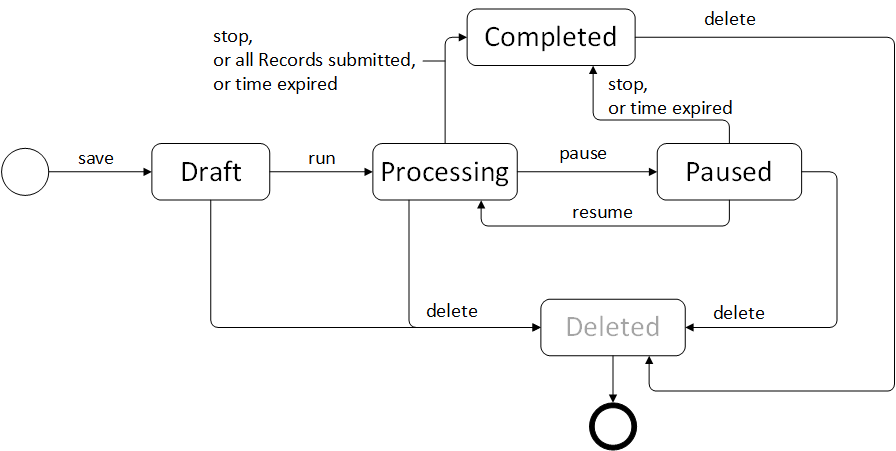
Task Available Actions
| ↓ Action \ Status → | Draft | Processing | Paused | Completed |
|---|---|---|---|---|
| Copy task | V | V | V | V |
| Copy task with data | V | V | V | V |
| Copy to new task | V | V | V | V |
| View properties | V | V | V | V |
| View data | V | V | V | V |
| Pause task | X | V | X | X |
| Resume task | X | X | V | X |
| Stop task | X | V | V | X |
| Delete task | V | V | V | V |
| Download original data | V | V | V | V |
| Export | V | V | V | V |
| Run | V | X | X | X |
| Preview* | V | V | V | V |
| Repair** | X | V | V | V |
* – For draft tasks, the Preview action is available if a data file was uploaded and mapped to Data Elements.
** – You can repair only tasks with processing issues.
Task data
A CSV file with source input data needed to run a task. The column headers in the file should be the same as the variables used within the task design. You can remap them when needed.
Task data and design
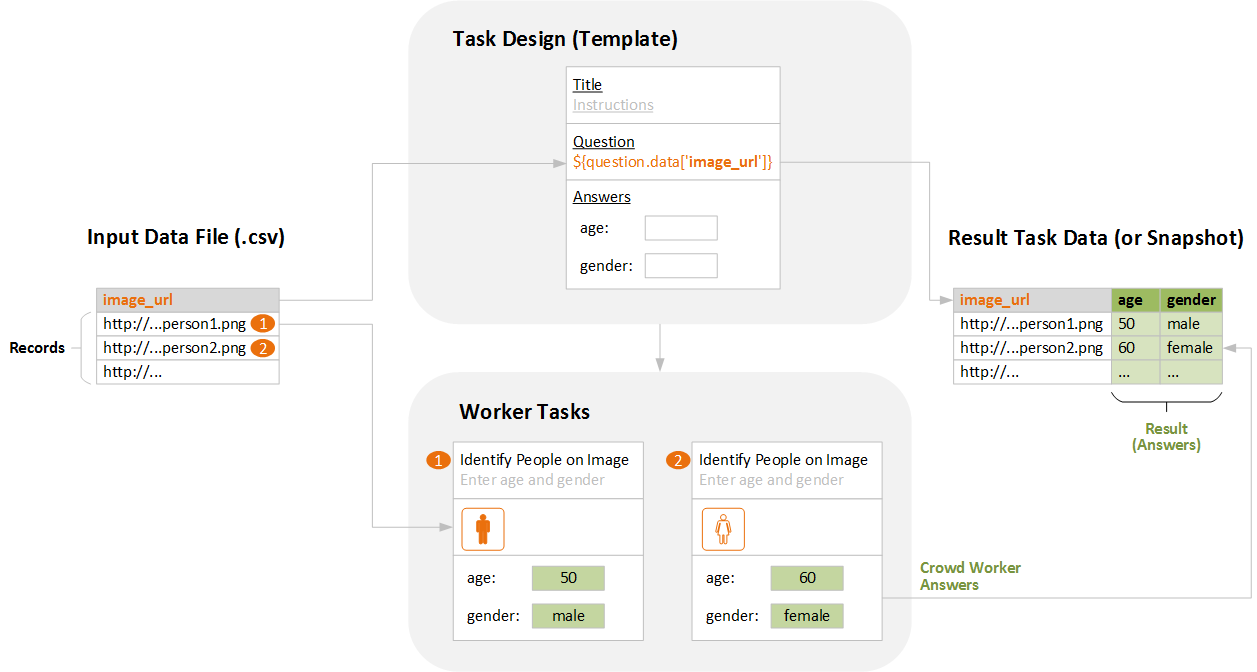
Task statechart
Template
The term can be used in the
A template is an entity in Control Tower that provides a way to reuse platform objects, such as a Manual Task, Business Process, and so on. Learn more on Templates.
A template (template model) is a new feature available from v10.2.8 enabling automated information extraction from structured forms (for instance, ACORD). Learn more on Template models.
Total Cost of Ownership
The purchase price of an asset plus the operation costs. Assessing the Total Cost of Ownership (TCO) represents taking a bigger picture of what the product is and its value over time.
Trained model
A final binary artifact resulting from model training. It contains a training set and a model to match it. Depending on the selected algorithm, the artifact can store the following information: the neural network structure, scores, coefficient matrix, decision tree configuration, and so on.
A trained model with accurate results can be further used in the execution process.
Training set
A set of documents—invoices, emails, contracts, and so on—used for model training. For information extraction, a training set consists of documents which contain gold data for a set of fields to be extracted. For classification, the training set consists of documents accompanied by a target class.
Trust and Security
One of the WorkFusion platform capabilities containing:
- Secrets Vault: centralized management of secured data for people and automations. Secrets Vault contains confidential items, for example, credentials to be used in your recordings and scripts
- Audit: full audit functionality to track user and system actions (login attempts, user and roles creation, modifications, and so on).
- Data segregation: ability to filter and segragate data, for example, to comply with legal requirements. Some customers may also want to store data in their region or country only.
- Access Control List (ACL): ability to control and streamline user access to software, tasks, processes, and data. Learn more about ACL.
Turnaround Time (TAT)
An external-facing metric that means the total amount of time taken to complete a customer-facing case or fulfill a request.
U
Ultimate Beneficial Owner (UBO)
A term used for an individual or entity that is the ultimate beneficiary of a company. Uncovering UBOs is a critical element in any anti-money laundering program. In most cases, if a shareholder owns or controls 25 percent or more of the shares or voting rights in a legal entity or company, it is considered a UBO. However, the threshold varies across jurisdictions and regulatory authorities.
V
VDI RPA Server
A Windows server containing one Bot Unit.
Virtual asset (VA)
A digital representation of the value that can be digitally traded, transferred, or used for payment but that does not exist in the physical form, for example, NFT or cryptocurrency.
Flat currencies and digital versions of flat currencies are not considered virtual assets since they represent a physical item.
W
Wait time
A period when a specific task or transaction is waiting to be processed by a person or machine. Wait Time is typically something you would aim to reduce. According to the Lean philosophy, this is an example of waste and doesn't create any business value.
Workbook
An entity in Tableau-based WorkFusion Analytics containing a designed dashboard.
Worker
An employee, a contractor, an SME who accepts and completes a task in WorkSpace.
See also BEP Worker.
Worker Management System (WMS)
A BEP's execution subsystem interacting with the cluster job orchestration system (currently, Mesos/Marathon) to start, stop, and scale BEP Workers.
Learm more about Worker Management System.
Workflow Engine
Executes automation processes authored in Control Tower according to process definitions. This is the server application configured within Control Tower. Execution is handled in different computing environments—RPA, WorkSpace, OCR, and AutoML.
Worker Accuracy
The percentage of all worker Answers that coincided with the Answers provided by other workers—the majority.
Workforce
A grouping entity that specifies who is working on a task. A Workforce can contain one or several Crowds.
WorkFusion Studio
An Eclipse-based IDE used to develop Bot configurations.
WorkSpace
A WorkFusion-built graphical user interface to support human-in-the-loop involvement with Digital Workers.
A WorkFusion application and graphical user interface to support human-in-the-loop involvement with Digital Workers. For example, articles identified during the automated Adverse Media Screening process are displayed as a Manual Task in WorkSpace.
Learn more about WorkSpace.
Z
ZooKeeper
Apache ZooKeeper is an open-source server for centralized coordination of cloud applications. WorkFusion uses its configuration service, synchronization service, and a naming registry for IA Cloud components.