Create Manual Task
A task is a unit of work assigned to workers—either public or private internal ones (contractors, SMEs, employees). The main goal of a task is to take the initial raw data (CSV file) and structure, enrich, or check the data according to specific rules.
IA Cloud Enterprise works with the following task types:
- Manual Task (MT)—a task completed by a human who is either a cloud worker or an internal employee
- Bot Task—a task completed through computer automation, such as data parsing, extraction, transformation, loading
- Qualification Task—a test task for screening workers and filtering out those not sufficiently qualified to take a specific task
Using the Manual Tasks menu in Control Tower, you can create and manage MTs, monitor their progress, and view their results.
Manual Task workflow
The basic MT workflow is as follows:
Create a Manual Task. On the Manual Tasks list, the MT appears with the Draft status.
Set up a design for the MT.
Configure the parameters to run it. To prevent occasional data loss, save the MT from time to time.
Run the MT in a development environment. At the step, the MT status is Processing.
After you post an MT, log in to WorkSpace as a worker, find and complete the created task.
To configure the Workforce settings, navigate to Manual Tasks > Run parameters.
Check the run results and edit the MT parameters if needed.
Copy the MT with data.
Run the copied task in a Production environment and monitor its execution.
Optionally, you can pause, resume, or stop the MT execution. When the MT is no longer needed, you can delete it.
For additional information on MT statuses and available actions, read the View all Manual Tasks topic.
Task data flow
As you create and manage a Manual Task, the flow of data is as described below:
You prepare an initial data file.
The data is enriched or transformed according to specific rules during the task execution. Human workers or Bot Configs perform these actions.
(Optional) Intermediate results are obtained by generating snapshots.
The final result data file is obtained. You can use the file as an input for another MT in a Business Process.
Create Manual Task
There are two ways to create a Manual Task:
- Select Manual Tasks > Create.
- On the Manual Tasks menu, select View All and click Create Manual Task.
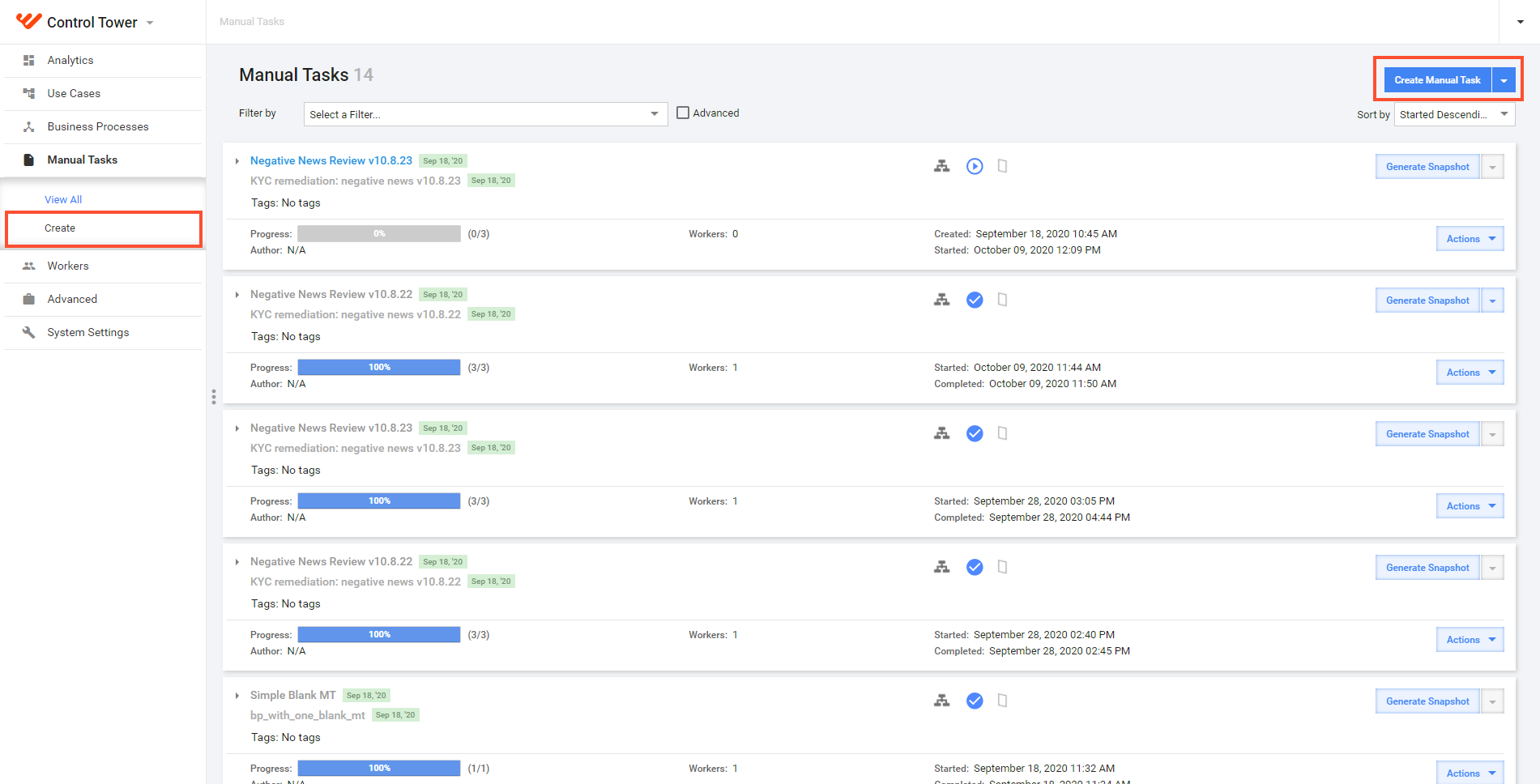
On choosing one of these options, you proceed to the Select an Operation step.
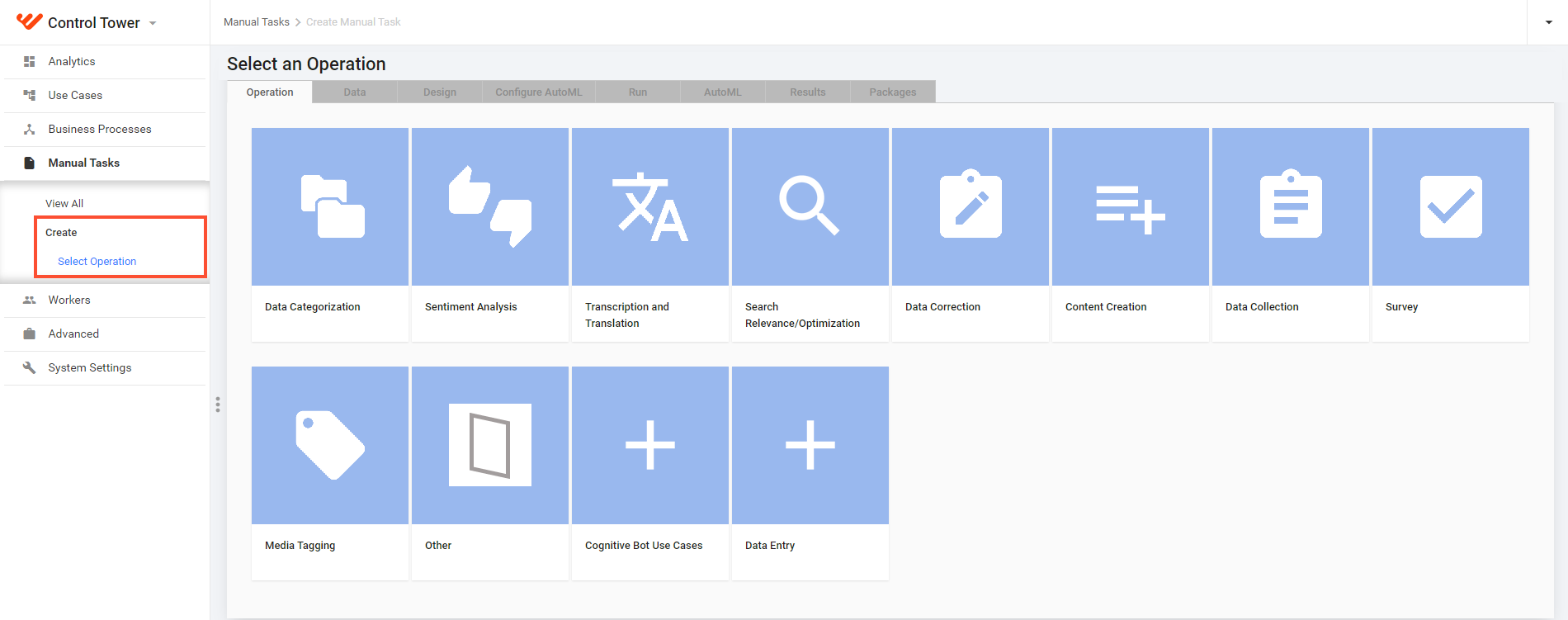
Select Operation
Operations describe the workflow of a particular Business Process and thus serve as a template to create either Manual or Bot Tasks:
For Manual Tasks, Operations simplify their creation by providing predefined questions, answers, instructions, sample input data files.
For Bot Tasks, Operations facilitate development by providing a baseline of the configuration code.
To select an Operation, follow the steps below:
Select a category to see all available Operations for it.
To create a task from scratch, select Other > Miscellaneous Tasks.
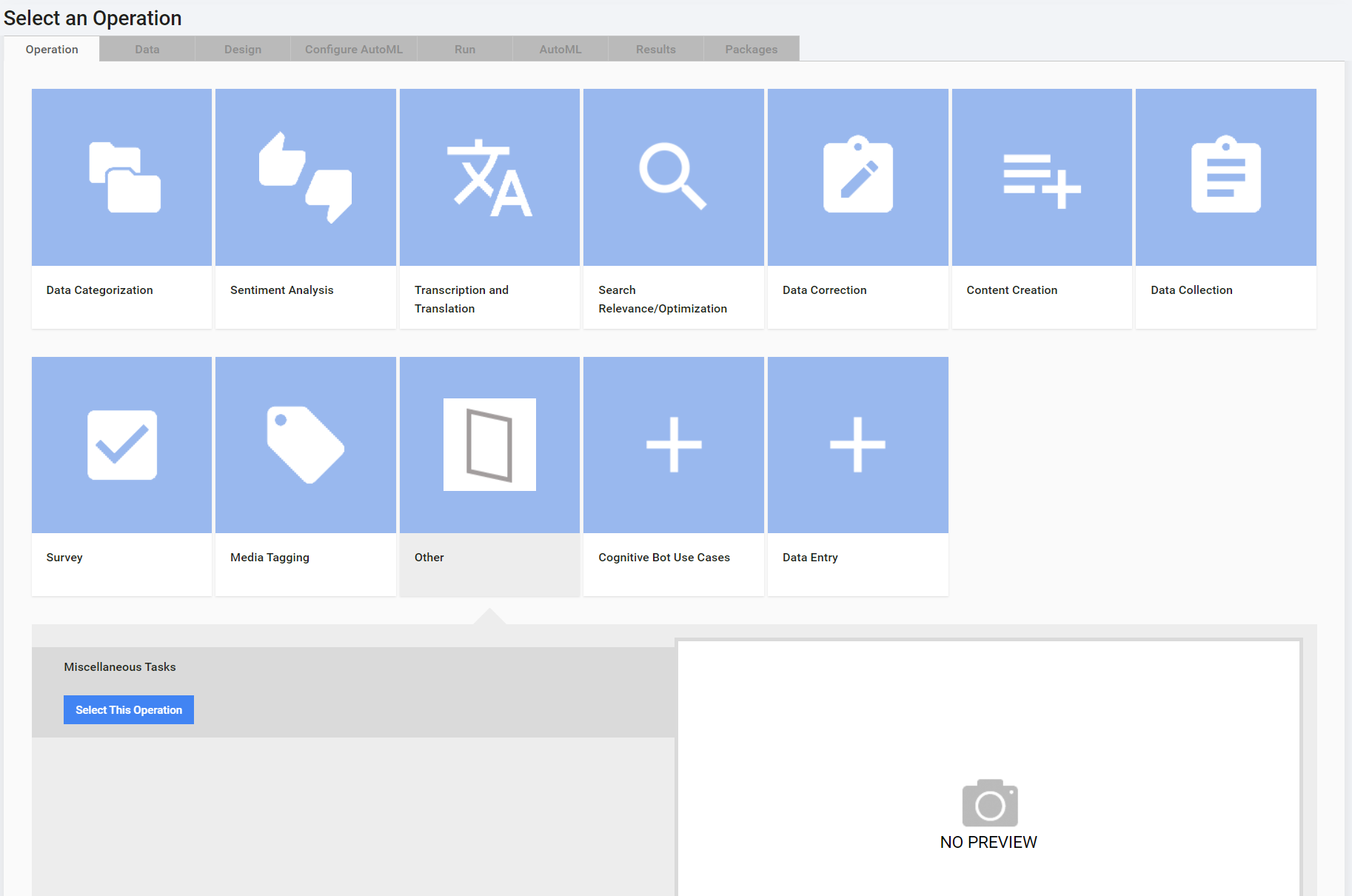
Select a specific Operation and, in the bottom right corner, click the Select This Operation button. Operations have a preview image on the right side (if any is available).
Available Operations include the ones listed below:
Data Categorization:
- Image Tagging
- Business listing categorization—utilize the taxonomy to accurately tag a business with micro categories based on the services it provides.
- Adult Content Classification—classify the content, including nudity and sexually explicit adult content, as viewed for a single product or offer.
- Assign Type of Website to Movie Websites—choose from six types and assign one to provided movie websites.
Sentiment Analysis:
- Sentiment with 5 Choices—classify the text as positive, negative, mixed, neutral, none.
- Sentiment with Yes/No Choices—answer Yes or No if a text includes the provided excerpt.
- Sentiment with 4 Choices—classify a text as positive, negative, mixed, neutral.
- Classify Sentiment toward the brand— read the article provided and classify the sentiment that the author expressed toward a brand or product.
Transcription and Translation:
- Moderate Translated Reviews—moderate the translation quality of user-generated hotel reviews.
- Translate Reviews—translate user-generated review snippets.
- Transcribe the text displayed on the image—enter the text from an image.
- Tax Bill Transcription—transcribe tax bills.
Search Relevance/Optimization:
- SEO Optimization—provide a short description of the text.
- Search Intent—decide whether or not a search query is looking for the same products.
- Search Intent with Taxonomy—decide whether or not a search query is looking for the same products.
- Music Search Intent—decide whether or not a search query is looking for music or musicians.
- SEO Optimization: Search Query Identification—classify a search engine query as specific music, general music, or not music. Look at the first two pages of Google or Bing to decide. Mind that it can include offensive or adult language.
Data Correction:
- Match Cover Letter vs. Invoice
- Product Name to UPC Matching—match a product name and its universal code (UPC).
- Verify/Correct Location—verify or correct the location of a business.
- Product description matching—match products and descriptions.
- Business Listing Verification—verify the business listing information.
- Verify Product Image—verify a product image against a name.
Content Creation:
- Moderate Product Reviews—moderate the review quality of user-generated product reviews.
- Product Review—write a product review.
Data Collection:
- Find Product UPC code
- Find hotel's official website—find the official website of a hotel based on its name and address.
- Find Company Logo—find a company logo.
- Find Hotel Info—find a hotel information template.
- Find a Person's Photo—find an executive photo.
- Collect Venue Information—collect venue information.
- Geocoding—manually find the center-point (latitude and longitude) of a specific building.
- Find Schedule—find schedule information.
- Find Person Profile—find a person's profile.
- Find Official Website—find an official website.
- Find the business official URL—locate the official URL of a specific company.
- Document attributes extraction—collect basic information about a given document.
Survey:
- Survey—includes a simple survey.
Media Tagging:
- Identify the number of people from Image
- Identify Age/Gender from Video—identify the age or gender of the main character from a video.
- Short Video Tagging—watch and tag a short video.
Other:
- Miscellaneous Tasks—used to create a task from scratch.
Cognitive Bot Use Cases:
- IE Cognitive Bot Task 10.2.0.9—input data you can download from the ie_input data store according to your version.
- Classification Cognitive Bot Task 10.2.0.9—input data you can download from the classification_input data store according to your version.
Data Entry:
- Extract Invoice Data—extract invoice attributes from a given image.
- Document Identification
- Cover Letter Extraction
caution
Once you've chosen an Operation, you cannot change it on subsequent steps. If you need to choose a different one, create a new Manual Task without saving the current one.
After you select an operation, proceed to configure the Manual Task. Start with uploading data.
Import package
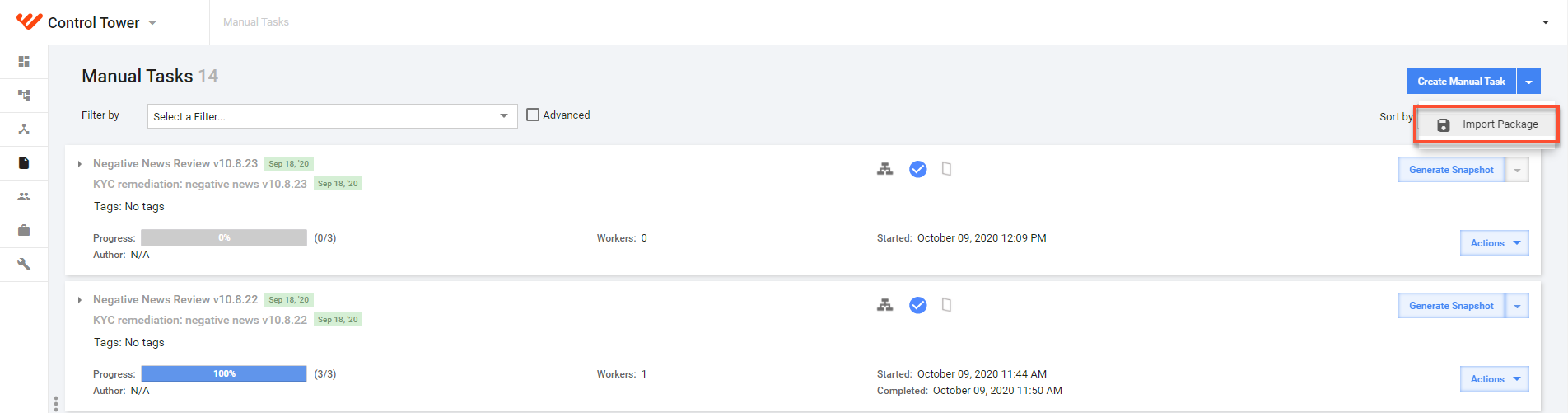
From Manual Tasks > View All, you can also import packages.
Click the Create Manual Task drop-down box and select Import package.
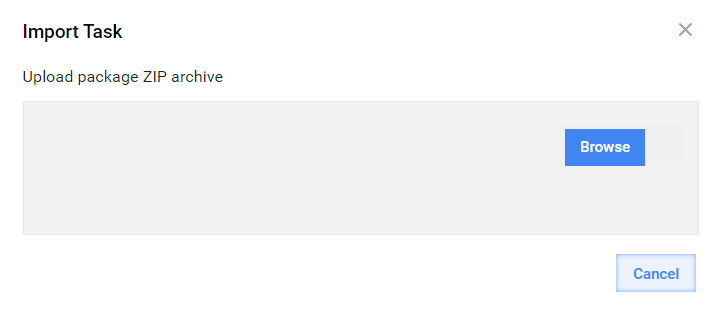
In the window that follows, click Browse and select a package archive.
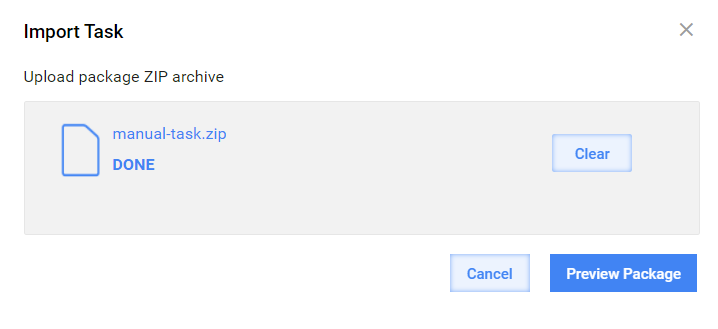
On uploading the file, click Preview Package.
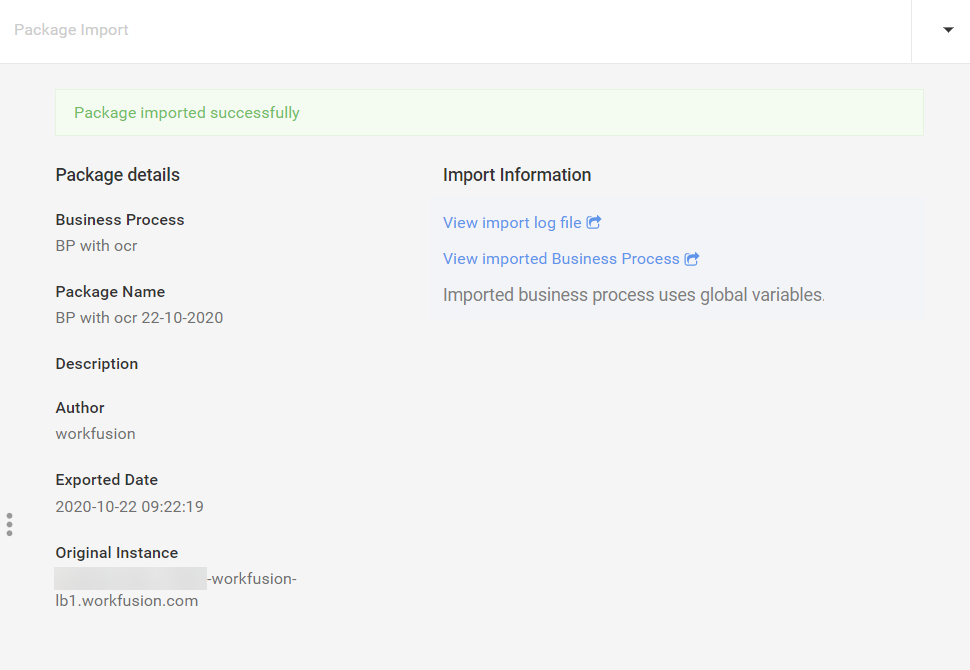
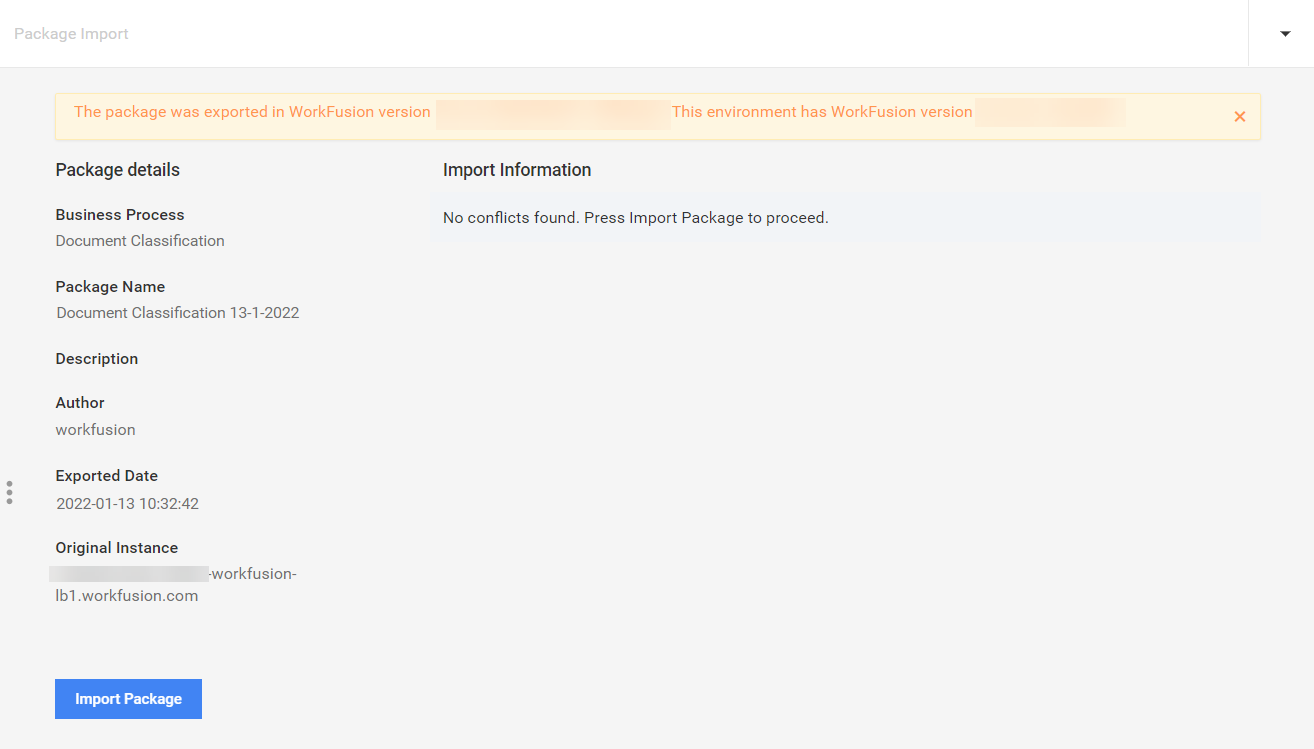
As soon as the check is done, you will see the package details. Click Import Package to finish.
When the import is finished, you see the message that the package is imported successfully. You can view an import log or imported Business Process right from the screen.