Overview
What is Adverse Media Monitoring
Evan AMM (formerly Evelyn AMM) is a pre-built AI Agent focused on automating adverse media monitoring (AMM), or Negative News. Evan's tasks involve searching for and reviewing news about a person or company to determine if conducting business with them would incur a reputational risk or potential involvement with criminal activity. It is vital to the Know Your Customer (KYC) and Anti-Money Laundering (AML) processes for banks and other financial institutions.
Adverse Media Monitoring investigations are essential for uncovering a client's involvement with money laundering, fraud, organized crime, and terrorism. Screening ensures that firms are not unwittingly involved in illegal activity.
Why our customers deal with Adverse Media Monitoring
Regulatory bodies force banks and other financial institutions to run searches on companies, their top executives, and shareholders. Bank regulators demand reliable operation and security control over Adverse Media Monitoring processing. Incompliance incurs heavy financial penalties and often causes long-term reputational damage.
How Adverse Media Monitoring process is handled today
Research on Adverse Media is mostly manual. Hence, this process is time-consuming and costly.
Central banks have dozens to hundreds of analysts who scan news feeds and aggregators. They review thousands of articles to determine risk. Over 95% of articles are removed because they are false positive alerts and are not relevant to the initial search request.
Benefits of Adverse Media Monitoring automation
Automating Adverse Media Monitoring provides the following benefits:
- Screen more significant amounts of information
- Simplify and standardize the screening process
- Reduce non-compliance risk by finding more relevant and complete adverse information
- Reduce documentation time
- Reduce manual efforts (gain of ~70%)
- Achieve real-time monitoring of events
- Provide operational control and security
- Improve employee satisfaction
Implementation of WorkFusion's Adverse Media Monitoring automation provides the following additional transformational benefits:
- Consistent, unbiased decision-making
- Faster response to customer requests
- Rapid scaleup of processing
- Better risk management through faster awareness of adverse news
Adverse Media sources
Sources include:
- Traditional news sources and media
- Social media and Internet forums
- Regulatory filings and databases, for example, SEC and FINRA disciplinary actions
- Blogs and other non-traditional media
- International organization databases, for example, the World Bank's Stolen Asset Recovery Database
Component and feature overview
Business Processes
A Business Process (BP) represents the core workflow and design of any automation within the Work.AI platform. The Adverse Media Monitoring solution includes three BPs:
- Adverse Media Monitoring (Core BP)
- Adverse Media Monitoring Ad hoc Investigation
- Adverse Media Monitoring File Ingestion
- Adverse Media Monitoring Quality Control
In addition to the above BPs, AMM includes a Data Purge one that enables periodic data cleanup based on internal retention policies, either on a set schedule or on demand. For details, read Install and configure | Data Purge.
Core BP
The core BP contains a suffix with the version number, for example, v4.2. The variation version is indicated after the AI Agent version.
The image below demonstrates the core BP at a high level. Additional information for each step is provided below. Within each process, one or more sub-processes can exist.
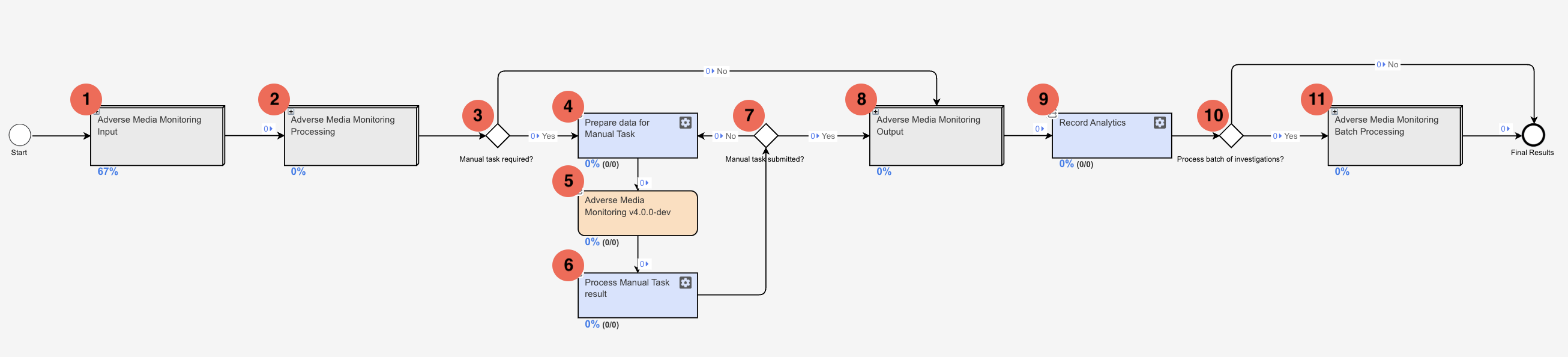
The following numbers correspond to the workflow graphic above.
Adverse Media Monitoring Input. For each search request (for instance, entity name), WorkFusion fetches news articles by calling API from pre-defined news sources, gathering text and metadata (such as title, date, and URL) from the articles.
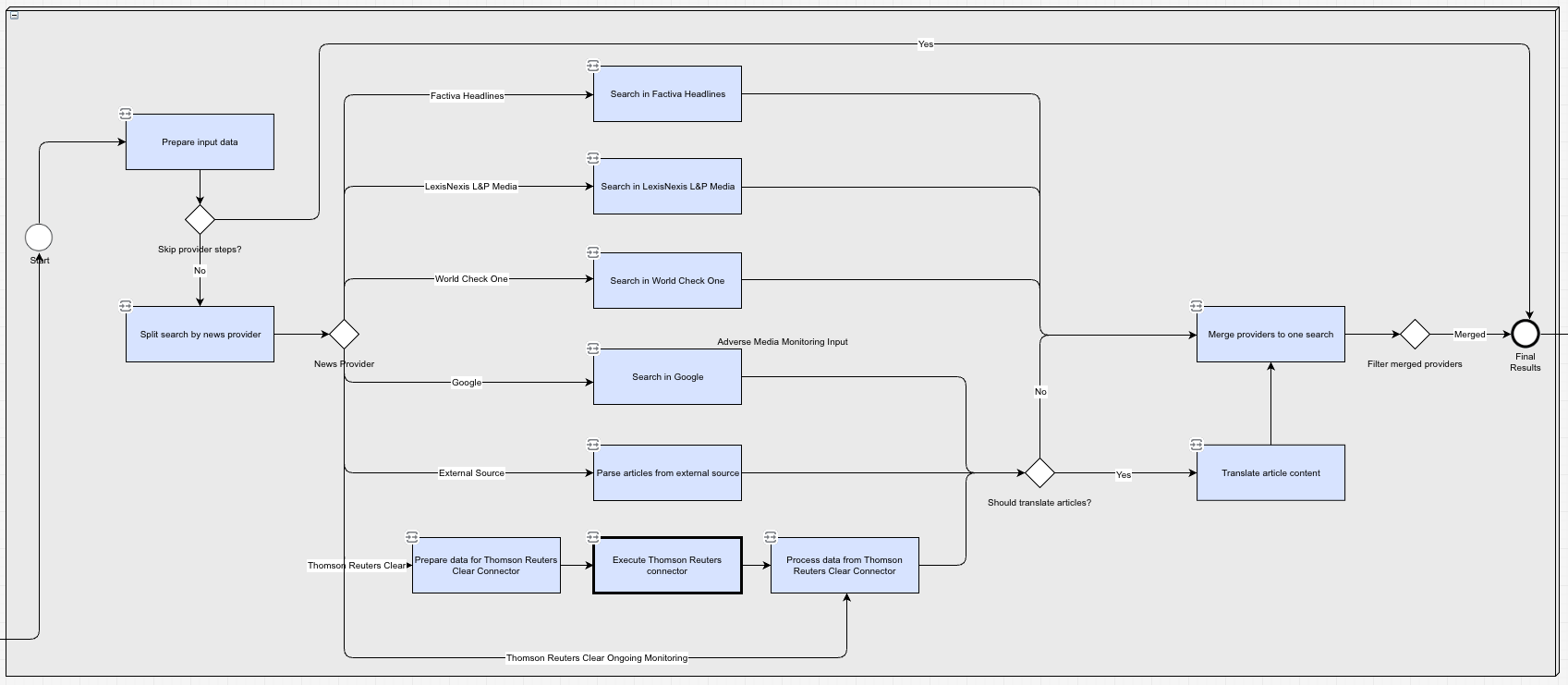
The figure below shows the steps in the sub-process:
Prepare input data parses and validates the input data.
Split search by news provider: if more than one provider is selected, the transaction is split into multiple sub-transactions executed in parallel.
The provider steps run an article search using corresponding external sources. The Parse articles from external source step (included if you choose input data to be sourced from a CSV file) downloads the article content from the links in the CSV file.
The Should translate articles? step checks if article translation is enabled in the settings.
Translate article content: translates the title, summary, and content for articles with unsupported languages using Google Translate API.
The Merge providers to one search step merges the search results from different providers.
The Filter merged providers step completes runs for the merged providers.
If Thomson Reuters ongoing monitoring is enabled in the configuration, the core process also includes the following steps:
- The Prepare data for Thomson Reuters Clear Connector prepares data for the Thomson Reuters connector.
- The Execute Thomson Reuters connector step executes the Thomson Reuters Adverse Media Connector Business Process.
- The Process data from Thomson Reuters Clear Connector processes the connector results.
Adverse Media Monitoring Processing. The unstructured text from each article, including the title, is processed to identify the risk materiality and relevance to the searched entity. The machine learning (ML) approach, architecture, and logic used to conduct this analysis include identifying risk factors, negative keywords, categorizing articles, and additional constraints, such as demographics or other information.
If no results are found for an entity or the Manual Task is disabled, a report is generated.
If results are found for an entity and the Manual Task is enabled, WorkFusion creates a task for users to review the findings in Workspace. You can access Workspace directly through the Workspace application user interface or via an institution's case management or client lifecycle management system. For more details on the review process, see the guide.
The figure below details the steps in the sub-process:
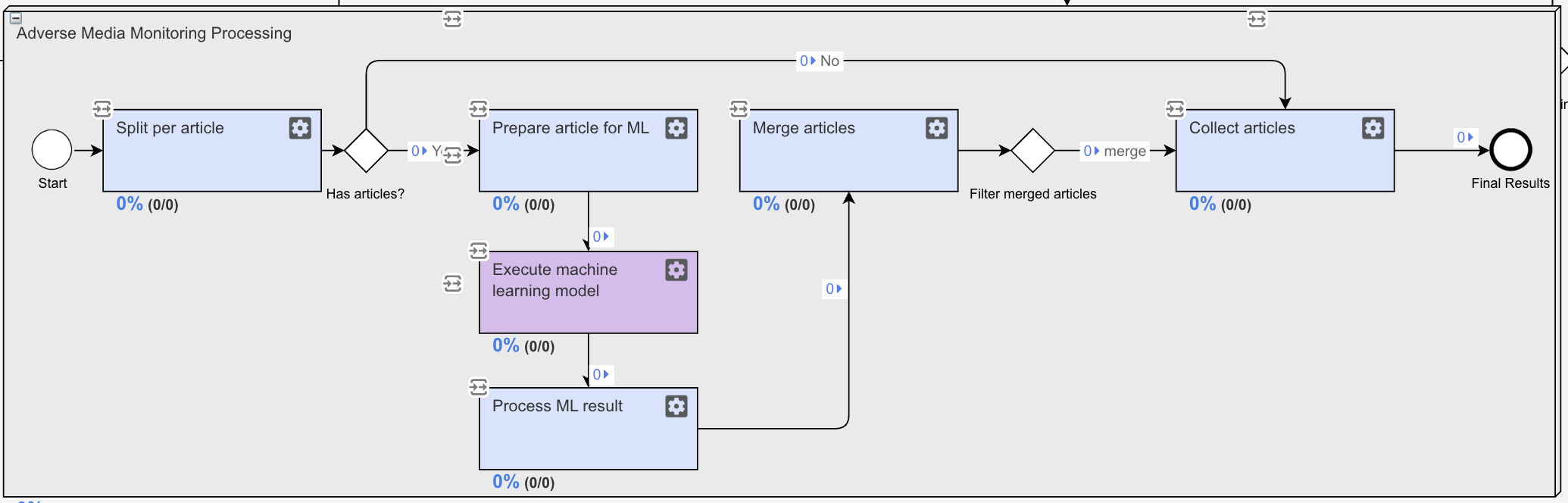
Split per article. The step splits the investigation per article to process all articles in parallel using an ML model.
Has articles? The rule skips the ML processing if no articles are found.
Prepare articles for ML. Articles are prepared to be processed by the ML model. Note that, in some instances, an article can't be processed. Common reasons for this include, but are not limited to, the following:
The article is in a language that is not supported. At the moment, only articles in English or Spanish are supported.
The media provider returned only a link, and the source website was unavailable due to scheduled or unexpected maintenance.
The content is unavailable in HTML, for example, an image of a government's most wanted poster.
The article's content is too small to be processed (under 50 words).
The article's content is too large to be processed and skipped due to a runtime error. The current limitation is 10,000 words.
Execute machine learning model. The machine learning model is executed over additional articles as needed. This and the previous steps are executed iteratively until all articles eligible for model screening have been processed.
Process ML result. Articles are prepared to be processed by the ML model. Depending on the media provider, texts might need to be parsed or reformatted.
Merge articles. All articles are merged back into one investigation.
Filter merged articles. The step completes the runs for the merged articles.
Collect articles. An investigation status for the transaction is set, and the output is grouped based on rules and ML results.
Manual Task required. The model checks to determine if a Manual Task should be created in Workspace. These settings are configured when setting up the AMM variation in Control Tower.
Prepare data for Manual Task. If the Manual Task is enabled, the data from the ML model is prepared to be reviewed in the Workspace interface.
Adverse Media Monitoring vX.X.X. A Manual Task (or investigation) is created for each screened entity in Workspace. For more information about the review process, see the guide.
Process Manual Task result. Once a user saves, skips, or closes an investigation, the results are processed.
Manual Task submitted. Checks to determine if the Manual Task is submitted (or closed) versus if it is saved or skipped. When not submitted, it is returned to the queue for an analyst to complete their investigation review.
Adverse Media Monitoring Output. A detailed audit trail is created in a standardized PDF (narrative report) or HTML format. The report contains the analyst's decisions on article materiality, cited articles, a confidence score for each article, static URL, keyword citations, full article text, and the final decision and adjudication for the investigation. For more information on the output, see the guide.
The figure below details the steps in the sub-process:
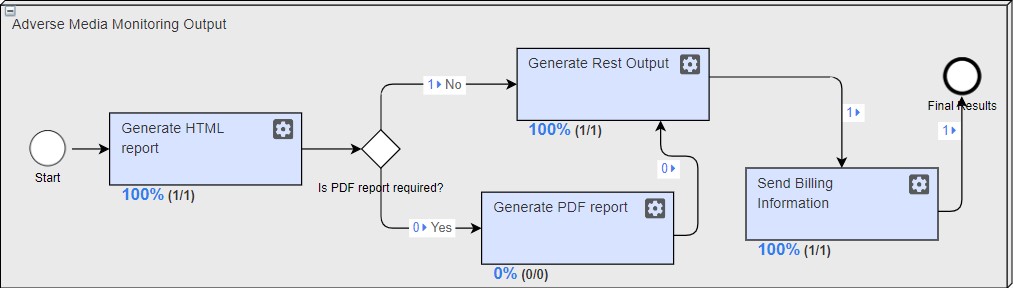
Generate HTML Report. During the step's execution, the results from the investigation are processed, and an HTML version of the report is generated.
If the Manual Task was used, the results also include information the analysts provided during their review.
Is PDF report required? Checks to see if the customer requested a PDF version of the report. This is determined by the parameter set when configuring the AMM variation in Control Tower.
Generate PDF report. Generates a PDF report, if required.
Generate Rest Output. Generates the output for the REST API.
Send Billing Information. Sends billing events to the billing platform.
Record analytics. Audit trail data is prepared for visualization in the WorkFusion Analytics dashboard. For additional information, refer to the guide.
Process batch of transactions. Check whether the execution requires batch processing for combined results generation for each batch. By default, every execution process results in a batch unless it is started via REST API.
Adverse Media Monitoring Batch Processing. In this step, every single transaction is arranged into user-specified batches to be processed together and generate combined result reports, such as a combined report and quality control report for each batch.
The diagram below details the steps within the sub-process:

Merge all investigations. Arranges each investigation into the specified batch. Each batch could contain one or more investigations.
Filter merged investigations. Filters every investigation, allowing only the batch of investigations to proceed.
Generate combined report. Generates a combined results report for each batch of investigations.
Generate quality control report. Generates a combined quality control report for each batch of investigations.
Split per investigation. Splits all investigations inside a batch into their own individual investigations.
Adverse Media Monitoring Ad Hoc Investigation
The Ad Hoc Investigation BP allows you to create an ad hoc search screen in Workspace for analysts to initiate investigations as needed.
The figure below demonstrates the Ad Hoc Investigation BP at a high level. Additional information for each step is provided below.

The numbers below correspond to the workflow above:
Split Ad hoc investigation tasks is triggered when a user starts the Ad hoc investigation BP. The Ad hoc investigation tasks are split based on whether or not the Human in the Loop feature is enabled in the configuration for the associated variation.
AMM Ad hoc investigation initialization creates an ad-hoc search screen in Workspace for analysts to use.
Submit Adverse Media Monitoring Investigation Request. Once an analyst submits a search request, WorkFusion fetches news articles by calling API from pre-defined news sources, gathering text and metadata (URL, title, date) from the articles.
Start main AMM BP. During the step's execution, the core BP is run.
Return record to the queue returns the ad-hoc search screen to the queue.
Wait for Manual Task Review. The step is used only if Human in the Loop is enabled. During the step's execution, individual investigations are submitted and marked as complete.
Wait for main AMM BP completion. The BP continues until it is stopped in Control Tower. This allows analysts in Workspace to run as many investigations as needed on an ad-hoc basis as long as the BP is running.
Adverse Media Monitoring File Ingestion
This BP looks for new CSV files in the configured S3 directory every minute and initiates a new investigation if a new file appears.
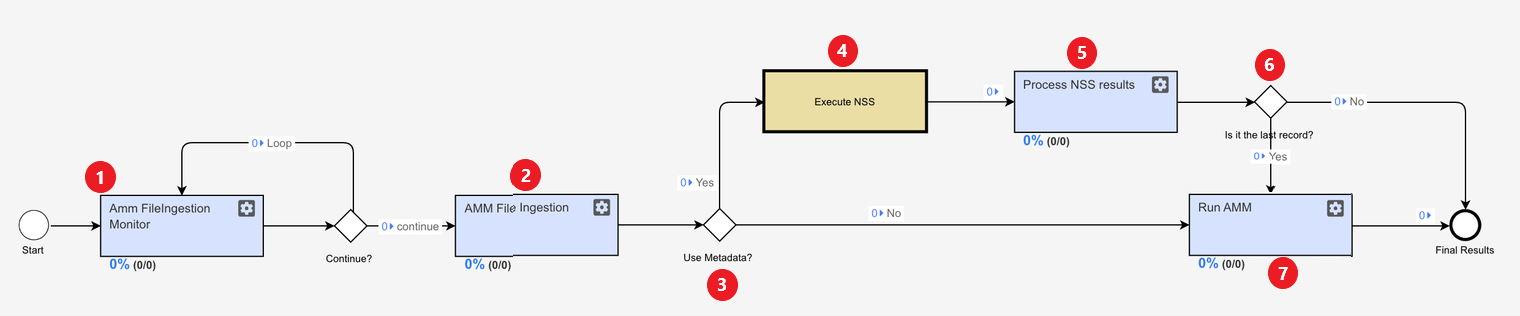
The numbers below correspond to the workflow above:
Amm File Ingestion Monitor. Monitors the S3 folder for a new file to start the BP according to the settings in the UI configuration.
AMM File Ingestion. The CSV file from S3 is parsed, and the input data is prepared for an NSS or AMM run.
Use Metadata? This is the rule based on the Do you want to use available meta data to adjudicate articles first? setting in the UI configuration. If the setting is Yes, the NSS BP is executed first.
Execute NSS. Synchronously executes the NSS Business Process.
Process NSS results. Processes the results from NSS.
Is it the last record? This is the rule that checks if it is the last transaction from the NSS response. If set to No, it ignores the result.
Run AMM. Asynchronously starts the core AMM BP.
Adverse Media Monitoring Quality Control
This is the quality control BP. It contains a suffix with the version number, for example, v4.2. The variation identification number is listed after the product version.
The diagram below illustrates a high-level workflow of the Quality Control (QC) BP.
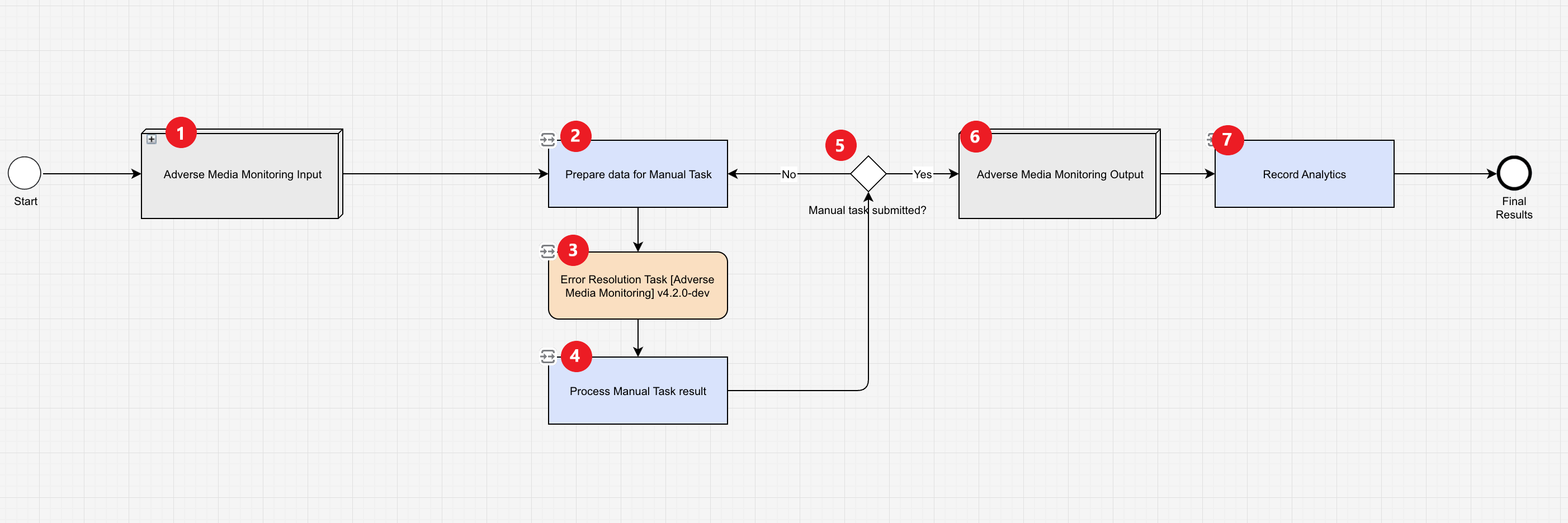
Adverse Media Monitoring Quality Control Input. For each provided investigation UUID, WorkFusion fetches information about the last run and prepares the same request for AMM. The diagram below displays the steps within the sub-process. If multiple providers are configured, the search request is split into distinct requests for each provider.
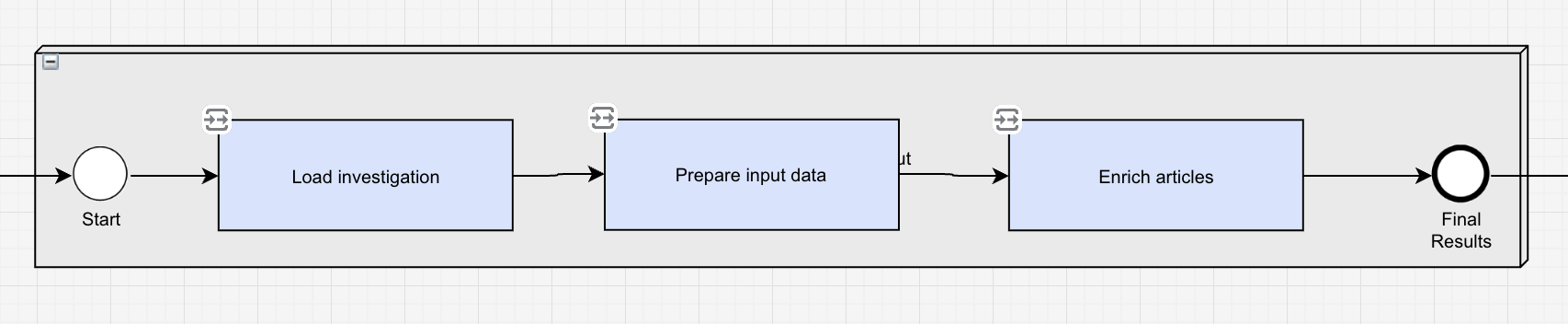
Load previous investigation: loads the last investigation for the provided investigation UUID. If no previous investigations are found, the step loads the original investigation. Then, the found investigation is used to re-create the original request for AMM.
Prepare input data: parses and validates the input data.
Enrich articles: enriches articles with metadata from the previous investigation.
Prepare data for Manual Task. If the Manual Task is enabled, the data from the ML model is prepared to be reviewed in the Workspace UI.
Error Resolution Task (Adverse Media Monitoring) vX.X.X. A Manual Task (also called an investigation) is created for each screened entity in Workspace.
Process Manual Task result. Once a user saves, skips, or closes an investigation, the results are processed.
Manual Task submitted? The step checks whether a Manual Task is submitted (closed), or saved, or skipped. If the Manual Task is not submitted, it is returned to the queue for an analyst to complete their review of the investigation.
Adverse Media Monitoring Output: A detailed audit trail is created as either a standardized PDF (such as a narrative report) or HTML format. The report contains the analyst decisions on article materiality, cited articles, a confidence score for each article, static URL, keyword citations, full article text, as well as the final decision and adjudication for the investigation.
The diagram below details the steps within the sub-process:
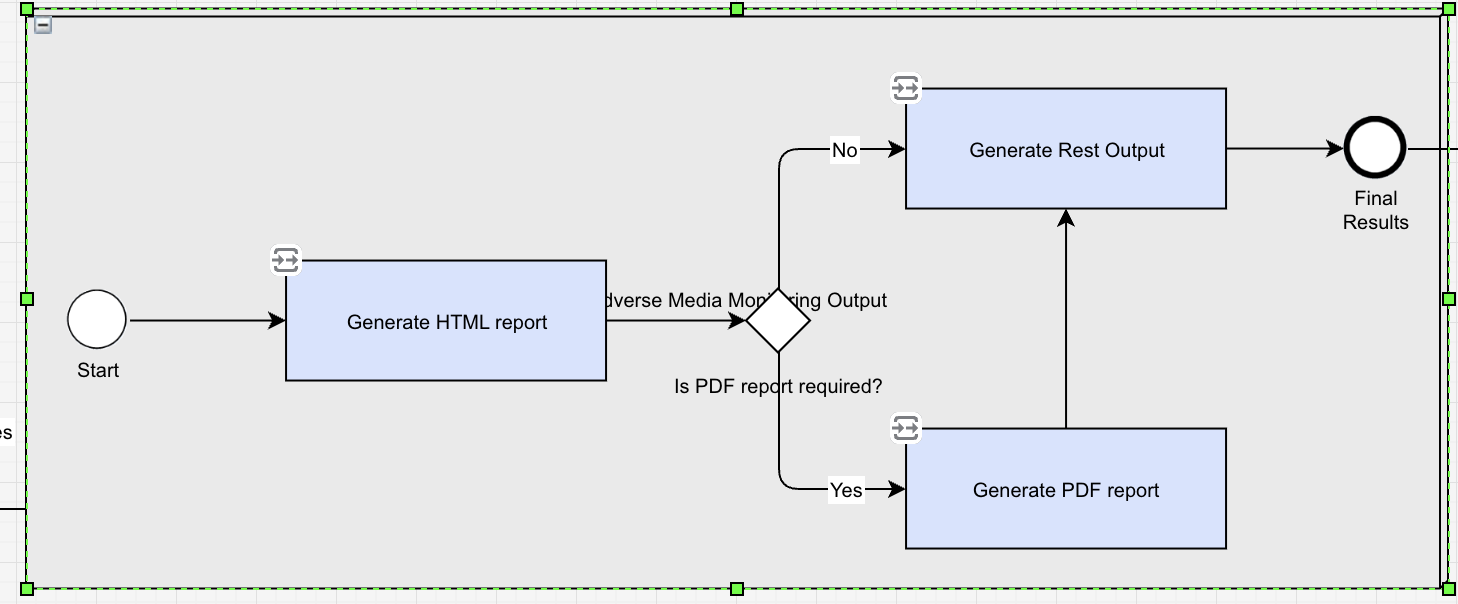
Generate HTML Report. The results from the investigation are processed, and an HTML version of the report is generated as the step is executed.
If a Manual Task is used, the results also include information provided by the analyst during their review.
Is PDF report required? The step checks whether a PDF version of the report is requested. This is determined by the parameter that was set when configuring the AMM variation in the Control Tower.
Generate PDF report. The step generates a PDF report, if required.
Generate Rest Output. The step generates the output for the REST API.
Record analytics. Audit trail data is prepared for visualization in the AMM dashboard.
Third-party data provider connectors
Evan AMM can connect to various data providers via API. Out of the box (OOTB), the following connectors are supported:
- Google Search (Google API)
- Factiva Dow Jones Web Services 2 API
- Refinitiv World-Check One
- LexisNexis World Compliance and L&P Media
- Thomson Reuters CLEAR Adverse Media
Content parser
For the OOTB data providers, like Google API and Thomson Reuters, and for articles from an external source, the content parser does the following:
- Extracts relevant article content
- Removes extraneous information, for instance, advertisements
- Formats the content to provide readability
Article classification ensemble model
The default model leverages thousands of labeled articles confirmed by compliance experts to assess material risk events. The model integrates multiple sub-models, including:
- Sentiment Analysis
- Named Entity Recognition
- Name Matcher
- Focality Analysis
- Age Matcher
- LLM processor
Supported languages
The system natively supports English and Spanish articles. Non-supported languages are flagged for manual review, ensuring visibility in reports and tasks.
For Google, Thomson Reuters, and External Source providers, you can enable the translation feature based on Google Translate API, allowing you to work with languages other than the supported English and Spanish. For details, read Install and configure | Translation settings.
Customizable features
Keyword library includes about 520 pre-tagged keywords for risk prioritization. You can change the set of keywords used for article search during the AI Agent's configuration in the Control Tower interface.
High-risk country identification allows you to define high-risk countries for the model to prioritize based on article context. You can specify such countries during the AI Agent's configuration in the Control Tower interface.
Manual review interface and reporting
Workspace provides a graphical user interface for displaying screening results, including article text and reconciliation tools. For details on the application, read Get started with Workspace.
The Audit trail creation feature generates standardized HTML or PDF audit trails documenting analyst decisions, article materiality, and other key metrics. For details, read the View report topic.
The Feedback feature, available in Workspace, allows reviewers to add their feedback on the relevancy of the article content and update Evan's website ignore list. For details, read Review search results in Workspace
Analytics dashboards provide real-time insights into automation performance, accuracy, improvement opportunities, and troubleshooting. For details, read the Analyze results article.
Decision reapplication
The decision reapplication mechanism allows you to reuse previously made article review decisions across multiple investigations of the same entity. For details, read Explore decision reapplication.
Download PDF
To download a PDF version of the documentation, right-click the document below and choose Save As or Print > Save.