Review deferral requests
The deferral request review is the part of Isaac's flow where analysts collaborate with Isaac by handling exceptions manually in the Workspace application. Isaac creates manual review tasks as part of the Transaction Monitoring Alert Investigation flow, provided you enabled it during configuration on the Human-in-the-loop step. One task is created per case or entity.
As you configure the Human-in-the-loop step for Isaac, you can pre-assign the tasks coming from a specific variation to a specific user and set the AI Agent to notify the assignee and other stakeholders when the deferral request is ready for review in Workspace.
You can enable or disable the Human-in-the-loop step per variation. If the step is disabled, a batch summary report is created instead of a manual review task and sent to the specified email (if any). For more information, read the Review output topic.
To review a deferral request, do as follows:
- Locate the manual review task generated by Isaac in the Workspace assignment list.
- Review the alerts in the deferral investigation and change their statuses and comments if needed.
- Complete the investigation.
Locate assignment
Once the Transaction Monitoring Alert Investigation Business Process creates a manual review task, it becomes available as an assignment in the Workspace application.
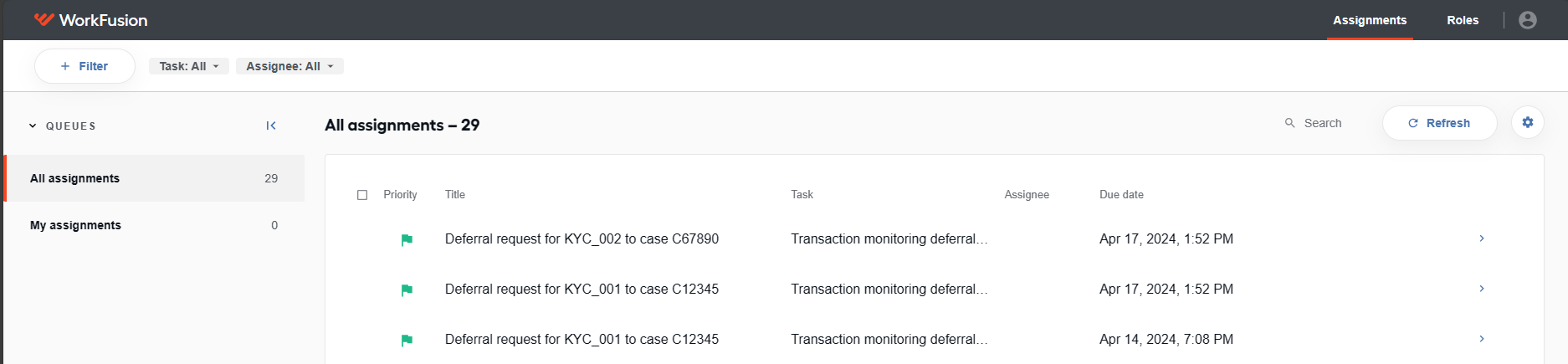
For easier management and prioritization, add assignments to a custom queue as described in the guide.
To ensure manual review tasks reach the right team member promptly, manual review tasks can be pre-assigned to a specific user during configuration. If there is no pre-assignment, you can assign tasks to a specific user in Workspace according to the guide.
Review deferral request
To open an assignment, click it in the list. As it opens, you see a deferral request with a structure similar to the one shown below. Your task is to review the alerts and update the statuses and comments as needed. You can also choose to skip the assignment by clicking the appropriate button in the top right corner.
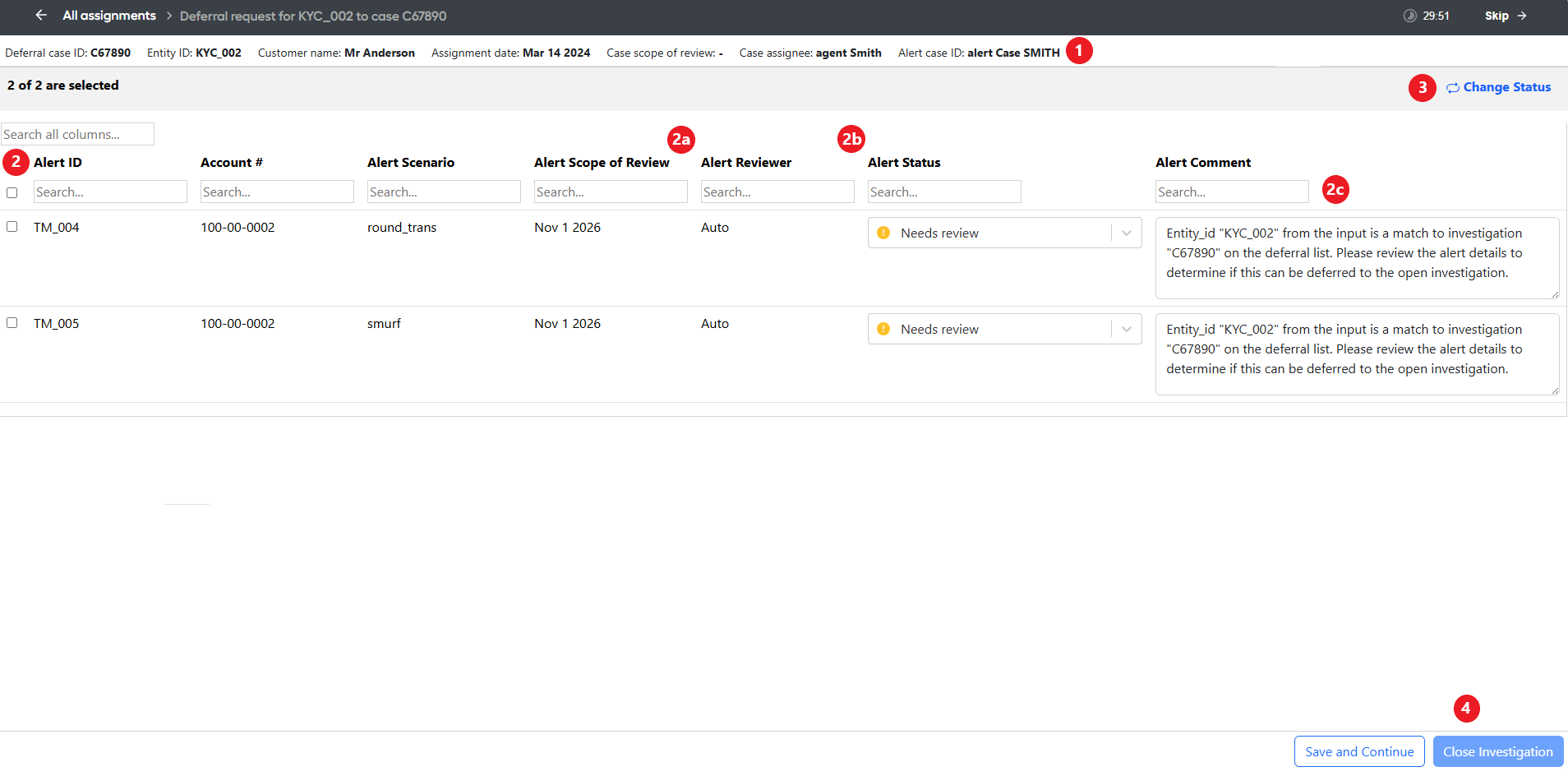
The following numbers correspond to those in the image above:
Header information: contains information about the open case for a specific entity or customer.
Alert information: contains information about the alerts in the deferral request.
a. Reviewer: the last user who edited the status or comment. The default reviewer is Auto, which means Isaac was the last to review the alert.
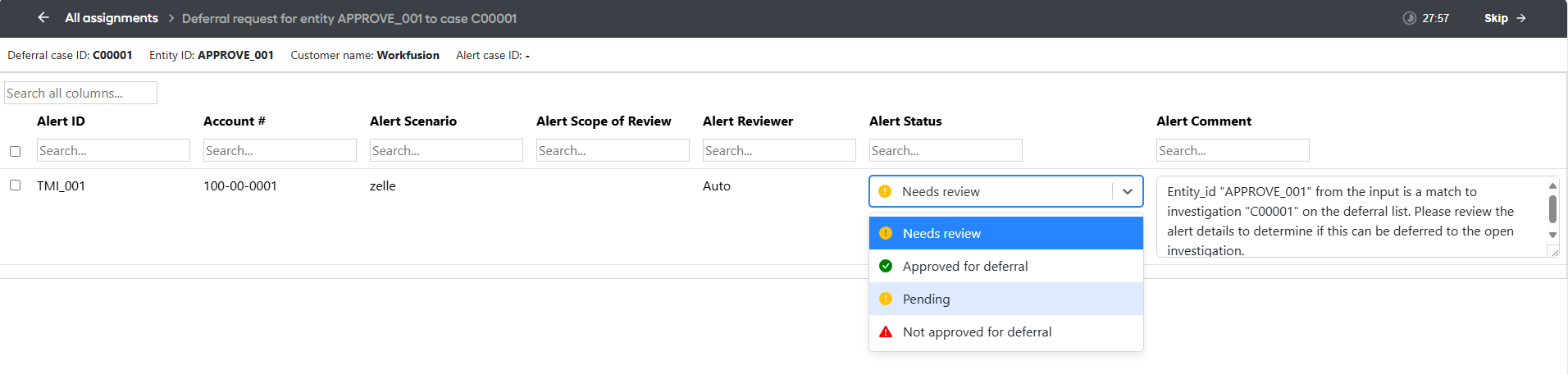
b. Status: defines the current status of alerts in the deferral request.
- Needs review: assigned to each alert by default.
- Approved for deferral: use to indicate the alert is eligible to be deferred to an open investigation.
- Not approved for deferral: use to indicate the alert is not eligible to be deferred to an open investigation.
- Pending: use to approve an alert conditionally based on the outcome of another investigation.
c. Comment: an editable comment for the alert.
Bulk change: allows users to update more than one alert at a time with the same status and decision comment.
Close Investigation: closes the investigation and completes the task. Upon clicking the button, users can select a status for the entire investigation and enter a comment.
Close investigation
Once you finish your review, you can click Close Investigation to complete the task. You are then prompted with a dialogue box to confirm the email address you want to use to receive the final alert summary report.
After the confirmation, you are either redirected back to the assignment list in the queue or, if the appropriate setting is enabled during configuration, to the next assignment in your queue.
The Close Investigation button is disabled if alert review is not completed.
Upon completion of the assignment, the final decision is saved to a dedicated Data Store. Additionally, as you configure Isaac, you can set it to generate a final alert summary report and email it to the specified address once the entire batch is completed.
If, prior to generating the report, you wish to escalate the review so that comments from another analyst can be included, click Save and Continue. Then, your progress is saved, and the task can be reassigned to another user in Workspace.