Data Analyst job
To understand a Data Analyst's expected contribution to a successful project delivery, let's first outline the context of a cognitive automation implementation.
We will overview the project delivery from the perspective of an entire team. It is a joint effort to implement an ML use case, so effective collaboration while understanding one's own contribution is part of the Data Analyst job.
Problem statement
Operations businesses in many industries (banking, insurance, financial services, manufacturing, healthcare) have a process of handling documents or information. This consists of many manual steps that, all together, build a workflow. A business goal is to reduce manual work and make processes more cost-effective.
Thus, a manual workflow is transformed into a Business Process when automation is set up. Manual steps in the workflow are replaced by Bot Tasks and Model steps. The transformation of manual workflows into Business Processes is completed for each automation solution to mimic all specific details, branches of logic, and amounts of data to be processed.
Documents in the workflow have to be processed in a certain way, defined by the solution requirements. Usually, data from the documents has to be taken out and then handled in specific workflow steps. For example, purchase order details (quantity, product, price) have to be entered into internal applications like SAP, CRM systems, and so on. When there are many document types, they can be processed in different ways. For example, data from purchase orders has to be entered into SAP, and data from invoices has to be sent by email in a table format. So, to best handle documents in this case, it's necessary to detect the document type first.
Solution lifecycle
To understand the ML Data Analyst's contribution to a successful project delivery, we need to first understand and properly start practicing project process. With the phases described below, the process has been proven to work and practiced by the WorkFusion proof of concept (PoC) while delivering complex implementations combining the RPA anc machine learning (ML) technologies.
On a high level, each solution comprises five main phases. Each phase has its requirements, steps, and roles involved. The Data Analyst contributes during the implementation phase.

Seven stages of implementation phase
Let's logically structure a typical automation solution implementation in stages defined by specific people doing specific work and handing off results to the next person:
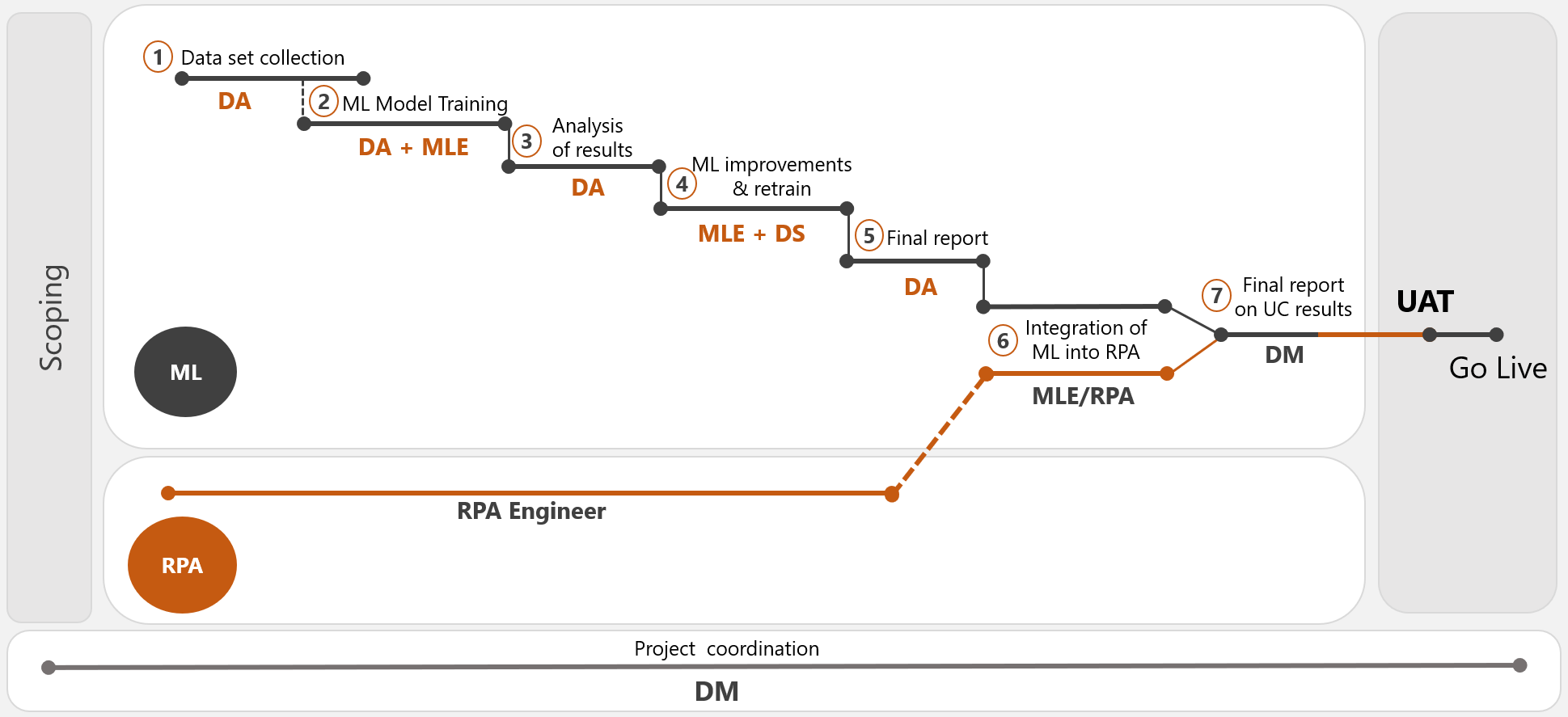
Each implementation consists of the ML and RPA parts. RPA deals with well-structured and repeatable processes and allows for designing automations that replace Manual Tasks. ML development delivers a model that handles unstructured or semi-structured data in the documents. The model is trained on a dataset collected from original documents. A high-quality dataset is the Data Analyst's main responsibility. The better the quality of a dataset is, the higher results of ML.
Implementation can be delivered as a PoC, Pilot, or Production, depending on the scope of the automation solution.
In dataset collection, the Data Analyst studies business logic and applicable documents, and defines the rules and corner cases. The Data Analyst works closely with the Subject Matter Experts (SMEs) from the customer or partner side on the dataset collection step. They have a deep understanding of the document logic and label the dataset for model training. The Data Analyst trains SMEs to label the documents and verifies labeling.
The Machine Learning Engineer or Automation Engineer Specialist leads model training, and the Data Analyst analyzes ML results and defines the rules that help to improve the model. ML results are evaluated by comparing the results provided by people (manual extraction or classification that is considered to be correct) and calculating quality metrics statistics. The Data Analyst calculates interim and final statistics and submits these to the customer in the form of a report.
At the analysis of results stage, the Data Analyst needs to review the model execution results and, if necessary, propose ways to improve. The model is trained on the training set for each training iteration. If there are several iterations, the Data Analyst calculates statistics of each iteration based on evaluation results. The Data Analyst needs to calculate statistics for each iteration and analyzes the delta for labeling iterations and model mistakes.
ML improvements and retraining is handled by the Machine Learning Engineer or Machine Learning Engineer + Data Scientist. This is the most complex stage as it includes creation of custom model components.
The (first) final report of automation results has to be shared with the customer, together with any reasons why some stats on some fields may fall below the success criteria. Moreover, further steps and solutions should be proposed.
In the integration of ML results into RPA stage, structured data from machine learning is entered into the organization's internal systems. Typically, RPA is used for that because corporate applications lack API support, and the only way is to have bots simulate user interactions with user interfaces.
During the final report, analytics helps DAs and business users to see and understand outcomes of automation in production. This may include aggregated numbers showing savings, amount of work done, SLAs, average ML measures, and so on.