Implement Analytics for AI Agents
For AI Agent or (AI Digital Worker) implementation, ODF 2 employs a standardized extendable Data Model. The model features a list of tables with dynamically defined names and specified naming conventions, enabling ETL (extract, transform, load) procedures to manage data properly. All pre-defined columns in these tables are set to be processed by WorkFusion Analytics automatically.
Advantages of new Data Model
The standardized Data Model allows for the following:
Optimizing data flows by moving predefined and well-structured data views to the WorkFusion's Analytics data warehouse.
The source data is stored in the ds schema and serves as an operational layer for process execution. The Analytics flow and pre-built ETL procedures move processed data to a separate warehouse. Thus, data access patterns are isolated, with the reporting and Analytics read access moved to a separate storage. This minimizes impact and dependencies for actual process executions, enabling simultaneous data read and insert operations.
Delivering unified and reusable Analytics to cover multiple AI Digital Workers.
Utilizing AI Digital Worker-specific data for building custom Analytics dashboards based on out-of-the-box capabilities.
The Data Store tables defined within the standardized model already include core fields required for the most common analytical needs. However, you can extend the set of core fields using the _bi custom attribute in the following format: [attribute name]_bi.
Subsequently, the ETL engine processes and moves automatically the custom _bi columns to Analytics. This simplifies further customization and allows one to bring in AI Digital Worker-specific data and attributes.
Developers are not limited to the list of tables defined under the standardized extendable Data Model. However, any additional table created cannot be automatically processed by ETL for Analytics purposes and further usage in BI tools.
ETL extension
The ETL extension to cover the standardized Data Model works as shown below:
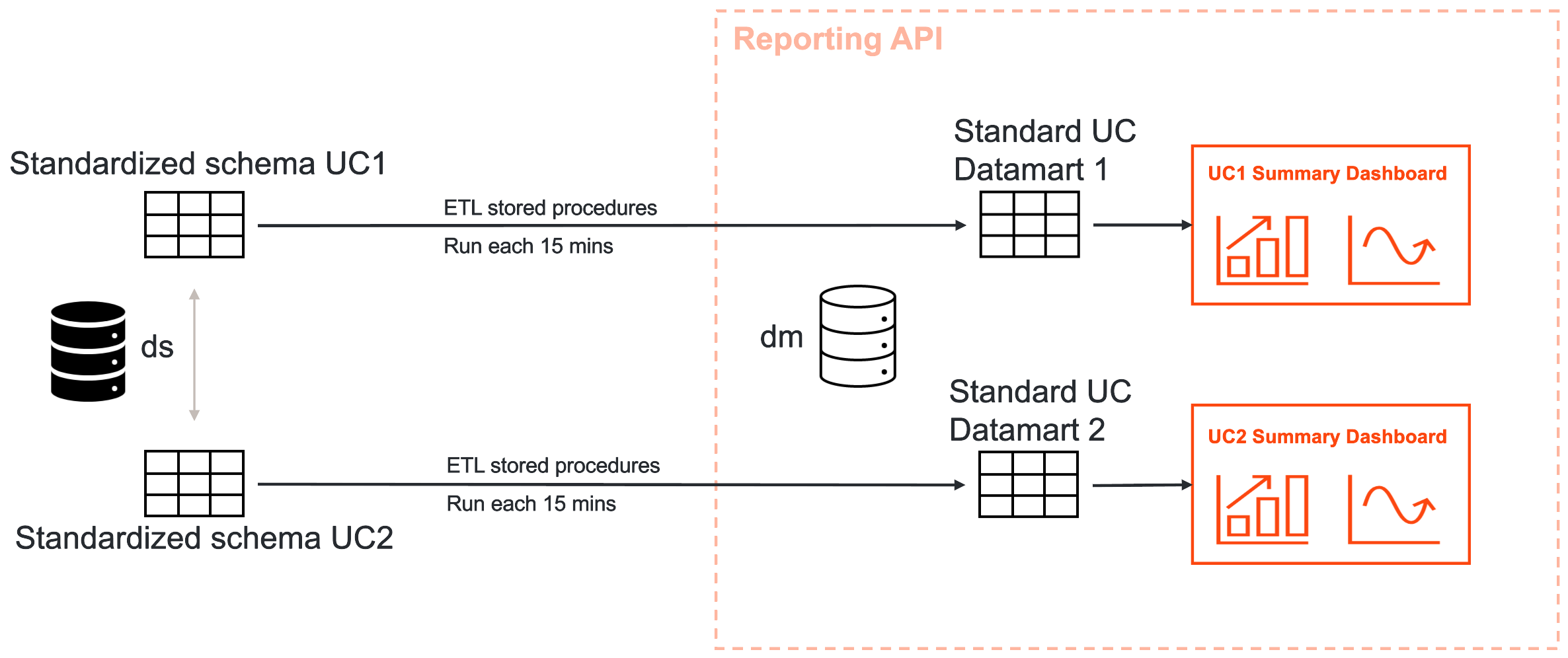
The detailed working flow is as follows:
Created and existing Data Stores are verified per AI Digital Worker according to the defined naming conventions.
Table structures are verified to contain all required fields in accordance with default extendable Data Model structures. Simultaneously, the existence of any additional _bi columns is checked.
ETL jobs process the content, obtaining data deltas by schedule from source Data Stores and move it to Analytics data tables under the dm schema following the same naming patterns as adopted for source tables.
A default ETL schedule is set up to run each 15 minutes.
As the data is transferred and available via dm tables, it is possible to clean up sources.