
Integrate LDAP and AD
Overview
Lightweight Directory Access Protocol (LDAP) is an open, vendor-neutral, industry standard application protocol for accessing and maintaining distributed directory information services over an IP network. Directory services play an important role in developing intranet and Internet applications by allowing the sharing of information about users, systems, networks, services, and applications throughout the network. As examples, directory services may provide any organized set of records, often with a hierarchical structure, such as a corporate email directory. Similarly, a telephone directory is a list of subscribers with an address and a phone number.
Active Directory (AD) is a directory service that Microsoft developed for Windows domain networks. It is included in most Windows Server operating systems as a set of processes and services. Initially, Active Directory was only in charge of centralized domain management. Starting with Windows Server 2008, however, Active Directory became an umbrella title for a broad range of directory-based identity-related services.
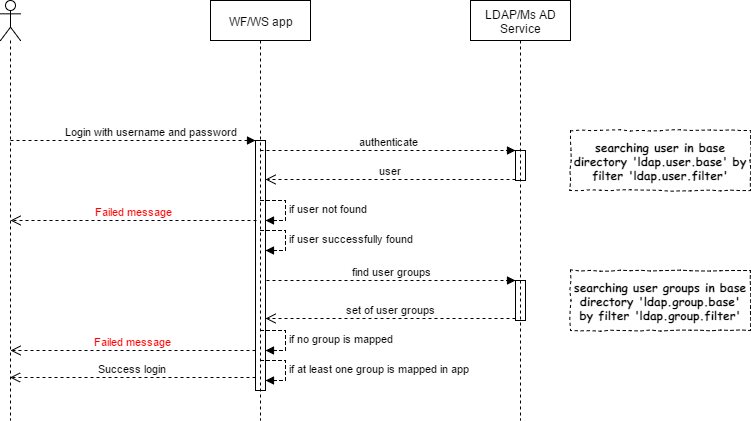
WorkFusion Control Tower and WorkSpace can provide security (authentication and authorization) through LDAP / AD integration. Authentication is based on Spring Security standard provider.
important
The domain users must mandatorily have an email to use the LDAP authentication.
Control Tower Configuration
By default, Control Tower provides local user/groups/role management. LDAP / AD integration can be enabled by setting the following parameters in:
INSTALL_DIR/workfusion/conf/workfusion.properties:
# ldap properties
ldap.enabled=true
# to activate LDAP with WF roles switch this property to true. No groups from LDAP will be used.
#Properties ldap.group.base and ldap.group.filter will be ignored
ldap.internal.authorization.enabled=false

# container of corporate user database used for authentication
# support several base directories pipe separated <baseDN1>|<baseDN2>|...
ldap.user.base=ou=People,dc=somecompanydomain,dc=com

# container of corporate user groups used for authorization
# support several base directories pipe separated <baseDN1>|<baseDN2>|...
ldap.group.base=ou=Groups,dc=somecompanydomain,dc=com

# user filter for search, optional, alternative = (uid={0})
ldap.user.filter=(sAMAccountName={0})

# group filter for search, optional, alternative = (memberUid={1})
ldap.group.filter=(member={0})


# page size to load big amount of records to avoid size limit error
ldap.search.page.size=500
# group filter for list of all group names
ldap.search.all.groups.filter=(|(objectClass=group)(objectClass=groupOfNames)(objectClass=groupOfUniqueNames)(objectclass=posixGroup))
# ldap object attribute name that contains group name
ldap.search.groups.name.attribute=cn
Default configuration:
# ldap properties
ldap.enabled=false
ldap.internal.authorization.enabled=false
ldap.user.filter=(sAMAccountName={0})
ldap.group.filter=(member={0})
ldap.search.page.size=500
ldap.search.all.groups.filter=(|(objectClass=group)(objectClass=groupOfNames)(objectClass=groupOfUniqueNames)(objectclass=posixGroup))
ldap.search.groups.name.attribute=cn
Secure properties:
# ldap server url
ldap.server.url=ldaps://{host}:{port}

# system user cridentials
ldap.bind.dn=<User distinguished name>
ldap.bind.password=<User password>
External authorization
Before enabling LDAP, at least one group must be mapped.
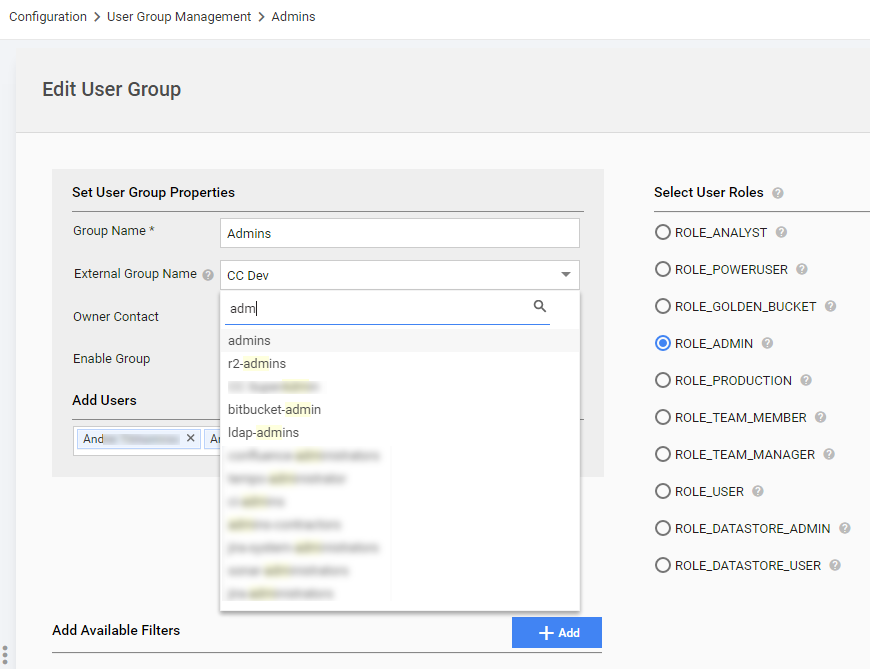
User groups are mapped in Control Tower during create/edit a User Group (default user roles you can find in Role Management):
After successful login, a user will be created/updated with data fetched from LDAP / AD.
The user properties cannot be changed in Control Tower, if LDAP configuration is enabled, only available filters can be added. The direct role selection is unavailable too.
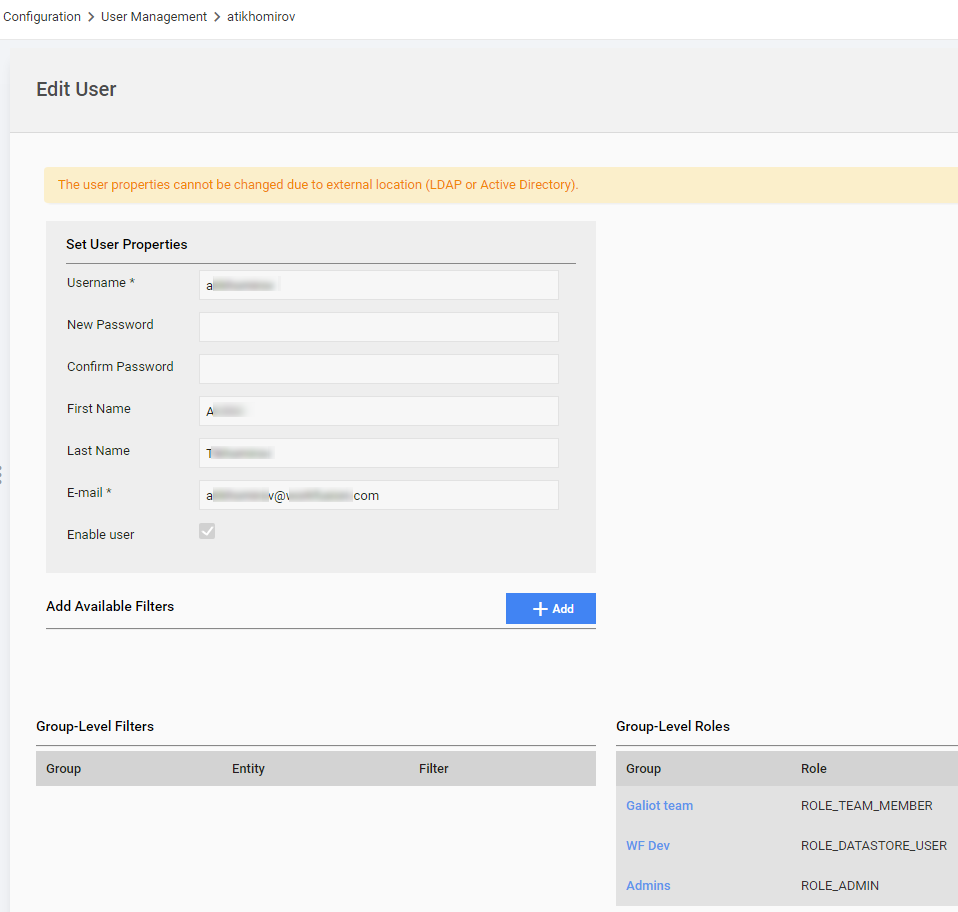
If LDAP is enabled,
- A user cannot be created, deleted, or disabled in Control Tower. The Create, Delete, and Disable buttons are unavailable.
- Sections System Preferences → User Settings: Account Details, and Change Password are disabled too.
Internal authorization
To enable internal authorization, set property ldap.internal.authorization.enabled to true.
Common assumptions:
- If LDAP authentication is passed successfully, a user is checked for existence in Control Tower, and Control Tower Roles are applied to the user, if such user exists. Otherwise, unable to login.
- User Properties cannot be changed in Control Tower, if LDAP Internal configuration is enabled. You can only edit roles and enable/disable the user.
- User can be created, deleted, and disabled in Control Tower. The Create, Delete, and Disable buttons on the User Management page are available, if LDAP with internal authorization is enabled.
- The System Preferences → User Settings: Account Details, and Change Password sections are disabled too.
- The following properties are not used, if LDAP with internal authorization is enabled:
ldap.group.baseldap.group.filt
Integrate LDAP / AD
This is an example to give an overview of LDAP / AD integration.
You must have
distinqueshedNameandpasswordof the "system user" to initialize the connection properties. It can be any user with privileges to read the directory tree and the object attributes.ldap.bind.dn=CN=System User,OU=demo,DC=somecompany,DC=local ldap.bind.password=********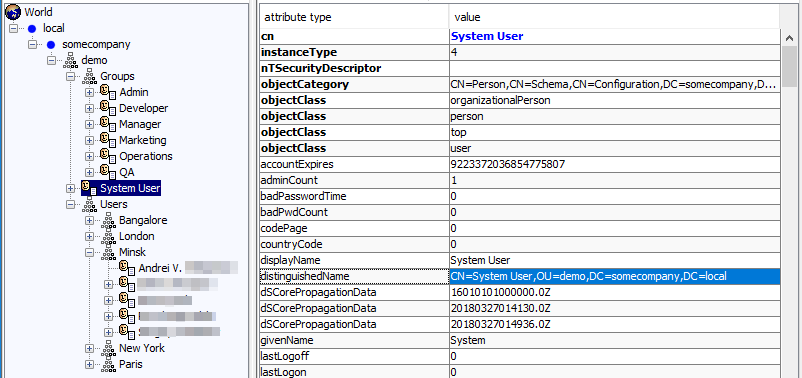
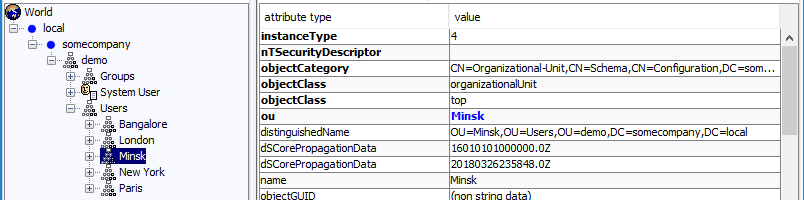
Configure the base directories for users and groups.
ldap.group.base=OU=Groups,OU=demo,DC=somecompany,DC=local
ldap.user.base=OU=Minsk,OU=Users,OU=demo,DC=somecompany,DC=local
It supports multi values with pipe separator for users and groups.
ldap.user.base=OU=Minsk,OU=Users,OU=demo,DC=somecompany,DC=local|OU=New York,OU=Users,OU=demo,DC=somecompany,DC=localWhen the base directories are configured properly, it can help reducing time for searching users and/or groups. ldap.group.base is a base directory for loading user's groups during login and a list of groups for "External Group Name" mapping on the Edit User Group page.

Configure user filter.
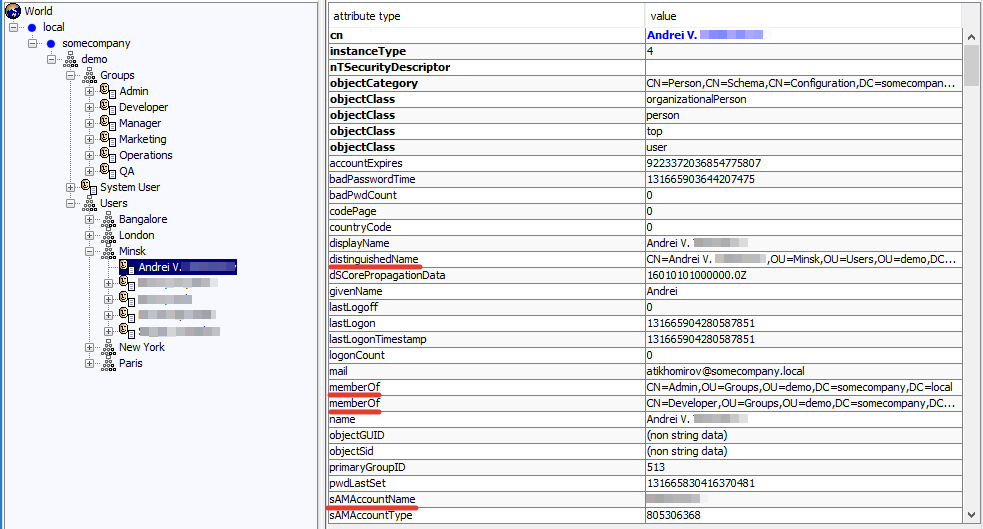
Usually, a username attribute for Microsoft Active Directory is
sAMAccountName. In this caseldap.user.filter=(sAMAccountName={0}).For example, if we are going to use the email for login, so the filter looks as
ldap.user.filter=(mail={0}). Keep in mind, that a user filter must return a unique result, otherwise it is configured incorrectly.Configure a user groups filter.
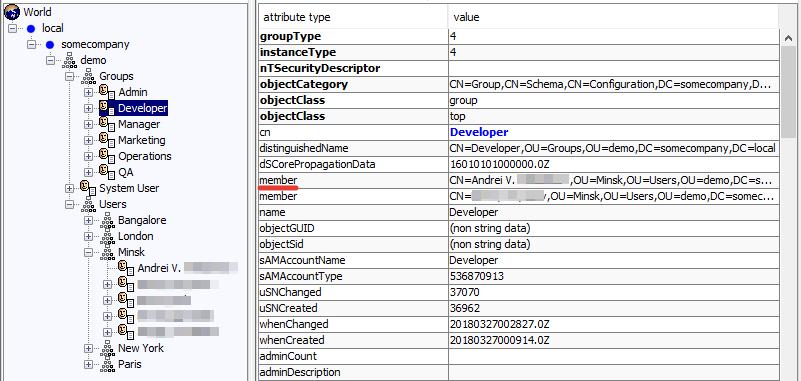
ldap.group.filter=(member={0}). In this case the{0}parameter isdistinqueshedNameof the logging in user.For example, an alternative filter
ldap.group.filter=(memberUid={1}), In this case the{1}parameter isusernameof the logging in user.Configure the filter to fetch all group names. For that in Control Tower → Create/Edit User Group page, fill External Group Name.
ldap.search.all.groups.filter=(objectClass=groupOfNames)ldap.search.groups.name.attribute=cn
WorkSpace configuration
By default, WorkSpace provides local user/role management. LDAP / AD integration can be enabled by setting the following parameters:
In INSTALL_DIR/workspace/conf/workspace.properties or workspace-sandbox.properties:
# ldap properties
ldap.enabled=true

# activate internal authorization if swithed to true with ldap.enabled
ldap.internal.authorization.enabled=false

# Comma separated group names from LDAP for mapping to worker users
ldap.worker.groups=CC Dev,Galiot,CC Ops

# Comma separated group of roles from LDAP which are mapped to the WorkSpace Requester role
ldap.requester.groups=CC Admin

# Name of license that is set to requester if new requester is created
ldap.requester.license=license_name

# container of corporate user database used for authentication
# support several base directories pipe separated <baseDN1>|<baseDN2>|...
ldap.user.base=ou=People,dc=crowdcomputingsystems,dc=com

# container of corporate user groups used for authorization
# support several base directories pipe separated <baseDN1>|<baseDN2>|...
ldap.group.base=ou=Groups,dc=crowdcomputingsystems,dc=com

# user filter for search, optional, alternative= (uid={0})
ldap.user.filter=(sAMAccountName={0})

# group filter for search, optional, alternative = (memberUid={1})
ldap.group.filter=(member={0})

# optional block
ldap.user.attribute.email=mail
ldap.user.attribute.firstName=givenname
ldap.user.attribute.lastName=sn
ldap.user.attribute.country=country
User group mapping is configured through ldap.worker.groups
Default configuration:
# ldap properties
ldap.enabled=false
ldap.internal.authorization.enabled=false
ldap.user.filter=(sAMAccountName={0})
ldap.group.filter=(member={0})
ldap.user.attribute.email=mail
ldap.user.attribute.firstName=givenname
ldap.user.attribute.lastName=sn
ldap.user.attribute.country=country
Secure properties:
ws.secure.ldap.server.url=ldaps://{host}:{port}
# system user cridentials
ws.secure.ldap.bind.dn=<User distinguished name>
ws.secure.ldap.bind.password=<User password>
External authorization
After successful login, a user will be created/updated with data fetched from LDAP / AD.
Register and Forgot password functionality is unavailable, if LDAP / AD is integrated.
Internal authorization
To enable internal authorization, set property ldap.internal.authorization.enabled to true.
Common assumptions:
- If LDAP authentication is passed successfully, a user is checked for existence in WorkSpace, and WorkSpace Roles are applied to the user, if such user exists. Otherwise, unable to login.
- User Properties cannot be changed in WorkSpace, if LDAP Internal configuration is enabled. You can only enable and disable the user.
- A user can be created, deleted, or disabled in WorkSpace. The Create, Delete, and Disable buttons on the Workers and Requesters pages are available for requesters.
- The following properties are not used, if LDAP with internal authorization is enabled:
ldap.group.baseldap.group.filter