
Test model execution locally
Once you develop and train a model, you can run it locally to get its extraction statistics. Using the statistics, you can analyze the model quality and decide whether you need to improve it.
To run the extraction locally, use the Archetype-generated ModelExecutionRunner class as shown in the example below. Only make shure to provide the following paths:
trainedModelPathto the trained model folderinputFolderPathto the dataset folderoutputFolderPathto the output folder
import java.nio.file.Path;
import java.nio.file.Paths;
import java.util.HashMap;
import java.util.Map;

import com.workfusion.vds.sdk.run.ModelRunner;
import com.workfusion.vds.sdk.run.config.LocalExecutionConfiguration;

public class ModelExecutionRunner {

    public static void main(String[] args) throws Exception {

        Path trainedModelPath = Paths.get("/home/post-processing/trained-model/");
        Path inputFolderPath = Paths.get("/home/post-processing/input/");
        Path outputFolderPath = Paths.get("/home/post-processing/output/");

        Map<String, Object> parameters = new HashMap<>();

        LocalExecutionConfiguration configuration = LocalExecutionConfiguration.builder()
                .inputDir(inputFolderPath)
                .outputDir(outputFolderPath)
                .trainedModelDir(trainedModelPath)
                .parameters(parameters)
                .build();

        ModelRunner.run(ExampleIeModel.class, configuration);
    }

}
warning
If you use Windows on your machine, take the following conditions into account:
- Install your Java, IDE, and the working folder on the same logical drive.
- Do not add the drive name to the path. Use
/home/data-set/instead ofC:/home/data-set/.
After the execution, you get an output folder with the following structure:
model-resultcontains JSON files with model extraction results.processing-resultcontains a JSON file where post-processing results are stored.statistics.csvis a file with statistics.
Inside the ModelRunner class, you can find an instance of ProcessingRunner. This is the main class that executes extraction and post-processing logic on your local machine.
The data-set folder contains a set of separate files (documents). However, if you have a CSV file only, for example, a snapshot from a Manual Task, instead of the run method, call runFromCsv, providing a path to the CSV file and the name of the column comprising the document content, for example, HTML, XML, or TXT. You can also use the TrainingSetUtils utility class that includes useful methods to convert a dataset from or to CSV and TXT files.
Statistics
Let's look closer at the statistics.csv file. Using the file, you can analyze the model extraction results and post-processing output.
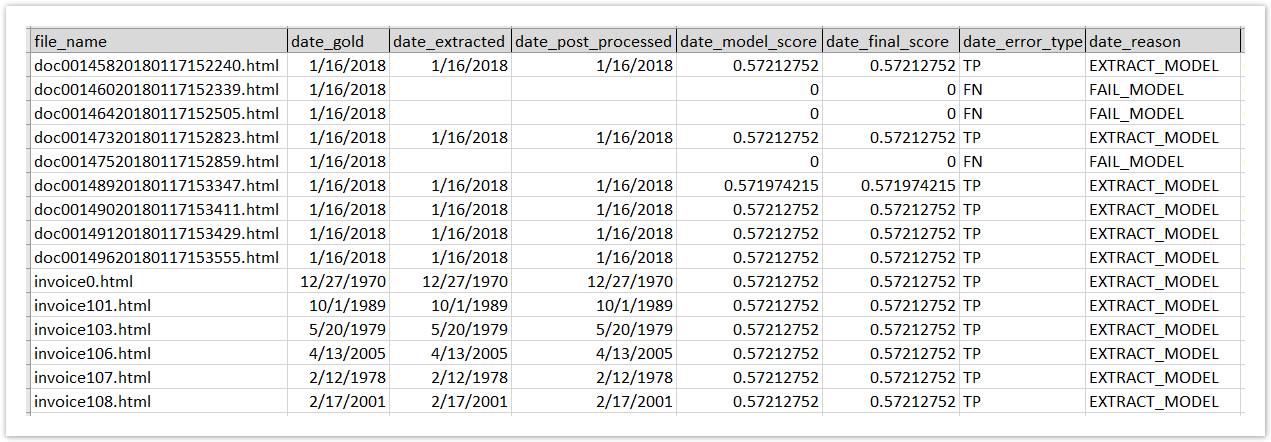
For each file in a dataset, there is a separate line. For each field in a dataset document, there are seven columns, where <%field\_name%> is the corresponding field name, for example, invoice_amount.
| Column name | Description |
|---|---|
<%field_name%>_gold | Value from the dataset file. |
<%field_name%>_extracted | Value extracted by the trained model. |
<%field_name%>_post_processed | Value after post-processing. |
<%field_name%>_model_score | Score provided by the model during extraction. |
<%field_name%>_final_score | Score changed by post-processing, the same as the model score if not changed. |
<%field_name%>_error_type | Error type. Possible values: TP, TN, FP, FN. |
<%field_name%>_reason | Reason why an error occurred, if any. Possible values: EXTRACT_MODEL, EXTRACT_RULES, FAIL_MODEL, FAIL_RULES. |
Once you update the model (Annotators, Feature Extractors, or Post-Processing), train the model again, run execution, and analyze the updated statistics.
Train model with limited resources
In some cases, you may need to train a model with limited CPU resources and less than 8 GB RAM. In this case, prepare the ModelTrainingRunner class to organize training field by field, nested into a try-catch block. Mind that the approach takes more time.
package ru.sberbank.run;

import java.nio.file.Path;
import java.nio.file.Paths;
import java.util.ArrayList;
import java.util.HashMap;
import java.util.List;
import java.util.Map;

import com.workfusion.nlp.uima.pipeline.constants.ConfigurationConstants;
import com.workfusion.vds.sdk.api.nlp.configuration.FieldInfo;
import com.workfusion.vds.sdk.api.nlp.configuration.FieldType;
import com.workfusion.vds.sdk.run.ModelRunner;
import com.workfusion.vds.sdk.run.config.LocalTrainingConfiguration;

import ru.sberbank.model.RussianIE;

public class ModelTrainingRunner {

    public static void main(String[] args) throws Exception {
        System.setProperty("WORKFLOW_LOG_FOLDER", "./logs/");
        System.setProperty("EVAL_WORKING_DIR_IS_UNDEFINED", "./eval/");

        List<FieldInfo> fields = new ArrayList<>();

        Path inputDirPath = Paths.get("D:\\generic\\input");
        String outputPathFolder = "D:\\dev\\train\\generic";
        LocalTrainingConfiguration configuration = null;
        String fieldName = "";
        FieldType type = FieldType.FREE_TEXT;
        Map<String, Object> parameters = new HashMap<>();
        parameters.put(ConfigurationConstants.HPO_TIME_LIMIT, 60 * 60 * 4);

        try {
            // train with the Address answer type
            fieldName = "full_address";
            type = FieldType.ADDRESS;
            fields.add(new FieldInfo.Builder(fieldName).type(type).build());
            configuration = LocalTrainingConfiguration.builder().inputDir(inputDirPath).outputDir(Paths.get(outputPathFolder + "\\model_" + "_" + fieldName))   .fields(fields).parameters(parameters).build();
            ModelRunner.run(RussianIE.class, configuration);
            fields.clear();
        } catch (Exception ex) {
            System.out.println(ex);
        }

        try {
            // train the same field with the Free Text answer type
            fieldName = "full_address";
            type = FieldType.FREE_TEXT;
            fields.add(new FieldInfo.Builder(fieldName).type(type).build());
            configuration = LocalTrainingConfiguration.builder().inputDir(inputDirPath).outputDir(Paths.get(outputPathFolder + "\\model_" + type + "_" + fieldName)).fields(fields).parameters(parameters).build();
            ModelRunner.run(RussianIE.class, configuration);
            fields.clear();
        } catch (Exception ex) {
            System.out.println(ex);
        }

        try {
            // train with the Number answer type for the Total amount field
            fieldName = "total_amount";
            type = FieldType.NUMBER;
            fields.add(new FieldInfo.Builder(fieldName).type(type).build());
            configuration = LocalTrainingConfiguration.builder().inputDir(inputDirPath).outputDir(Paths.get(outputPathFolder + "\\model_" + type + "_" + fieldName)).fields(fields).parameters(parameters).build();
            ModelRunner.run(RussianIE.class, configuration);
            fields.clear();
        } catch (Exception ex) {
            System.out.println(ex);
        }
    }
}
Customize logging levels for local run
For debug purposes, during local execution or training, you can change the logging level for any logger. You can use the SpringBoot-like approach: apply JVM parameters with the logging.level prefix. See the example below:
-Dlogging.level.root=DEBUG
-Dlogging.level.com.workfusion=WARN
-Dlogging.level.my.custom.packages=TRACE