
Migrate packages of Tasks and Business Processes
You can create a package with a Business Process (BP) or a Task and import it from one WorkFusion environment to another, for example, from DEV to UAT or PROD. Let’s assume the source is a DEV environment and the destination is a UAT environment.
A package is a ZIP archive that contains the following:
- An XML file with a Task or BP export information, such as design, settings
- All Data Stores used in a Task or BP steps
- Meta information
caution
To view, import, and export packages, you must have the Import/Export permission.
Prerequisites
WorkFusion Intelligent Automation Cloud executes multiple Business Processes (BPs) created by third parties. When upgrading from one Intelligent Automation Cloud version to another, it is important to make sure all BPs are still working.
Parts of BPs are migrated automatically by the WorkFusion's embedded tooling. However, in the instances where it's not possible to do it automatically, refer to the applicable migration guide for your version of WorkFusion Intelligent Automation Cloud.
note
Make sure you reviewed and applied notes for all Intelligent Automation Cloud versions between the source and target versions. Deprecation notes (if there any) should also be taken into account. For more details, see the Release Notes section.
Configuring Bot Config Bundle
Skip this step if no BCB is used for the BP.
Bot Config Bundle (BCB) configuration—the source code located in a Java project—should be deployed to GIT/SVN. For deployment, follow the steps below:
Use the Maven command to deploy the latest code to the DEV environment:
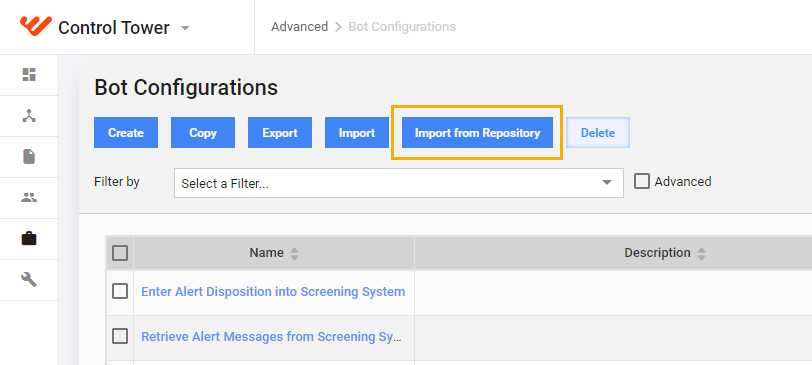
mvn clean package deployUpdate BCB from Control Tower: Advanced > Bot Configurations > Import from Repository.
AutoML Operation
important
Skip this step if no automation is applied to Manual Tasks (MT).
If automation is applied to MTs, apply the AutoML Automation Operation to the existing BP.
If the latest version of the BP contains AutoML Operation, perform the following steps:
- Create a new BP copy with the new name and version.
- Replace all AutoML Operations with appropriate Manual Tasks.
- Save the BP without any AutoML Operations inside.
If any MT contains AutoML settings, automation can be applied on the destination environment to the already imported BP.
Custom AutoML Operation
If AutoML Operation is a custom one and completed changes in the source environment, do as follows:
Create a BP using an AutoML Operation template in the Cognitive Bot Operations section.
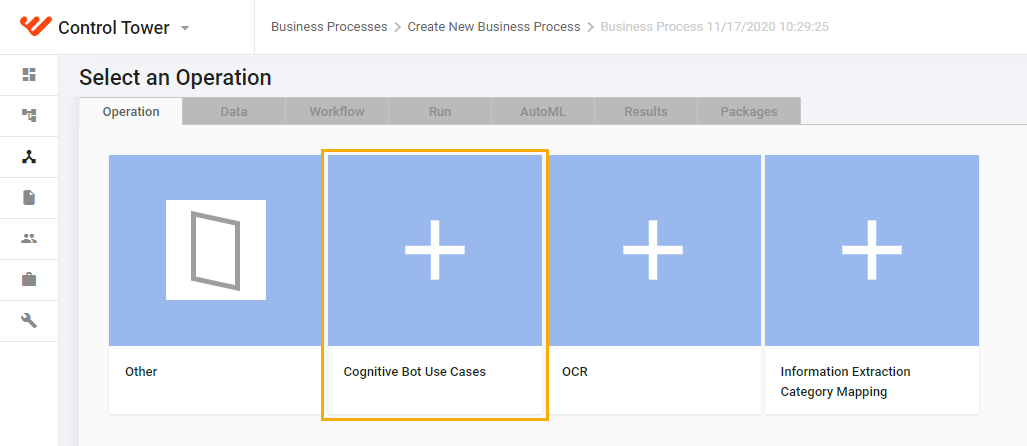
Open Workflow for this BP.
Drag and drop the original MT from the left pane to replace the empty task with it.
Save the BP. There should be no validation errors.
Prepare the package for export to the destination environment.
Import the package to the destination environment.
Open the imported BP and select the Workflow diagram.
Replace the MT inside it with an empty MT.
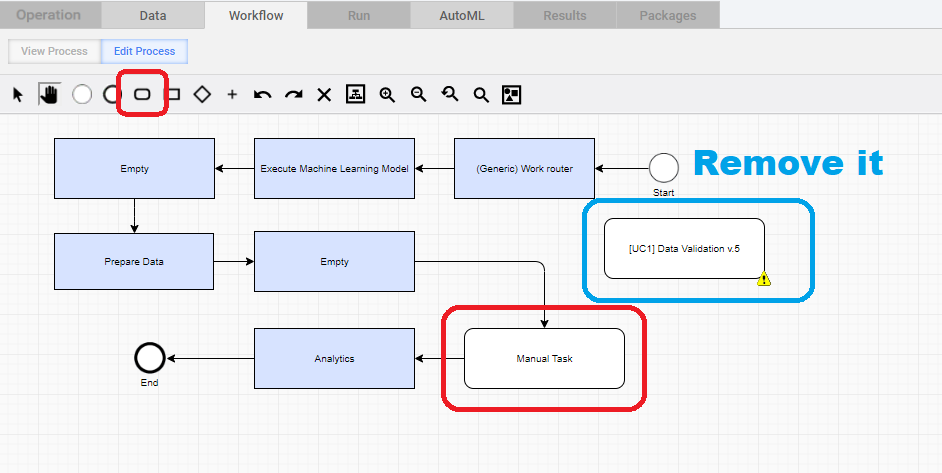
Save the BP.
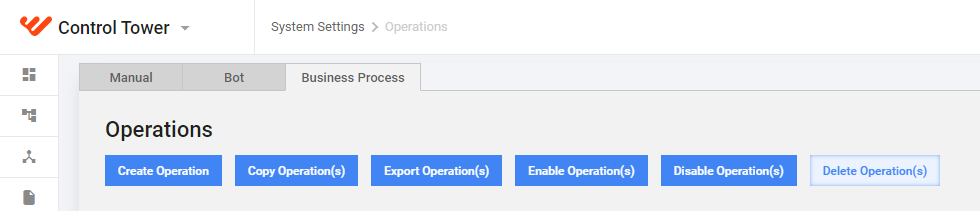
Create a new Auto ML Operation from System Settings > Operations > the Business Process tab.
To avoid conflicts during import or export, set a new version and name for the source BP.
Copy ML artifacts
If the BP has a Machine Learning model linked to the MT, migrate a binary model and a pre-trained model. For more details, see Migrate trained model.
Migration is required for each model linked to the MT.
Create package
To create a package, follow the steps below:
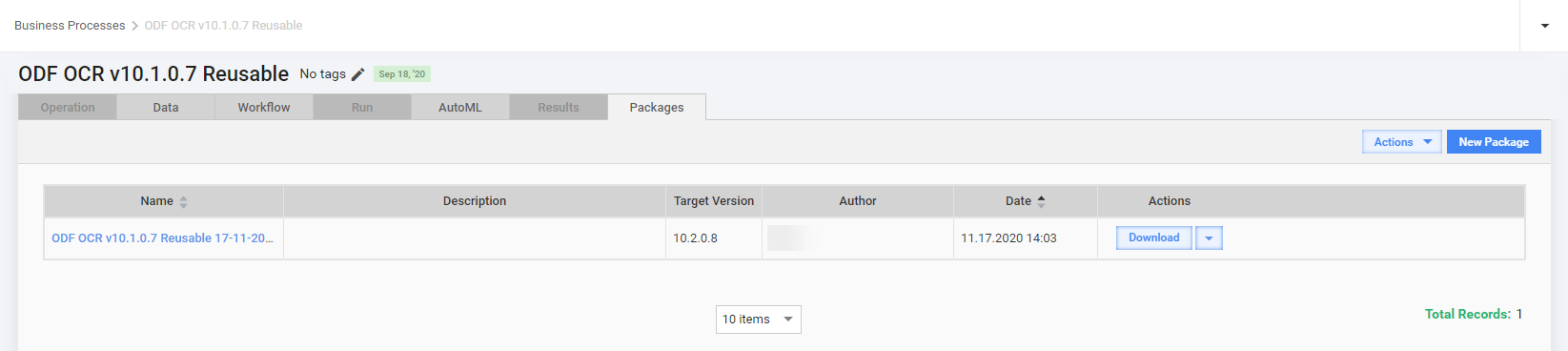
Go to Business Processes (or Manual Tasks) > View All. Select a BP and select the Packages tab.
Click the New Package button.
Enter a meaningful Name and Description for the package.
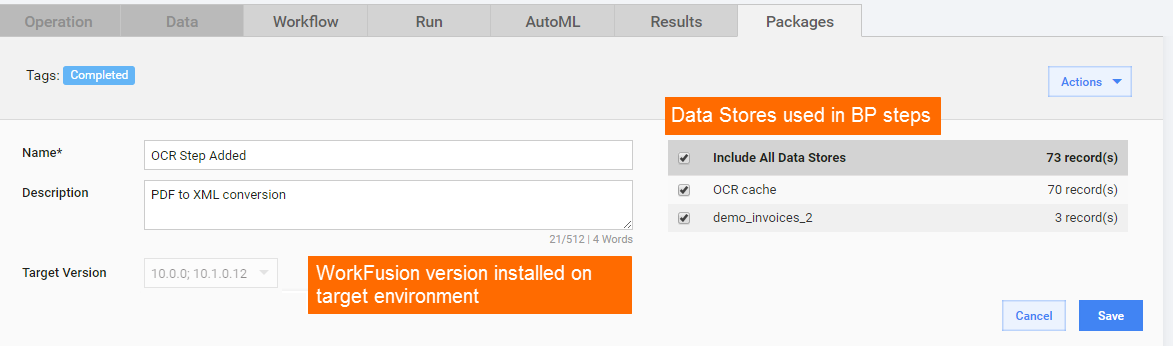
Choose Data Stores to include in the package by ticking appropriate checkboxes. The list contains all Data Stores used in the BP's Manual or Bot Tasks. You can uncheck a Data Store if you are sure that the target WorkFusion environment contains one with the same name and appropriate data.
(Optional) Select the version in the Target Version drop-down box for the current package. The feature helps to move processes from instances with an older WorkFusion version to new instances and vice versa.
caution
Mind that you cannot migrate 10.x BP packages to 9.x versions.
Click on the Save button.
Download package
To download a package to your local machine, go to the Actions grid column and click the Download button.

As a result, the package is downloaded as a ZIP file.
You can delete a package if it is not needed anymore. For that, click the arrow icon near the Download button and select Delete.
Import package
warning
It is strongly recommended not to update or import the same Business Process during the execution of its instances as it can cause undesired effects or warnings.
To import a package, follow the steps below:
Log in to the target WorkFusion environment, for example, PROD or UAT.
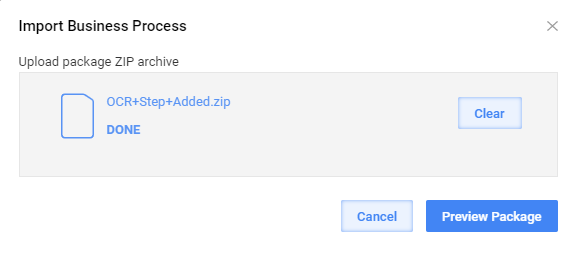
Go to Business Processes (Manual Tasks) and, in the top right corner, click Import Package.

Upload the package ZIP archive downloaded from the source environment and click the Preview Package button.
In the Package Import window, resolve all possible conflicts if needed.
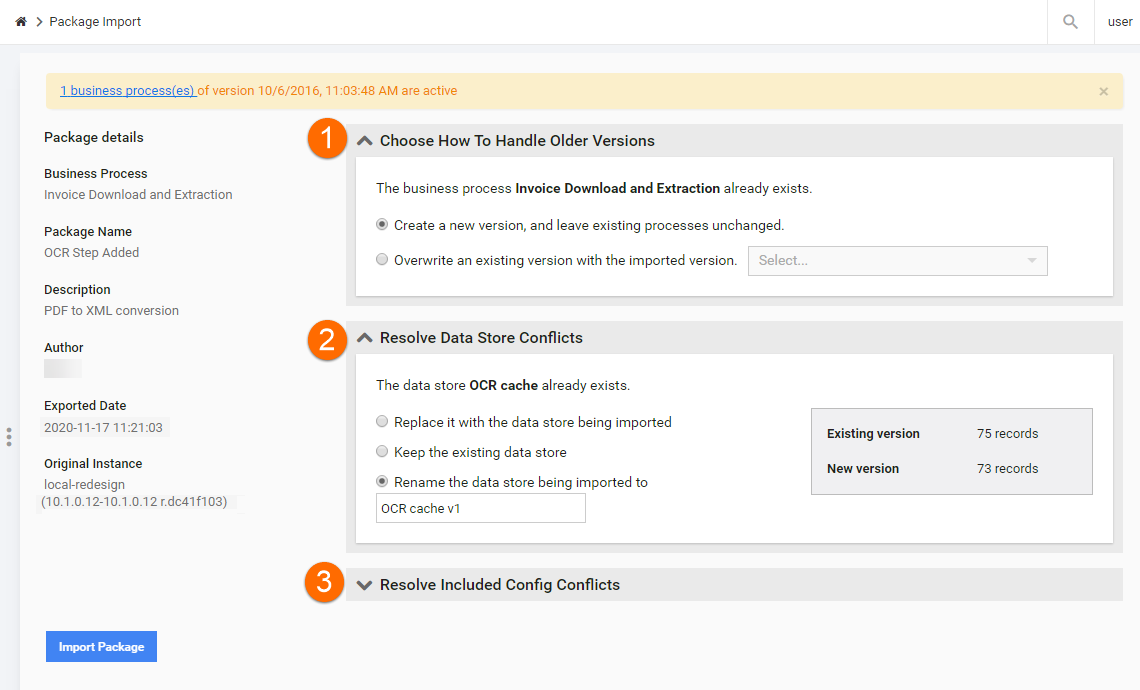
You can see the following warnings:
"<N> business processes of version <date> are active": you need to decide whether you want to overwrite active processes or not. You can optionally pause or stop active processes.
"The package was exported from WF version <XXX>. This environment has WF version (YYY)": the import can potentially cause some issues. You should check its results in the generated log file.
AutoML conflicts
If the Machine Learning model with the same name, model version, and trained model id included in the imported package is not available on your production environment, you get one of the following errors.


note
The "Trained model ID is not available" error message is displayed only if the model version is correct.
You have to acknowledge that AutoML configuration will not be set to import your package.

If you are importing the same package more than once, create another version or overwrite a particular version of this Task (BP). When overwriting an existing BP version, you can have a diff view for the process structure and each process step. This function can help make a decision on whether to rewrite the BP or not.
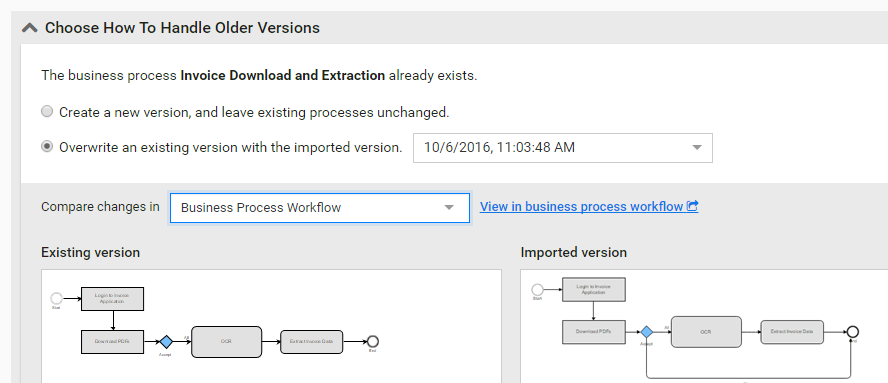
After you apply the overwrite feature during import, the following changes are made:
- Completed Tasks and BPs will have an old version.
- Draft Tasks and BPs will have a new version.
- Processing Tasks and BPs without significant changes (steps added, deleted, or substituted with other steps) will have a new version.
- Schedules are switched to a new version.
If the imported and existing process versions have significant differences (steps added, deleted, or substituted with other steps), you need a special Advanced Package Import permission to make such potentially dangerous overwrite. See the Role Management topic.
Expand to learn more
This import type can be required when you need to update active process runs, avoid schedule re-creation, or re-use already configured <start-task> plugins (by UUID).
When importing a package with a modified process structure, the following notifications are shown:
- Amount of added or removed process steps and rules
- Amount of active process runs
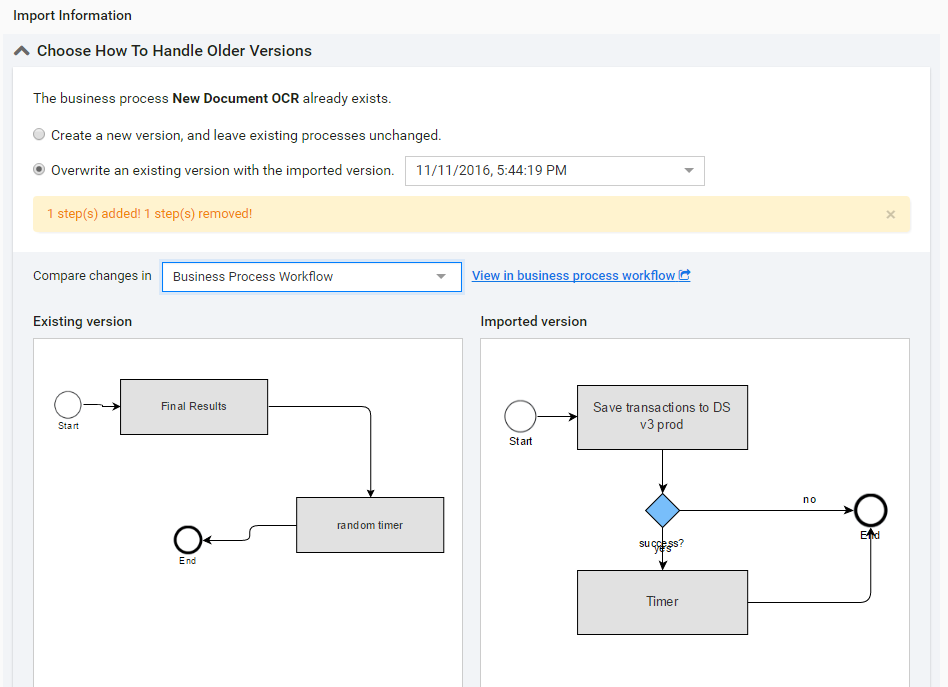
When you overwrite an active process run, its result data can be inconsistent because of added, removed, or changed steps and rules.
If your package contains Data Stores or included Bot Configs, you can get the following Resolve Import Conflict section(s).
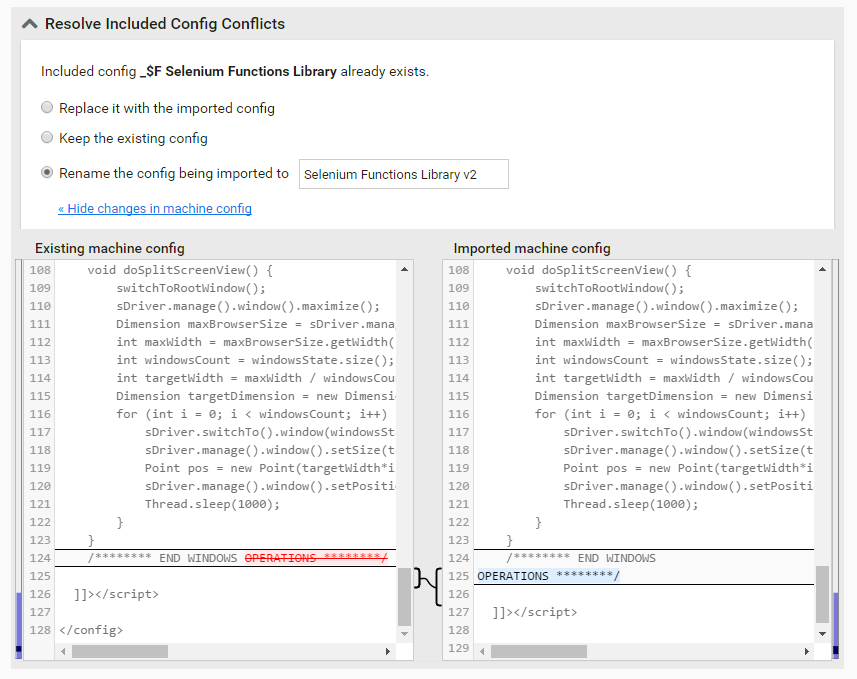
In this case, proceed as described below:
Choose one of the options (Replace, Keep, or Rename) for each conflict section.
- Data Stores are compared by the structure and number of records.
- For included Bot Configs, you can toggle a diff view.
When all import conflicts are resolved, click the Import Package button in the bottom left corner.
If the package is successfully imported, you see the import result message.
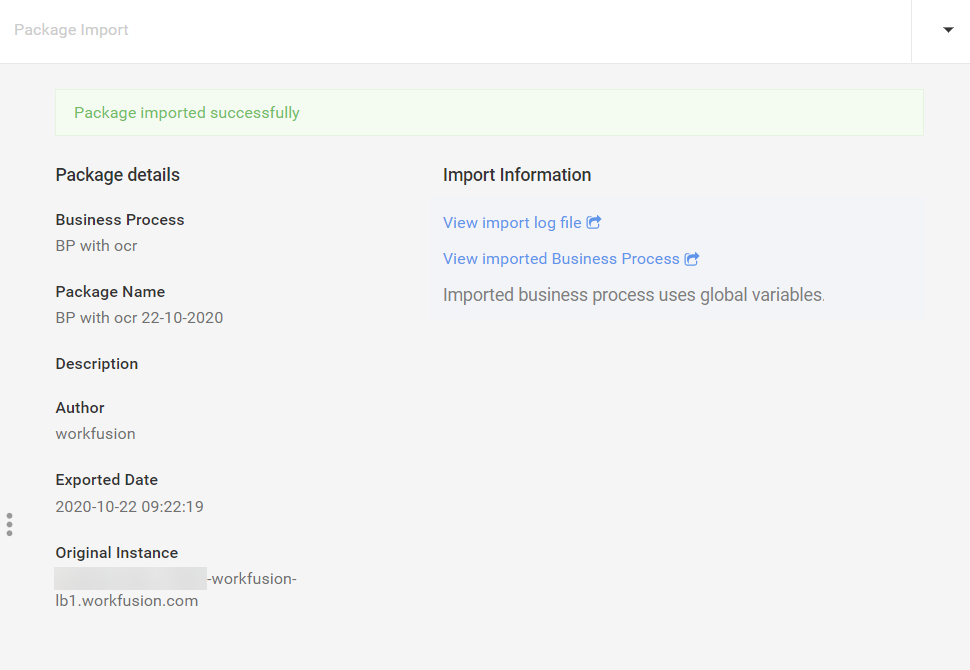
- You can download a detailed import report by clicking the View import log file link. This log can be useful in case some issues are found after import.
- When a package is imported, the platform checks its structure and displays useful notes and action items to be completed before running the imported Task or BP (for example, Define global variables).
View the imported BP (Task) or navigate elsewhere using the main menu.
The imported BP or Task creates a Run in a Draft state.
When a new Task version is imported to a target WorkFusion environment, the Automation settings and Workforce parameters are copied from the previous version that already exists on this environment.
Apply ML model
If a BP was copied with an AutoML Operation and a model, follow these steps to apply AutoML settings: Model retraining.
Import BCB project
If a source BP was developed using a BCB project, deploy and import it as described in the BCB Configuration section.
Create a new BP copy with the same name to update all BCB Configs if the BCB is used for the BP.
The machine configs from the BCB used as steps in the BP are not replaced by import. Instead, they are skipped, and the warning is added in the audit log for the BP import: "WARNING: Machine config from BCB with inclusion code '%s' and name '%s' already exist, it will not be rewritten".
For the machine configs from the BCB used as included configs, the import shows three options to resolve:
- Replace: the content of the included config is to be replaced with that from the imported package.
- Skip: the content of the included config is to be skipped.
- Rename: not recommended; creates a new machine config with the specified name and autogenerated inclusion code, but it will not be used in any BP after import.
note
Manually created machine configs are replaced as before.
Version labels
Let's assume that you have a BP and did the following:
- Created the first package for the BP and imported the package to the PROD environment
- Edited the BP and saved it
- Created the second package for the BP and imported the package to the PROD environment
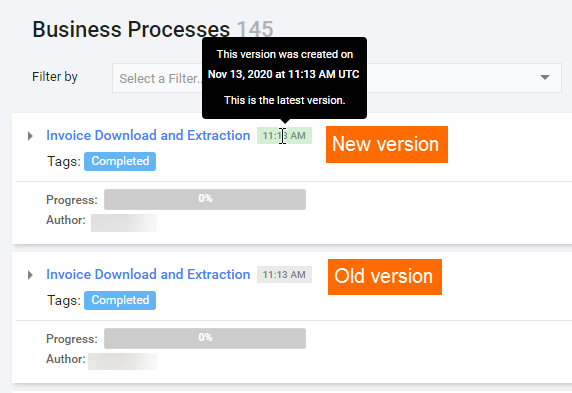
As a result, each newly imported package creates a BP or Task run that is automatically labeled by a timestamp.
The latest version is highlighted in green color, other versions are colored in grey.
The following Task and BP settings are NOT included in a package:
- Workforce for each MT. During import, the settings are taken from the target instance defaults.
- Global variable values. During import, respective columns are created in the Global Variables Data Store, but with empty values.
- Custom Attributes.
- Priority.
- Permanent open tasks.