
Data Purge overview
IA Cloud Enterprise generates a considerable amount of data. Much of it results from completed Business Processes (BPs) or internal maintenance. Accumulation of obsolete data can lead to the following issues:
- Low disk space. The database can run short of free disk space, resulting in unexpected BP errors.
- Low performance. The increasing number of strings in the database affects their processing speed.
- Security flaws. Sometimes, corporate security policies require removing data older than two or four weeks.
For the above reasons, it is strongly recommended to remove unwanted data from the Control Tower (CT), Data Stores, and S3 buckets regularly, using the Data Purge feature.
Additionally, separate purge procedures are available for the Analytics component.
Best practices
As you start working with a BP that writes data to a disk, make sure to enable automatic purging for CT data. If you fail to do this before you start, here is what you must do:
- Once you see that the free space on the database server is quickly diminishing and the data occupies about 70-75% of the disk, configure automatic purging for 20 hours with minimal delay.
- If it is too late for Step 1, run forced purge.
- As a last resort, you can do the following:
- Mount another disk with enough available space.
- Copy the data to it.
- Clean up the
AwsHitQuestiontable. By default,AwsHitQuestionoccupies about 70% of the available disk space. After cleaning it up, you can free another 30-40%. - Execute
shrink_dbto restore all freed extends to the system. - Restore the copied data and set up automatic purging.
It is also recommended to monitor the Analytics component regularly and clean it up monthly.
Purge CT data
The standard CT purge procedure cleans up the data of completed BPs. It also verifies that the process is finished correctly with due account for all links and that the data integrity inside the database is preserved.
The figure below is an example of a BP after you run Data Purge:
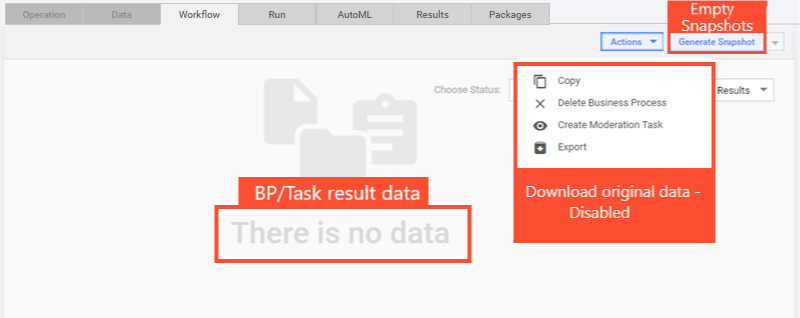
- Results Data: empty
- Snapshots: empty
- Download original data: disabled
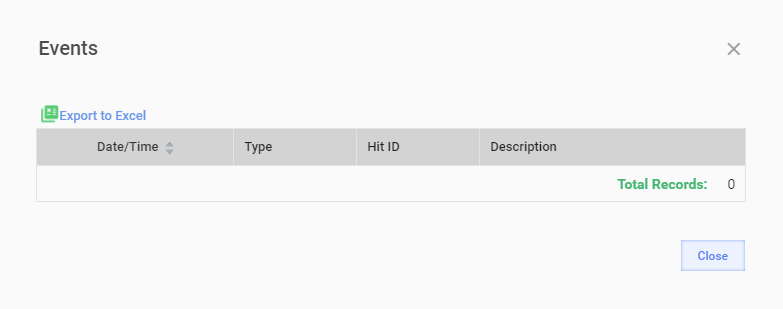
- Events: empty
Out-of-the-box purge
The out-of-the-box (OOTB) purge in Control Tower removes the data automatically from the following main tables according to a configured schedule:
| Schema | Table | Description |
|---|---|---|
| ct | AwsHit | Contains the BP record execution information. |
| ct | AwsHitQuestion | Contains JSON with the answer processing output for a record. |
| ct | AwsHitAssignment | Contains job execution information per single process task. |
| ct | AwsHitAssignmentAnswer | Contains raw answers given by a worker to a record. |
| ct | HitSubmissionDataItem | Contains JSON with the input data for a record. |
| ct | HitSubmissionDataItemHistory | Contains snapshots of the existing record input data if it is modified by step transition (for example, two records are merged). |
| ct | HitDataItemLog | Contains a log of life cycle events for a record, for example, posting, submission, approval. |
| ct | DataItemTrackerLog | Contains information about a transaction passing through BP steps to support the Transaction tracking capability for WokFusion Analytics. |
| ct | EndPointTaskAssignment | It is a temporal entity. Contains a number of assignments accepted by workers and appears when a worker accepts a task. |
| ct | EndpointTask | Appears as a clone of AwsHit after AwsHit is submitted successfully to a Crowd. |
| ct | WorkerActivityLog | Contains worker or Bot assignment statistics. |
| ct | PluginExecutionLog | Contains information about plugin executions to support Bot Analytics. |
| ct | BotRecordExecutionAttempt | Contains all non-completed bot step execution attempts, including step execution errors or retry limits exceeded, release-plugin timeout exceeded, steps without release or export plugin execution. |
| ct | file | Contains a file description, for example, name and type. |
| ct | data_store | Contains the binary content of files. |
| ct | event_tracking | Contains a text description of an event, for example, a message or an exception stack trace. |
| ct | event_object | Contains a reference to an object-induced event, for example, a BP step or a definition. |
The entity-relationship diagram is as follows:
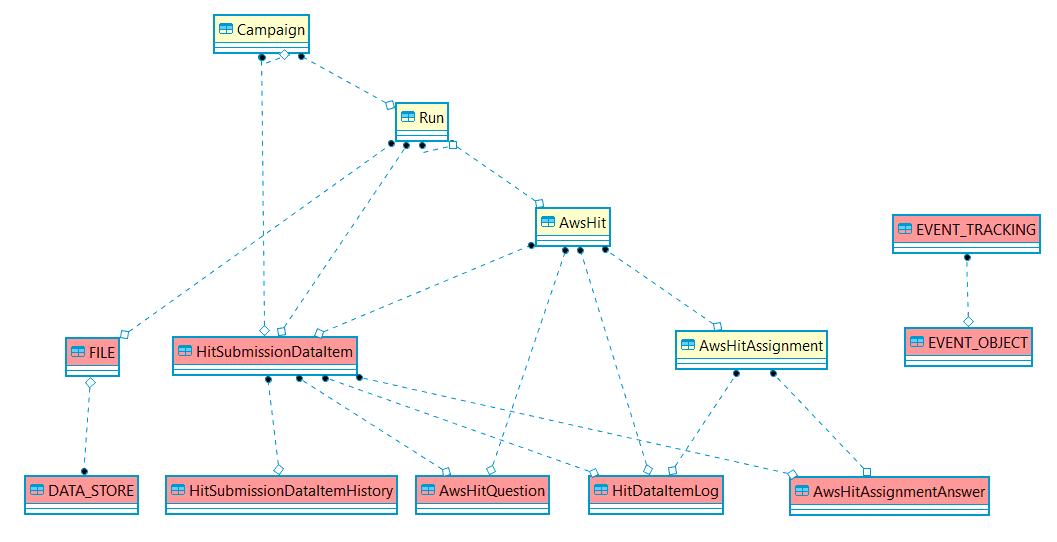
You can set up and run an OOTB Data Purge via the Control Tower UI based on one of the stored procedures as described in the Configure and run Data Purge topic.
Forced purge
Forced purge is applied manually to remove all data before a specific date by id.
Remember that Data Purge produces a high disk load. So, before running the procedure, make sure there are no non-completed BPs started before the purge date and you understand what you are doing. Otherwise, a forced purge may lead to unpredictable consequences.
caution
Forced purge uses run.createDate to get runs for purging, which can lead to losing some data of the runs closed after the last date.
important
Forced purge is not intended for consistent data removal. In some cases, data after the last date can be affected.
Forced purge can clean up the following tables:
| Schema | Table | Description |
|---|---|---|
| ct | AuditData | Contains audit information stored by CT objects. |
| ct | AwsHit | Contains the BP record execution information. |
| ct | AwsHitAssignment | Contains job execution information per single process task. |
| ct | AwsHitAssignmentAnswer | Contains raw answers given by a worker to a record. |
| ct | AwsHitQuestion | Contains JSON with the answer processing output for a record. |
| ct | EndpointTask | Appears as a clone of AwsHit after AwsHit is submitted successfully to a Crowd. |
| ct | EndPointTaskAssignment | It is a temporal entity. Contains a number of assignments accepted by workers and appears when a worker accepts a task. |
| ct | HitSubmissionDataItem | Contains JSON with the input data for a record. |
| ct | HitSubmissionDataItemHistory | Contains snapshots of the existing record input data if it is modified by step transition (for example, two records are merged). |
| ct | HitDataItemLog | Contains a log of life cycle events for a record, for example, posting, submission, approval. |
| ct | DataItemTrackerLog | Contains information about a transaction passing through BP steps to support the Transaction tracking capability for WokFusion Analytics. |
| ct | Package | Contains the description of packages created in CT. |
| ct | WorkerActivityLog | Contains worker or Bot assignment statistics. |
| ct | WorkerDayActivity | Contains daily worker or Bot statistics. |
| ct | PluginExecutionLog | Contains information about plugin executions to support Bot Analytics. |
| ct | BotRecordExecutionAttempt | Contains all non-completed bot step execution attempts, including step execution errors or retry limits exceeded, release-plugin timeout exceeded, steps without release or export plugin execution. |
| ct | file | Contains a file description, for example, name and type. |
| ct | data_store | Contains the binary content of files. |
| ct | event_tracking | Contains a text description of an event, for example, a message or an exception stack trace. |
| ct | event_object | Contains a reference to an object-induced event, for example, a BP step or a definition. |
The best option to force purge these tables is to create a Data Purge configuration and run it manually via the Control Tower UI as described in the guide. When creating the configuration, choose the dp#purge_forced_sp procedure.
Alternatively, proceed the old way:
Via console, connect to the
workfusionMS SQL database.Create a
purgeData_forceByIdgeneric procedure. The process removes all rows where IDs are lower than thei_lastIdvalue.MS SQL purgeData_forceById (with progress tracking)
Prerequisites:-- as db_owner (sys.admin): create table ct.force_purge_log ( id bigint identity(1,1) not null primary key , log_date datetime2 not null default getUTCDate() , table_name nvarchar(128) not null , n_rows bigint not null );Stored procedure:
if object_id('[ct].[purgeData_forceById]') is not null drop procedure [ct].[purgeData_forceById];
go
create procedure [ct].[purgeData_forceById]
( @i_tableName  nvarchar(63)
, @i_idColumn   nvarchar(63)
, @i_lastId     bigint
, @i_batchSize  bigint       = 30000
, @i_sleepTime  nvarchar(12) = '00:00:00.01'
) as
begin
--set nocount on;
set xact_abort on;
    /***
    PRE-REQUESITES:
        create table ct.force_purge_log
        ( id bigint     identity(1,1)   not null primary key
        , log_date      datetime2       not null default getUTCDate()
        , table_name    nvarchar(128)   not null
        , n_rows        bigint          not null
        );
    CHANGELOG: 10.1-rev-5
        2021-01-22 apouckatch   added: logging, @i_sleepTime
        2020-11-11 ksakharchuk  changed to delete top() and removed transaction
        2020-10-02 apouckatch   commit every batch (instead of once per table)
        2020-02-01 onovak       adopt for MSSQL
        2018-08-31 apouckatch   lower a transaction level to READ COMMITTED
        2018-08-21 apouckatch   created
    ***/
    declare @v_tabCount  bigint;
    declare @v_rowCount  bigint;
    declare @v_rowTotal  bigint;
    declare @batchSize   bigint = @i_batchSize;
    declare @batchDeleteSQL nvarchar(max);

    -- check the table name in DB dictionary (prevent an SQL injection):
    select @v_tabCount = count(*)
    from information_schema.columns as c
    where c.table_schema = 'ct'
      and c.table_name   = @i_tableName
      and c.column_name  = @i_idColumn;

if @v_tabCount >= 1
begin
try
    set @v_rowTotal = 0;

    set @batchDeleteSQL  = N'
        declare @row_count bigint;
        while (1=1)
        begin
                delete top ('+cast(@batchSize as nvarchar(10))+')
                from ct.['+ @i_tableName + ']
                where [' + @i_idColumn + '] <= ' + cast(@i_lastId as nvarchar(100)) +';

                set @row_count = @@rowcount;
                if @row_count = 0
                    break;
                set @v_rowTotal =@v_rowTotal + @row_count;

                insert into ct.force_purge_log( table_name, n_rows)
                values( ''' + @i_tableName + ''', @row_count);
                waitfor delay @sleep;
        end;';

    exec sp_executeSql @batchDeleteSQL, N'@sleep nvarchar(12), @v_rowTotal bigint output', @sleep = @i_sleepTime, @v_rowTotal = @v_rowTotal output;

end try
begin catch
    declare @errormessage   nvarchar(4000)  = error_message();
    declare @errorseverity  int             = error_severity();
    declare @errorstate     int             = error_state();
    raiserror(@errormessage, @errorseverity, @errorstate);
end catch;

select @i_tableName  as Table_Name
     , @v_rowTotal   as Deleted_Rows;

end;
go
MS SQL purgeData_forceById (without progress tracking, obsolete)
if object_id('[ct].[purgeData_forceById]') is not null drop procedure [ct].[purgeData_forceById];
go
create procedure [ct].[purgeData_forceById]
( @i_tableName  nvarchar(63)
, @i_idColumn   nvarchar(63)
, @i_lastId     bigint
, @i_batchSize  bigint = 30000
) as
begin
--set nocount on;
set xact_abort on;
    /*** CHANGELOG: 10.1-rev-3
    2020-11-11 ksakharchuk  changed to delete top() and removed transaction
    2020-10-02 apouckatch   commit every batch (instead of once per table)
    2020-02-01 onovak       adopt for MSSQL
    2018-08-31 apouckatch   lower a transaction level to READ COMMITTED
    2018-08-21 apouckatch   created
    ***/
    declare @v_tabCount  bigint;
    declare @v_rowCount  bigint;
    declare @v_rowTotal  bigint;
    declare @batchSize   bigint = @i_batchSize;
    declare @batchDeleteSQL nvarchar(max);
    declare @sleep_time  nvarchar(12) = '00:00:01';

    -- check the table name in DB dictionary (prevent an SQL injection):
    select @v_tabCount = count(*)
    from information_schema.columns as c
    where c.table_schema = 'ct'
      and c.table_name   = @i_tableName
      and c.column_name  = @i_idColumn;

if @v_tabCount >= 1
begin try
    set @v_rowTotal = 0;

    set @batchDeleteSQL  = N'
        declare @row_count int = 1;
        while (@row_count > 0)
        begin
                delete top ('+cast(@batchSize as nvarchar(10))+')
                from ct.['+ @i_tableName + ']
                where [' + @i_idColumn + '] <= ' + cast(@i_lastId as nvarchar(100)) +';

                set @row_count = @@rowcount;
                set @v_rowTotal =@v_rowTotal + @row_count;
                waitfor delay @sleep;
        end;';

    --set transaction isolation level read committed;
    --print @batchDeleteSQL
    exec sp_executesql @batchDeleteSQL, N'@sleep nvarchar(12), @v_rowTotal bigint output', @sleep = @sleep_time, @v_rowTotal = @v_rowTotal output;

end try
begin catch
    declare @errormessage nvarchar(4000) = error_message();
    declare @errorseverity int = error_severity();
    declare @errorstate    int = error_state();
    raiserror(@errormessage, @errorseverity, @errorstate);
end catch;

select @i_tableName  as Table_Name
     , @v_rowTotal   as Deleted_Rows;

end;
go
Edit the value of the last date:
set @last_date = '<insert-your-date-here>';. All data before the date is removed.Copy and save the following script. Remember to redefine
@last_date.MS SQL script
declare @last_date          datetime = '2020-12-31'
    ,   @preserve_active    bit      = 0            -- = 1, to keep any active RUNs and their BPs
    ,   @preserve_draft     bit      = 0            -- = 1, to keep 'DRAFT' BPs
    ,   @batch_size         int      = 3000
    ,   @last_run_id        bigint
    ;
with cte_min_active_run as
(   select  min(r_min.id) as run_id
    from ct.run as r_min
    where r_min.status not in
        ( 'COMPLETED'
        , 'DELETED'
        , case when @preserve_draft = 0 then 'DRAFT' else '-dummy-' end
        )
)
, cte_first_active_root_run as
(   select first_act_root_run.id as run_id
    from ct.run             as first_act_run_full
    join cte_min_active_run as first_act_run_1    on first_act_run_full.id   = first_act_run_1.run_id
    join ct.run             as first_act_root_run on first_act_root_run.uuid = first_act_run_full.rootRunUUID
)
, cte_upper_limit_run as
(   select coalesce
        (   (select run_id from cte_first_active_root_run where @preserve_active = 1)
        ,   (select max(id) + 1 from ct.run)
        ,   1
        ) as run_id
)
select @last_run_id = max(id)
from ct.run as r
where r.id < (select run_id from cte_upper_limit_run)
    and r.startDate <= @last_date
;
/*** previous version without preserving of runs: ***
declare @last_run_id  bigint = (select isnull( max(id) , 0) as last_run_id  from ct.Run                    as r  where r.startDate     <  @last_date  );
***/
declare @last_item_id bigint = (select isnull( max(id) , 0) as last_item_id from ct.HitSubmissionDataItem  as i  where i.run_id        <= @last_run_id);
declare @last_aud_id  bigint = (select isnull( max(id) , 0) as last_aud_id  from ct.AuditData              as a  where a.createdDate   <  @last_date  );
declare @last_hit_id  bigint = (select isnull( max(id) , 0) as last_hit_id  from ct.AwsHit                 as h  where h.run_id        <= @last_run_id);
declare @last_trk_id  bigint = (select isnull( max(tracker_id), 0) as tr_id from ct.DataItemTrackerHitLink as tr where tr.data_item_id <= @last_item_id);
declare @last_aha_id  bigint = (select isnull( max(id) , 0) as last_aha_id  from ct.AwsHitAssignment       as ha where ha.hit_id       <= @last_hit_id);
declare @last_et_id   bigint = (select isnull( max(id) , 0) as last_et_id   from ct.EndpointTask           as et where et.run_id       <= @last_run_id);
declare @last_ev_id   bigint = (select isnull( max(id) , 0) as last_ev_id   from ct.event_tracking         as et where et.created_time <  @last_date  );
declare @last_file_id bigint = (select isnull( max(id) , 0) as last_file_id from ct.[file]                 as f  where f.runid         <= @last_run_id);
declare @last_ds_id   bigint =
(   select coalesce
        (   (   -- case 1: skip Data_Store that has the [file] not purged this time
                select min(f.data_store_id) - 1 as last_ds_id
                from ct.[file] f
                where f.runid <= @last_run_id
                and exists
                    (   select 1
                        from ct.[file] fr
                        where fr.data_store_id = f.data_store_id
                        and fr.id > (select max(id) from ct.[file] where runid <= @last_run_id)
                    )
            )
        ,   (   -- case 2: just fetch Data_Store for the last purged [file]
                select max(f.data_store_id) as last_ds_id
                from ct.[file] f
                where f.runid <= @last_run_id
            )
        ,   -- case 3: dummy id
            0
        ) as last_ds_id
);

-- output interim results:
select
      @last_run_id  as last_run_id
    , @last_item_id as last_item_id
    , @last_aud_id  as last_aud_id
    , @last_hit_id  as last_hit_id
    , @last_trk_id  as last_trk_id
    , @last_aha_id  as last_aha_id
    , @last_et_id   as last_et_id
    , @last_ev_id   as last_ev_id
    , @last_file_id as last_file_id
    , @last_ds_id   as last_ds_id
;

begin try
    exec ct.purgeData_forceById 'AwsHitQuestion'                  , 'item_id'          , @last_item_id, @batch_size;
    exec ct.purgeData_forceById 'HitDataItemLog'                  , 'item_id'          , @last_item_id, @batch_size;
    exec ct.purgeData_forceById 'HitSubmissionDataItemHistory'    , 'item_id'          , @last_item_id, @batch_size;
    exec ct.purgeData_forceById 'PluginExecutionLog'              , 'data_item_id'     , @last_item_id, @batch_size;
    exec ct.purgeData_forceById 'HitRecordSource'                 , 'runId'            , @last_run_id , @batch_size;
    exec ct.purgeData_forceById 'AuditData'                       , 'id'               , @last_aud_id , @batch_size;
    exec ct.purgeData_forceById 'HitDataItemLog'                  , 'assignment_id'    , @last_aha_id , @batch_size;
    exec ct.purgeData_forceById 'DataItemTrackerHitLink'          , 'tracker_id'       , @last_trk_id , @batch_size;
    exec ct.purgeData_forceById 'DataItemTrackerLog'              , 'tracker_id'       , @last_trk_id , @batch_size;
    exec ct.purgeData_forceById 'DataItemTracker'                 , 'id'               , @last_trk_id , @batch_size;
    exec ct.purgeData_forceById 'AwsHitAssignmentAnswer'          , 'assignment_id'    , @last_aha_id , @batch_size;
    exec ct.purgeData_forceById 'WorkerFitnessHistoryAssignment'  , 'assignmentId'     , @last_aha_id , @batch_size;
    exec ct.purgeData_forceById 'AwsHitAssignment'                , 'hit_id'           , @last_hit_id , @batch_size;
    exec ct.purgeData_forceById 'HitSubmissionDataItem'           , 'id'               , @last_item_id, @batch_size;
    exec ct.purgeData_forceById 'WorkerActivityLog'               , 'run_id'           , @last_run_id , @batch_size;
    exec ct.purgeData_forceById 'WorkerDayActivity'               , 'runId'            , @last_run_id , @batch_size;
    exec ct.purgeData_forceById 'Package'                         , 'fileId'           , @last_file_id, @batch_size;
    exec ct.purgeData_forceById 'FILE'                            , 'id'               , @last_file_id, @batch_size;
    delete from ct.WorkerQualification where qualification_id in (select id from ct.CustomQualification cq where cq.TEST_STORE_ID <= @last_ds_id);
    exec ct.purgeData_forceById 'CustomQualification'             , 'TEST_STORE_ID'    , @last_ds_id  , @batch_size;
    exec ct.purgeData_forceById 'DATA_STORE'                      , 'ID'               , @last_ds_id  , @batch_size;
    exec ct.purgeData_forceById 'EndPointTaskAssignment'          , 'task_id'          , @last_et_id  , @batch_size;
    exec ct.purgeData_forceById 'EndpointTask'                    , 'id'               , @last_et_id  , @batch_size;
    exec ct.purgeData_forceById 'event_object'                    , 'event_tracking_id', @last_ev_id  , @batch_size;
    exec ct.purgeData_forceById 'event_tracking'                  , 'id'               , @last_ev_id  , @batch_size;
end try
begin catch
    throw;
end catch;
During maintenance
To reclaim free space, run the dbcc shrinkdatabase workfusion command.
Transactional purge
Out-of-the-box purge can also remove data related to a specific record or business transaction. Such an action can be requested by various regulators to remove the ID of a document or transaction from all systems.
Before you launch a transactional purge, make sure that the associated BP contains a step with activated tracking.
The operation finds all hits or items by tracker_id and then clears all related tables in the ct and ws schemas.
Root tables:
ct.AwsHitws.hit(ws.hit.unique_request_token = ct.AwsHit.uuid)
Initial Key: AwsHit.uuid
CT tables to purge:
| Table | Column |
|---|---|
assignmentforhitjob | hitid |
awshit | id, hitid |
awshitassignment | hitid |
awshitevent | hit_id |
awshitquestion | hitid |
awshitviewhistory | hitid |
botrecordexecutionattempt | hitid |
endpointtask | awshitid |
event_tracking | hitid |
external_task_submission | hitid |
hitdataitemlog | hit_id |
hitdisabledforworker | hitid |
hitrecordsource | hitid |
hitsubmissiondataitem | hitid |
run_assignments | hitid |
run_aws_hits | hit_id hit_uuid |
submission | awshit_id |
worker_message | hitid |
workeractivitylog | hitid |
workercommunication | hitid |
workerfeedback | hitid |
workerfitnesshistory | hitid |
WorkSpace (WS) tables to purge:
| Table | Column |
|---|---|
assignment | hit_id |
hit | unique_request_token |
hit_audit | hit_id |
hit_history | hit_id |
hit_type_preview_data | hit_id |
notification_event | hit_vid |
notification_receptor | hit_type_id |
To run a transactional purge, use the following procedure:
View procedure
CREATE PROCEDURE dbo.purge_tx_hit_sp
  @i_hit_uuid   nvarchar(36)
, @o_rec_cnt    bigint output
, @i_estimate   bit = 0
, @i_verbose    bit = 0
AS
begin
    set nocount on;
/***
    CHANGELOG: 10.1-rev-7
        2019-12-16 apouckatch reverse order
        2019-12-13 apouckatch created

    SAMPLE:
        declare @uuid   nvarchar(36) = '7641e603-6bac-450e-ac21-82998bf5a12f';
        declare @cnt    int;
        exec purge_tx_hit_sp @i_hit_uuid = @uuid, @o_rec_cnt = @cnt output;
        print formatMessage( 'CNT:%s', cast( @cnt as nvarchar(10))

***/
    declare cur_tables_to_purge cursor read_only forward_only for
    select
          schema_name
        , table_name
        , key_col_name
        , case sql_where_in
            when 'CT_HIT_ID'    then 'select ct_hit_id   from #tx_hits'
            when 'CT_HIT_UUID'  then 'select ct_hit_uuid from #tx_hits'
            when 'CT_ITEM_ID'   then 'select ct_item_id  from #tx_hits'
            when 'CT_ASMT_ID'   then 'select a.id        from ct.AwsHitAssignment a where a.hit_id in (select ct_hit_id from #tx_hits)'
            when 'CT_TRK_ID'    then 'select tracker_id  from #tx_tracker'
            when 'WS_HIT_ID'    then 'select ws_hit_id   from #tx_hits'
            when 'WS_ASMT_ID'   then 'select a.id        from ws.assignment a where a.hit_id in (select ws_hit_id from #tx_hits)'
            else sql_where_in
            end             as sql_where_id
    from ( values
              -- Control Tower:
                (      0, 'ct' , 'AwsHit'                       , 'id'              , 'CT_HIT_ID'  )
              , (      5, 'ct' , 'DataItemTracker'              , 'id'              , 'CT_TRK_ID'  )
              , (     10, 'ct' , 'AwsHitEvent'                  , 'hit_id'          , 'CT_HIT_ID'  )
              , (     20, 'ct' , 'AwsHitAssignment'             , 'hit_id'          , 'CT_HIT_ID'  )
              , (     30, 'ct' , 'AwsHitViewHistory'            , 'hitid'           , 'CT_HIT_ID'  )
              , (     40, 'ct' , 'AwsHitAssignmentAnswer'       , 'assignment_id'   , 'CT_ASMT_ID' )
              , (     41, 'ct' , 'AwsHitAssignmentAnswer'       , 'item_id'         , 'CT_ITEM_ID' )
              , (     50, 'ct' , 'HitSubmissionDataItem'        , 'hit_id'          , 'CT_HIT_ID'  )
              , (     60, 'ct' , 'HitSubmissionDataItemHistory' , 'item_id'         , 'select i.id from ct.HitSubmissionDataItem i where i.hit_id in (select ct_hit_id from #tx_hits)')
              , (     70, 'ct' , 'AwsHitQuestion'               , 'hit_id'          , 'CT_HIT_ID'  )
              , (     71, 'ct' , 'AwsHitQuestion'               , 'item_id'         , 'CT_ITEM_ID' )
              , (     80, 'ct' , 'HitDataItemLog'               , 'hit_id'          , 'CT_HIT_ID'  )
              , (     81, 'ct' , 'HitDataItemLog'               , 'item_id'         , 'CT_ITEM_ID' )
              , (     82, 'ct' , 'HitDataItemLog'               , 'assignment_id'   , 'CT_ASMT_ID' )
              , (     90, 'ct' , 'DataItemTrackerLog'           , 'data_item_id'    , 'CT_ITEM_ID' )
              , (     91, 'ct' , 'DataItemTrackerLog'           , 'tracker_id'      , 'CT_TRK_ID'  )
              , (    100, 'ct' , 'DataItemTrackerHitLink'       , 'data_item_id'    , 'CT_ITEM_ID' )
              , (    101, 'ct' , 'DataItemTrackerHitLink'       , 'tracker_id'      , 'CT_TRK_ID'  )
              , (    110, 'ct' , 'HitRecordSource'              , 'hitid'           , 'CT_HIT_ID'  )
              , (    120, 'ct' , 'WorkerActivityLog'            , 'hitid'           , 'CT_HIT_UUID')
              , (    130, 'ct' , 'run_aws_hits'                 , 'hit_id'          , 'CT_HIT_ID'  )
              -- WorkSpace:
              , (    500, 'ws' , 'hit'                          , 'id'              , 'WS_HIT_ID'  )
              , (    510, 'ws' , 'assignment'                   , 'hit_id'          , 'WS_HIT_ID'  )
              , (    520, 'ws' , 'hit_submission'               , 'assignment_id'   , 'WS_ASMT_ID' )
              , (    530, 'ws' , 'assignment_audit'             , 'assignment_id'   , 'WS_ASMT_ID' )
              , (    540, 'ws' , 'hit_history'                  , 'hit_id'          , 'WS_HIT_ID'  )
              , (    550, 'ws' , 'hit_type_preview_data'        , 'hit_id'          , 'WS_HIT_ID'  )
              , (    560, 'ws' , 'hit_audit'                    , 'hit_id'          , 'WS_HIT_ID'  )
         ) as t ( seq_id, schema_name, table_name               , key_col_name      , sql_where_in )
    order by seq_id desc   -- to track dependencies from details to master

    if @i_verbose = 1
        print 'Purging [hit_uuid:' + @i_hit_uuid + ']'

    set @o_rec_cnt = 0

    -- prepare a tracker:
    select trk.tracker_id
    into #tx_tracker
    from ct.awsHit                  as hit
    join ct.hitSubmissionDataItem   as item on hit.id  = item.hit_id
    join ct.dataItemTrackerHitLink  as trk  on item.id = trk.data_item_id
    where hit.uuid = @i_hit_uuid

    -- prepare a set of hits:
    select
          tx_ct_hits.id     as ct_hit_id
        , tx_ct_hits.uuid   as ct_hit_uuid
        , tx_items.id       as ct_item_id
        , tx_ws_hits.id     as ws_hit_id
    into #tx_hits
    from #tx_tracker                as trk
    join ct.dataItemTrackerHitLink  as tx_trk       on tx_trk.tracker_id = trk.tracker_id
    join ct.hitSubmissionDataItem   as tx_items     on tx_items.id       = tx_trk.data_item_id
    join ct.awsHit                  as tx_ct_hits   on tx_ct_hits.id     = tx_items.hit_id
    left join ws.hit                as tx_ws_hits   on tx_ct_hits.uuid   = tx_ws_hits.unique_request_token

    create nonclustered index idx_tx_hits_ct_hit_id   on #tx_hits( ct_hit_id  )
    create nonclustered index idx_tx_hits_ct_hit_uuid on #tx_hits( ct_hit_uuid)
    create nonclustered index idx_tx_hits_ct_item_id  on #tx_hits( ct_item_id )
    create nonclustered index idx_tx_hits_ws_hit_id   on #tx_hits( ws_hit_id  )

    -- loop tables:
    open cur_tables_to_purge

    while (1=1)
    begin
        declare @schema_name    nvarchar(128)
            ,   @table_name     nvarchar(128)
            ,   @key_col_name   nvarchar(128)
            ,   @sql_where_in   nvarchar(4000)
            ,   @sql_from_where nvarchar(1000)
            ,   @sql_execute    nvarchar(1000)
            ,   @start_date     datetime2
            ,   @end_date       datetime2
            ,   @exec_ms        bigint
            ,   @rec_cnt        bigint

        fetch cur_tables_to_purge
        into  @schema_name  , @table_name
            , @key_col_name , @sql_where_in

        if @@fetch_status != 0
            break

        set @start_date = getDate()

        set @sql_from_where = formatMessage
            ( 'from [%s].[%s] where [%s] in (%s)'
            , @schema_name, @table_name, @key_col_name, @sql_where_in
            )

        if @i_estimate = 1
        begin
            set @sql_execute = formatMessage( 'select @cnt = count(*) %s', @sql_from_where)
            exec sp_executeSql @sql_execute
                , N'@cnt int out'
                , @cnt = @rec_cnt output
        end
        else
        begin
            set @sql_execute = formatMessage('delete %s', @sql_from_where)
            exec sp_executeSql @sql_execute
            set @rec_cnt = @@rowcount
        end

        set @end_date = getDate()

        set @exec_ms = dateDiff( ms, @start_date, @end_date)

        set @o_rec_cnt = @o_rec_cnt + @rec_cnt

        if @i_verbose = 1
            print formatMessage
                ( 'DBG: [%3s].[%-30s][cnt: %7s][ms: %7s][sql:%s]'
                , @schema_name
                , @table_name
                , cast( @rec_cnt as nvarchar(7))
                , cast( @exec_ms as nvarchar(7))
                , @sql_execute
                )

    end -- while(1=1)

    close      cur_tables_to_purge
    deallocate cur_tables_to_purge

end
Purge Data Stores
Purging of Data Stores is required to avoid performance issues when executing Bot Tasks. To run a Data Store purge, create a configuration based on custom SQL as described in the Configure and run Data Purge guide.
Purge S3 (MinIO)
You can set up and manage S3 (MinIO) data purging in one of the following ways:
Via the Data Purge user interface in Control Tower. For details, refer to the Configure and run Data Purge topic.
Using the API endpoints described in the Data Purge API topic.
Purge Analytics
The Analytics component features a customizable Data Purge procedure that cleans up data from Control Tower, Elasticsearch, RPA, Data Stores, and other components you can add. You have to run the procedure manually. The purge executes the delete process table-by-table using specific settings for each table (dp_config).
For instructions on purging Analytics, refer to Configure and run Data Purge | Purge Analytics.
Levels
According to the solution architecture, the Analytics data contains a number of levels:
- source: pm.* tables
- ods: an intermediate level between the source and wh storages
- wh: the dashboard creation level
Data Purge cleans up all these levels at a time.
Tables
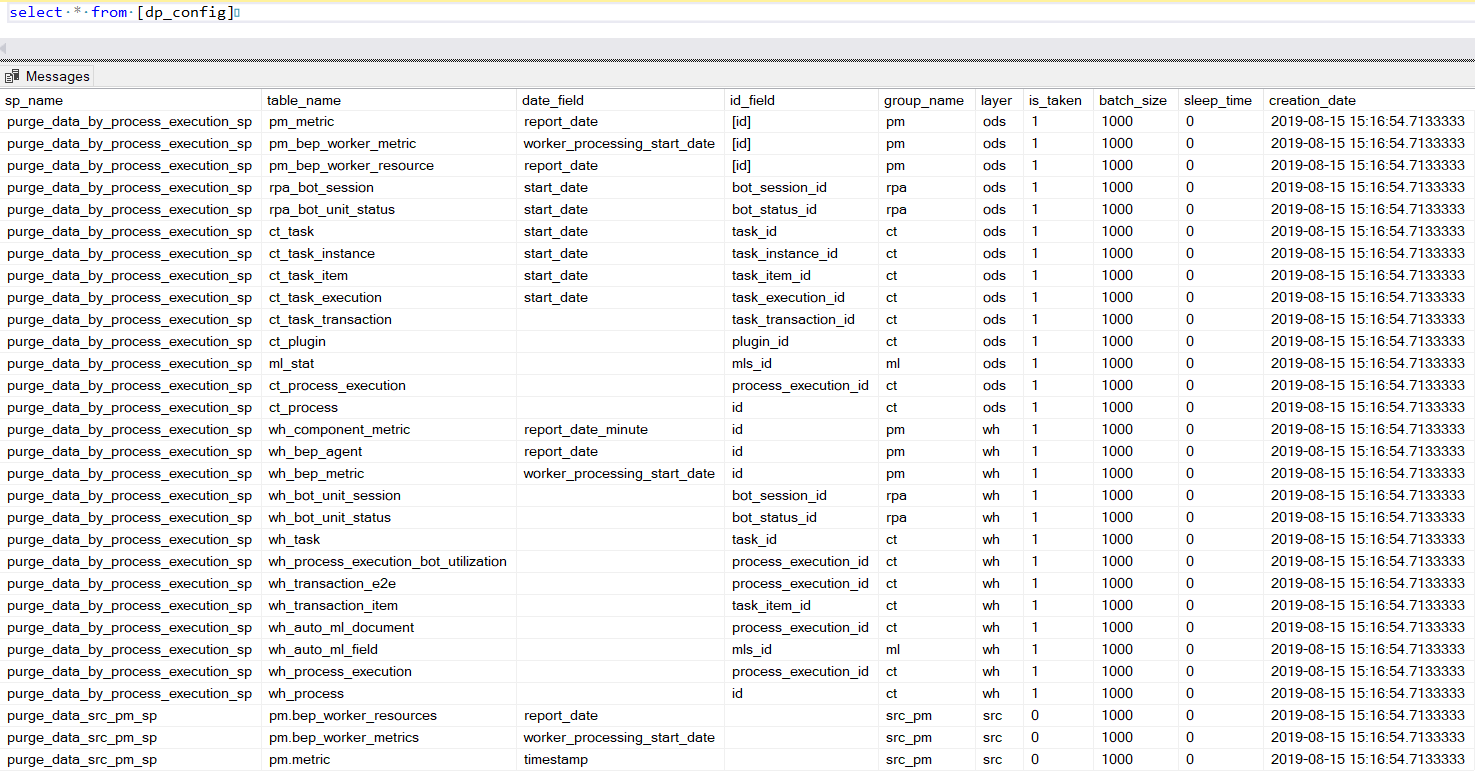
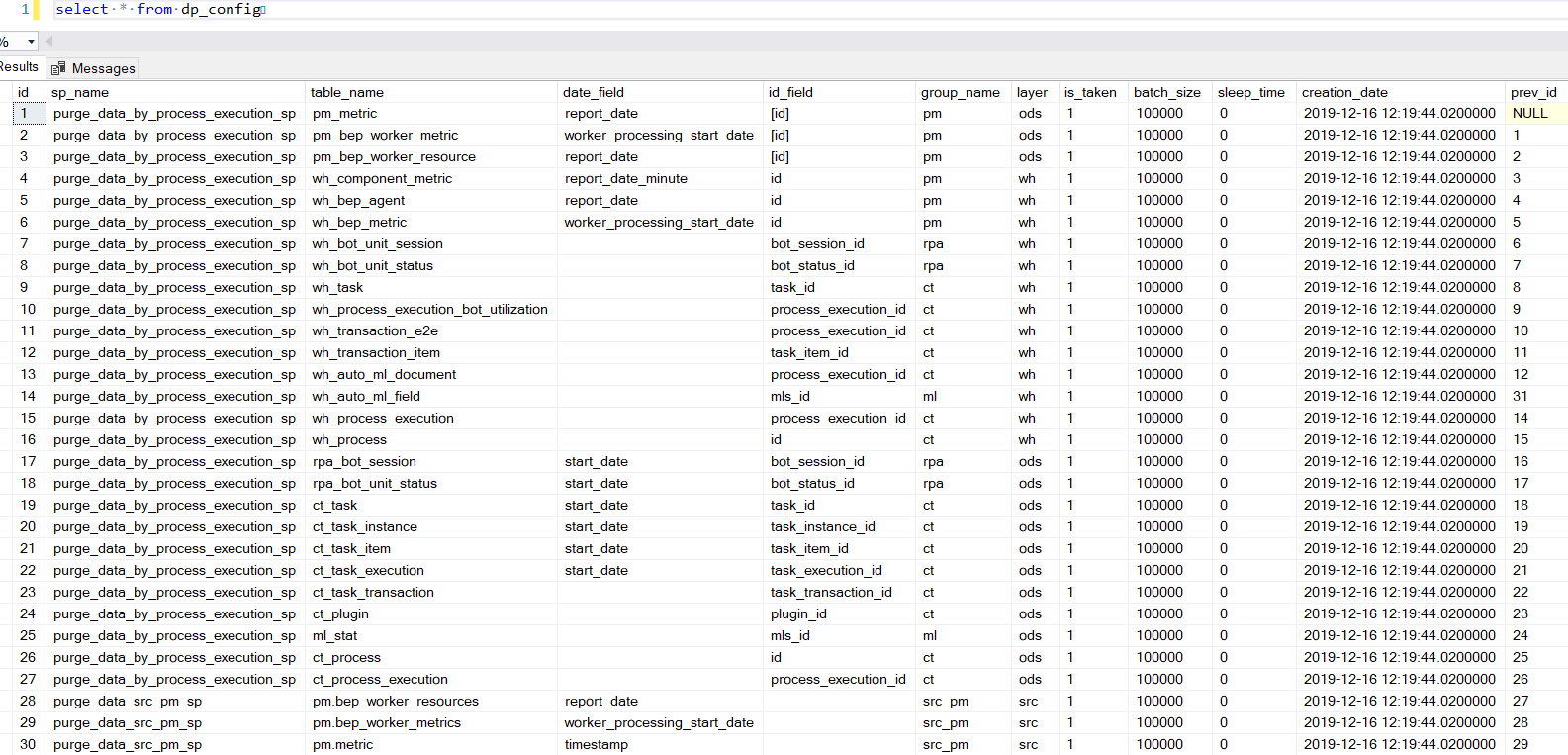
dp_config
The table stores the settings for purging data per table. For Data Purge to run correctly, it should have at least one row with the is_taken = 1 flag.
| Schema | Table | Description |
|---|---|---|
| pm | metric | Source table with system metrics, such as CPU, disk, and memory usage, for all components |
| pm | bep_worker_metrics | Source table containing the results of processing tasks of Bot Execution Platform (BEP) Agents |
| pm | bep_worker_resources | Source table with information about the consumption of resources by a BEP Agent |
| dm | pm_bep_worker_metric | Transitional table between the source and data warehouse containing the results of processing the tasks of BEP Agents |
| dm | pm_bep_worker_resource | Transitional table with information about the consumption of resources by BEP Aagents |
| dm | ct_task_instance | Transitional table with information about tasks per each BP step |
| dm | ct_task_execution | Transitional table with information about each assignment in a task for workers |
| dm | ct_task_item | Transitional table with information about each input record |
| dm | wh_bep_agent | Data Warehouse table with information about the resource consumption by a BEP Agent |
| dm | wh_bep_metric | Data Warehouse table containing the results of processing the tasks of BEP Agents |
| dm | wh_component_metric | Data Warehouse table with system metrics, such as CPU, disk and memory usage, for all components |
| dm | wh_transaction_item | Data Warehouse table with information about each input record or document in a BP |
| dm | wh_transaction_e2e | Data Warehouse table with aggregated statistics about each input record or document in a BP |
The stored settings are as follows:
id: increment bigint.sp_name: the nvarchar(255) name of the stored procedure to delete rows in a table.table_name: the nvarchar(255) name of the table.date_field: the nvarchar(255) name of thedatetimefield in thetable_nametable. Used when data deletion is based on a time range.id_field: the name of the identity column in thetemptable. It is used when data deletion is based on IDs.group_name: the name of the group to which the data belongs (pm,rpa,ct,ml,src_pm).layer:ods,wh, orsrc.is_taken: the flag to define whether the table is taken next time.batch_size: the count of rows to delete at a time. The default value is 100000. Limiting the rows is required for performance improvement. The count is to be investigated and depends on the size and load of your database.sleep_time: delay time in milliseconds before the next step begins. The default value is 0.prev_id: the ID of the previous step. If null, it's the first step in a sequence.
dp_log
The table stores the data set for a purge run:
id: increment bigint.sp_name: the nvarchar(255) name of the stored procedure.table_name: the nvarchar(255) name of the table.date_field: the nvarchar(255) name of thedatetimefield in thetable_nametable.purge_run_id: the increment integer to count purge sets. Each execution of the master procedure adds 1 to previouspurge_run_id.rows_cnt: the number of rows deleted per table.duration_sec: the duration in seconds of the Data Purge process per table.start_date: the date and time when the process started.end_date: the date and time when the process ended.status:okor an error message if something went wrong.
Additional reading
For information about other means to optimize Business Process data, refer to the article.