
OCR license
License categories
Base category includes supported languages, except Arabic, Farsi, Chinese, Japanese, Korean, Thai, Hebrew, Yiddish and Vietnamese.
CJK category contains "Base" category languages plus Chinese Traditional, Chinese Simplified, Japanese, Korean and Korean Hangul.
All category contains all supported languages (see the language list).
Activate license
FRE SDK location (Linux) /ABBYY_FRE11 FRE SDK location (Windows) /FineReaderEngine
After installation of OCR components, you'll find on OCR server the following file:
Linux location of license_request.txt file
<fre_sdk_dir>/license_request.txt
If you are doing the migration from old versions (pre 8.5), follow the steps below to reuse available number of pages in your new environment. First, get the number of unused pages from pre 8.5 versions.
Actions below should be repeated for all activated licenses for all OCR servers.
Run License Manager using any user.
export LD_LIBRARY_PATH=$LD_LIBRARY_PATH:<INSTALL_DIR>/apps/ABBYY/FREngine11/Bin
<INSTALL_DIR>/apps/ABBYY/FREngine11/Bin/LicenseManager.Console
License serial number and other license parameters can differ from samples.
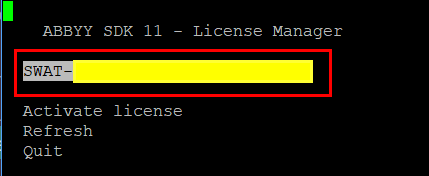
Select the activated license:
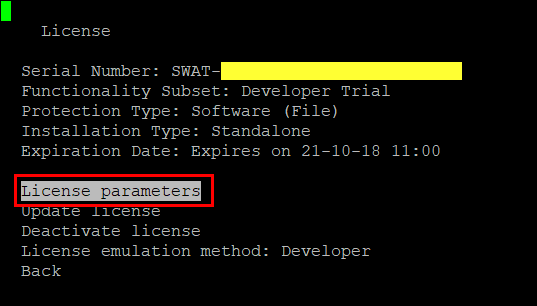
Open license parameters:
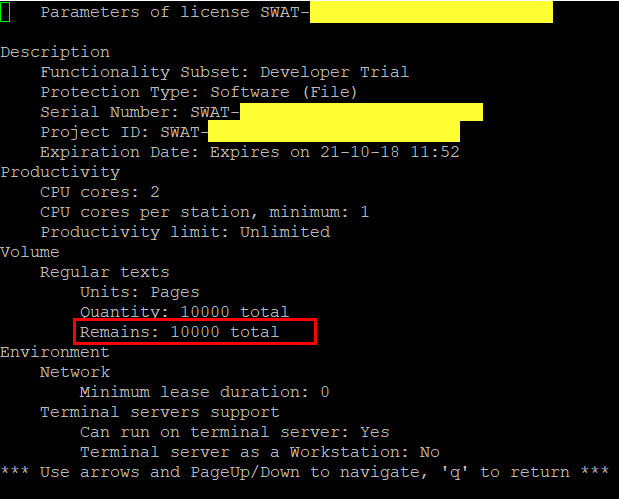
Make a screenshot of the first page. Ensure that the line with Volume → Regular Text → Remains is visible.
Request and activate license by sending an email to your account manager in WorkFusion or create a Service Desk ticket according to the template from the next step. Attach all license screenshots if remaining is greater than 0.
Send an email to your account manager in WorkFusion or create a Service Desk ticket according to the following template. Attach the
license_request.txtfile to the email:Dear Support Team, Please, provide OCR license according to the following requirements: Company name: ___ Number of pages to include: ___ *) Platform type:___ (Linux or Windows) Status of the server (Production, POC, UAT, DEV) ____ Category of languages: Base, or CJK (supports Chinese, Japanese, Korean), or All Token returned by the
prepareLicenseAPI: ___ (content of thelicense_request.txtfile on the OCR server).*) The number of OCR pages should be estimated during the POC based on the customer workload: if, during a day, they consume 1,000 pages, they need 30,000 pages to run the same for a month.
Non-prod licenses as stated below have some predefined values: 10K, 50K, or 100K pages, depending on the complexity of the customer workload. Ideally, request the minimal one.
The account manager is aware of the number o the pages included into the contract: it’s part of the negotiations with the customer.Pay attention that the cost of the license depends on the number of pages as well as the category. Make sure your contract with WorkFusion covers it.
If you have multiple OCR servers to balance the workload, request multiple OCR licenses–separately for each server.
In response to your email, WorkFusion will send you the license_response.txt file.
Copy the license_response.txt file to the following location on OCR server:
<fre_sdk_dir>/license_response.txtcaution
Mind that license_response.txt is valid for three days only and should be activated within this period.
If you haven't managed to activate the license during this time, request the WorkFusion Support team to re-issue the license_response file.
Navigate to <fre_sdk_dir>/ directory on your OCR server and execute script according to the configuration:
activate_wf.sh on Linux
activate_ocr.bat on Windows in SPA
Example:
cd <fre_sdk_dir>/
./activate_wf.sh
If everything is OK, the command reports a success result like this:
{"message":{"content":"License Activation Succeeded"}}
note
Take into consideration that if the category of a newly activated license is different from your previous one, the change will take effect immediately after the activation. Even if you have a lot of pages left from your previous license.
Verifying license
After activation you may check the state of your active license. For that use activeLicense API. You need to SSH into OCR server firstly.
If authentication is disabled (auth-disabled profile is configured), no authentication header is needed and the command looks like this:
curl -s http://localhost:9002/api/v1/cloud/activeLicense | python -m json.tool
If authentication is enabled, the command looks like this:
curl -s -H "Authorization: ..." http://localhost:9002/api/v1/cloud/activeLicense | python -m json.tool
In place of ..., provide credentials according to the OCR Service configuration.
The header can look either like "Authorization: Basic
your_username_pwd_base64" for basic authentication or "Authorization: Bearer your_jwt_token" for JWT authentication .
Reporting OCR usage
If you use "pay as you go" type of license, you activate it once per installation and don't need to activate more licenses later. Instead you need to report license consumption April 1, July 1, October 1, January 1. Send the consumption information to WorkFusion using the steps below:
SSH into OCR server and invoke the following command:
curl -X POST http://localhost:9002/api/v1/cloud/activeLicenseCopy the output of the above command and send it to the WorkFusion support.