Manage trained models
To access a list of available trained models, select AutoML > Trained models. Control Tower updates the list every time you complete a model training, or a new trained model is deployed to your environment.
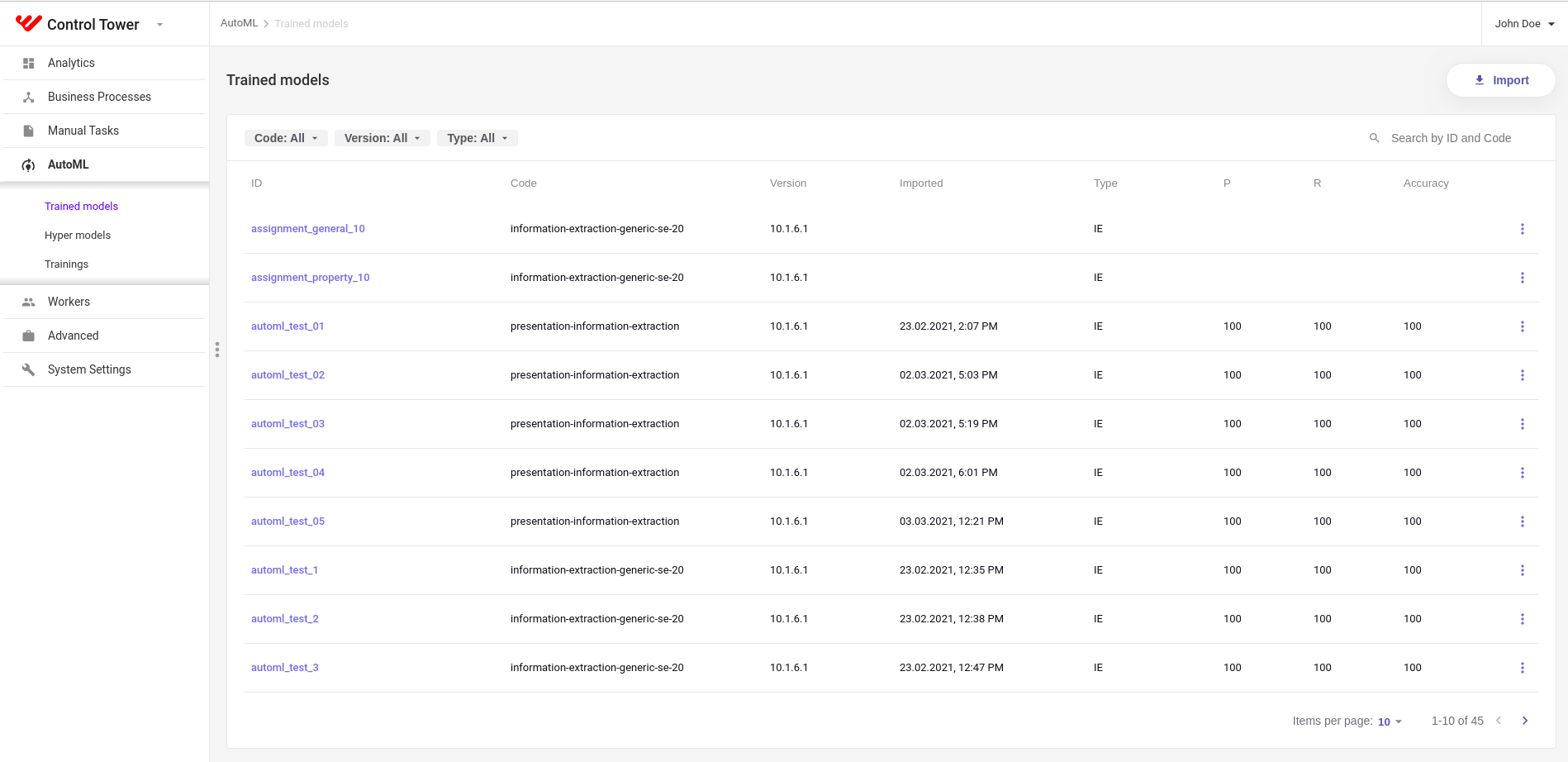
From the list, users can also find out the following information about available trained models:
| Column | Description |
|---|---|
| ID | The model identifier specified by users in the course of model training. |
| Code | The associated hyper model identifier specified in its source code description. |
| Version | The associated hyper model version specified in its source code description. |
| Imported | The date and time (dd.mm.yyyy, hh:mm) when the trained model was added to your environment. New models appear in an environment either via explicit import operations or after training. |
| Type | The problem type the trained model can solve (for instance, information extraction). |
| P | Precision of the trained model calculated based on training results. |
| R | Recall of the trained model calculated based on training results. |
| Accuracy | Accuracy rate for the trained model calculated based on training results. |
View parameters
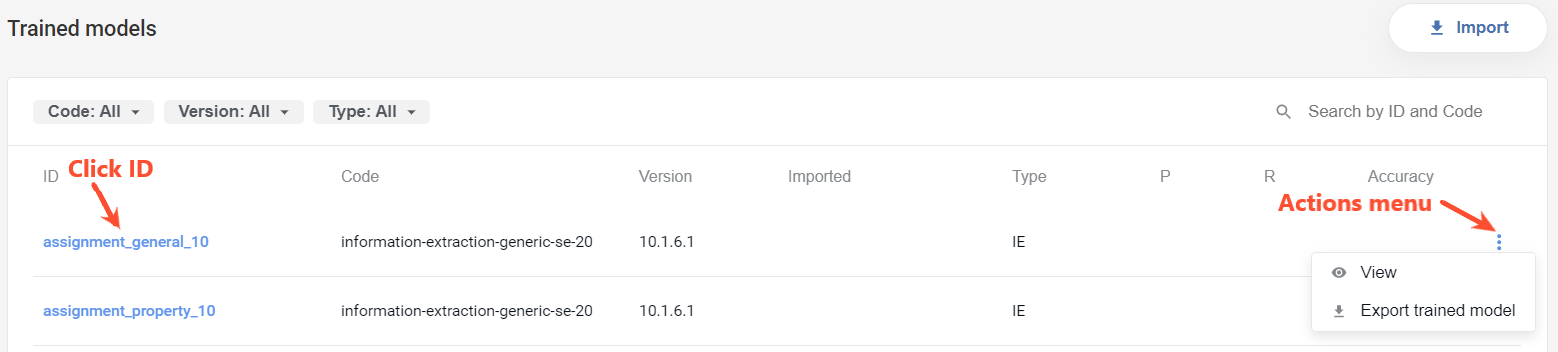
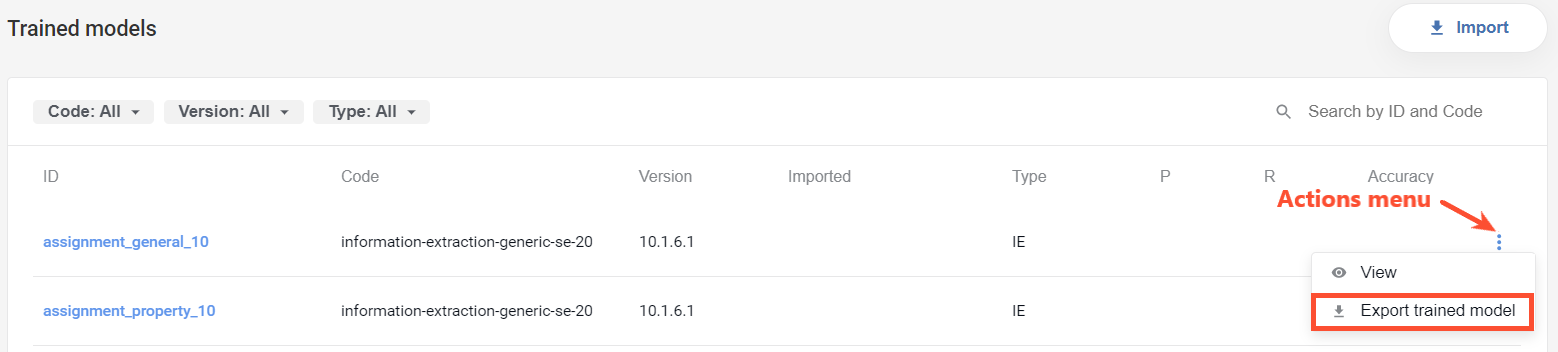
To view the parameters of a particular trained model, either click its ID in the list or open its Actions menu and select View.
The displayed page contains the following information about a particular trained model:
- Code
- Version
- Import timestamp (dd.mm.yyyy, hh:mm)
- Type
- Environment
- Associated model data
- Statistics
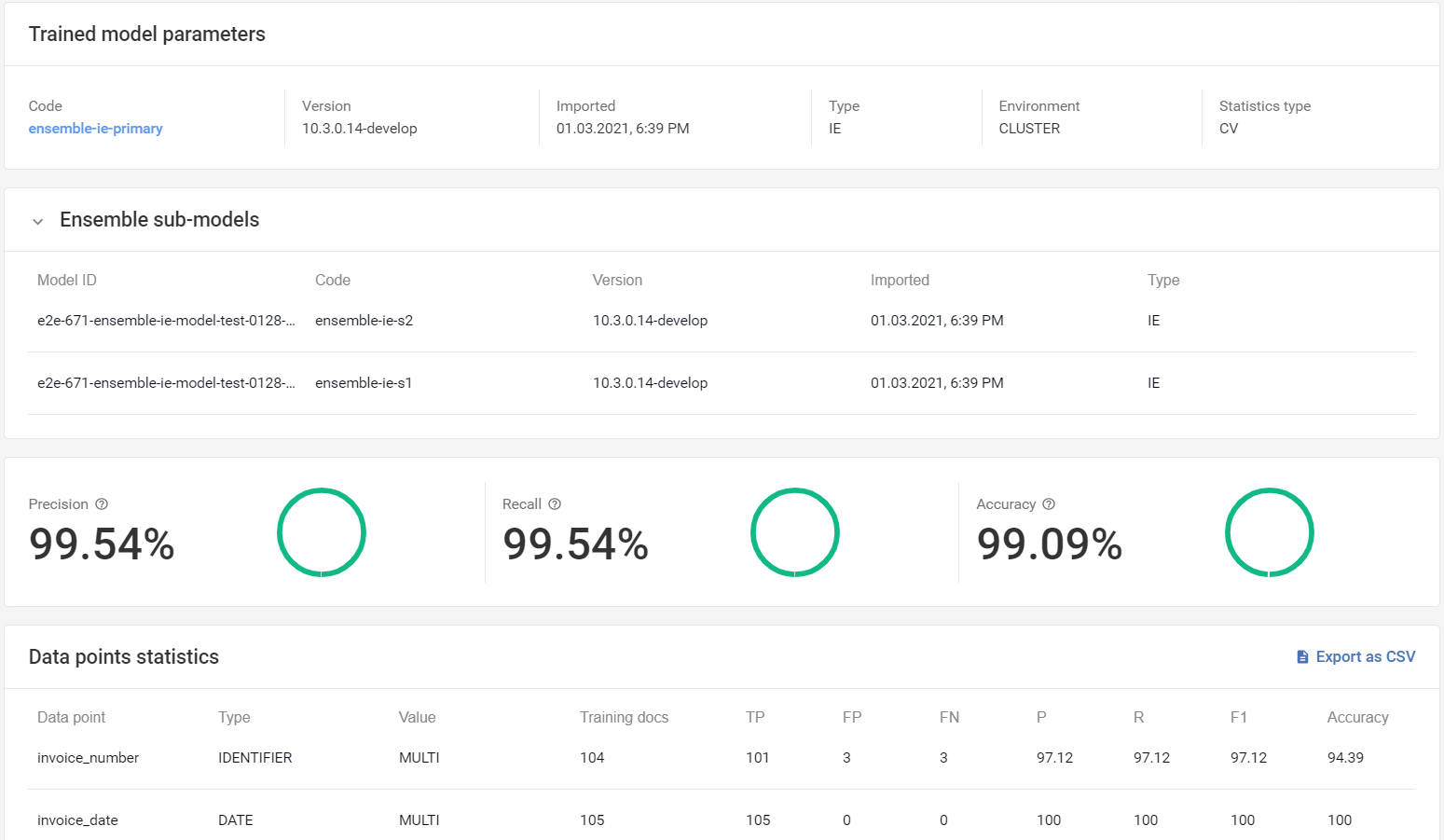
From the page, you can also export data point statistics (if available) by clicking Export as CSV.
Filter and search
You can filter the list of displayed trained models based on any or all the three criteria:
- Associated hyper model code
- Associated hyper model version
- Trained model type
To apply the criteria, click one or more filter buttons at the top of the trained model list and select required items or find them using the search box. Filters turn blue as they become active, and the items in the trained model list change accordingly.
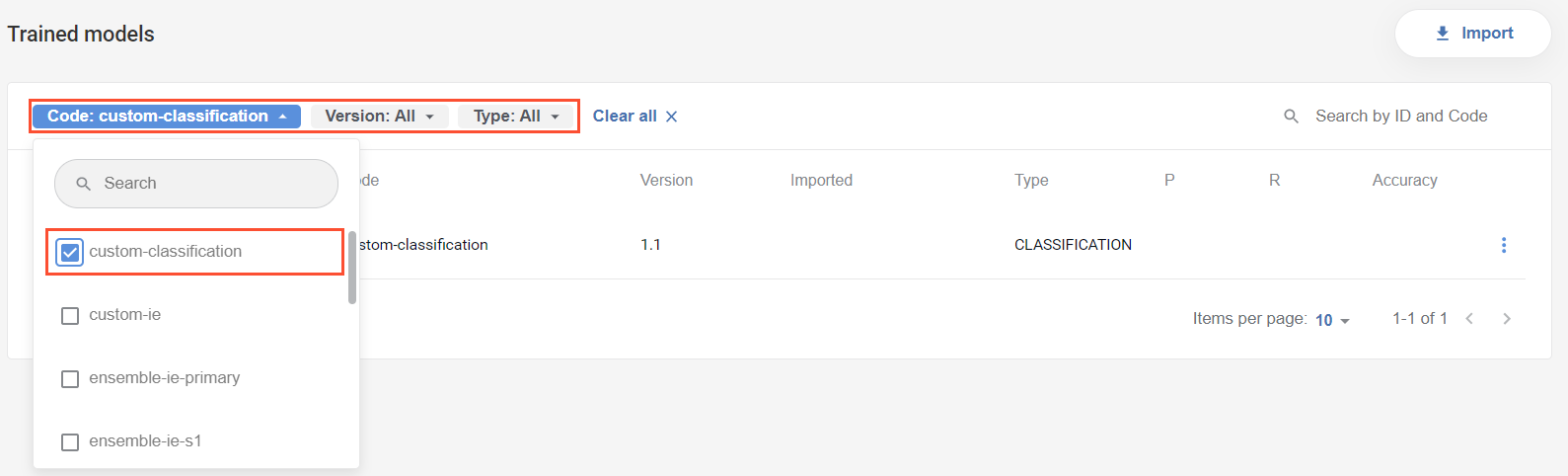
To turn off an active filter, click it again. To reset them all, click Clear all.
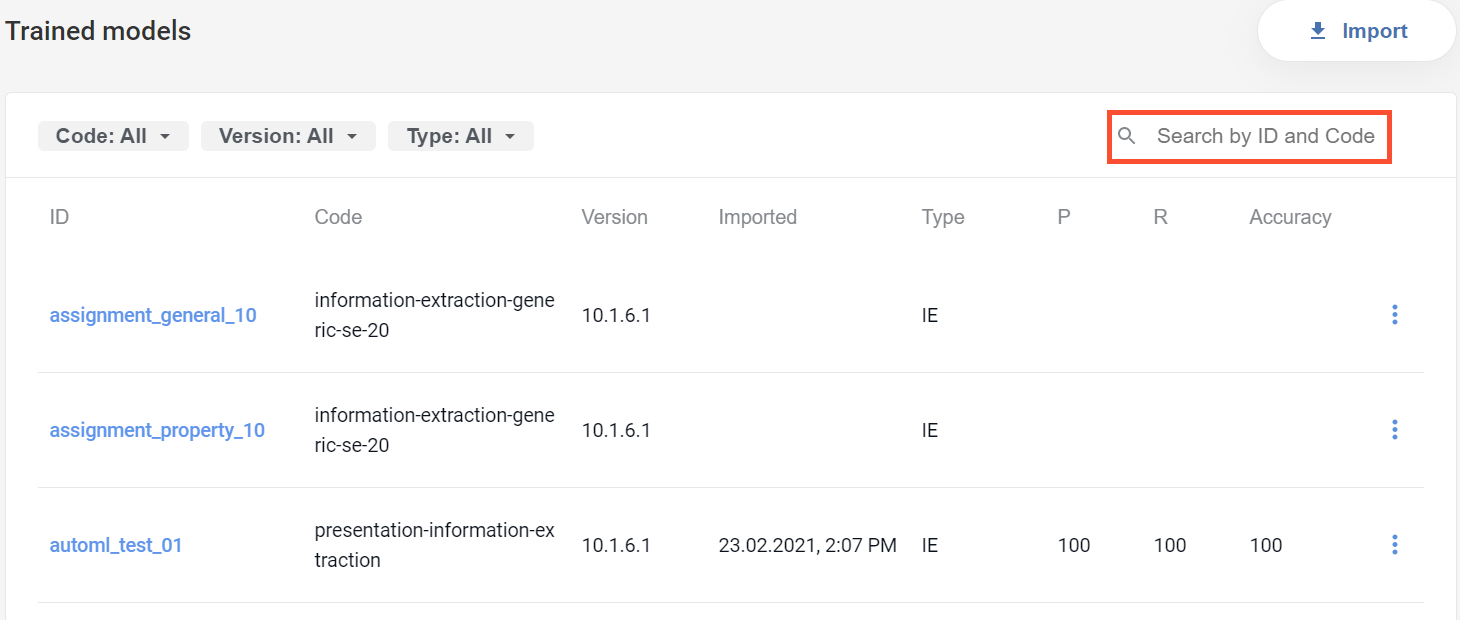
You can also search the list for particular trained models using the Search by ID and code box in the top right corner.
Export
You can export a trained model as a bundle (zip archive) in one of the two ways:
Open the Actions menu and select Export trained model.
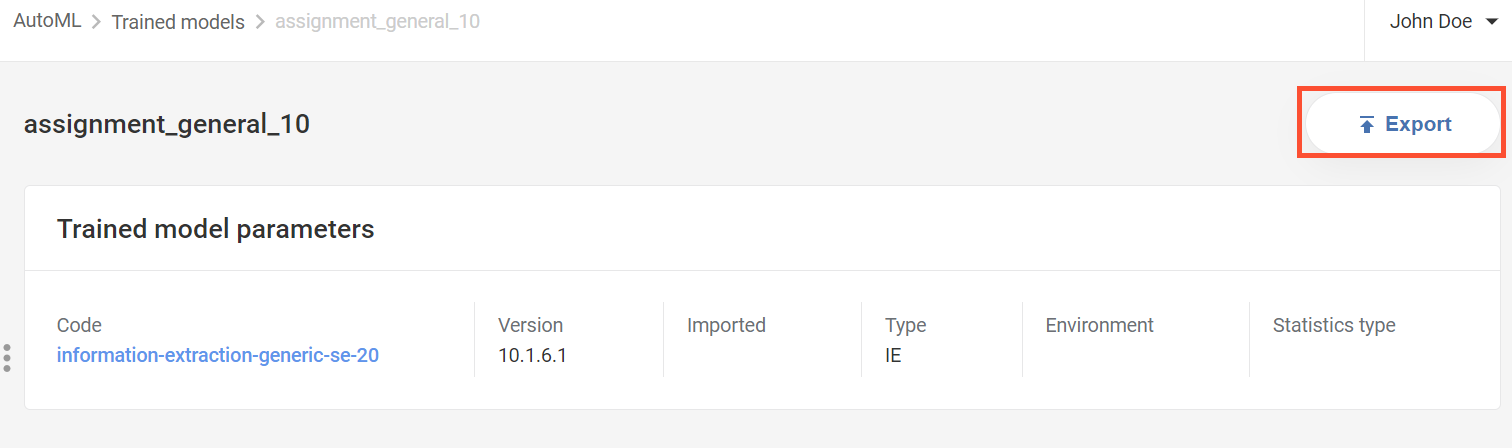
Click the trained model's Code. On the parameter page, click Export.
The resulting zip bundle contains a model (training output) and a hyper model (artifact).
Import
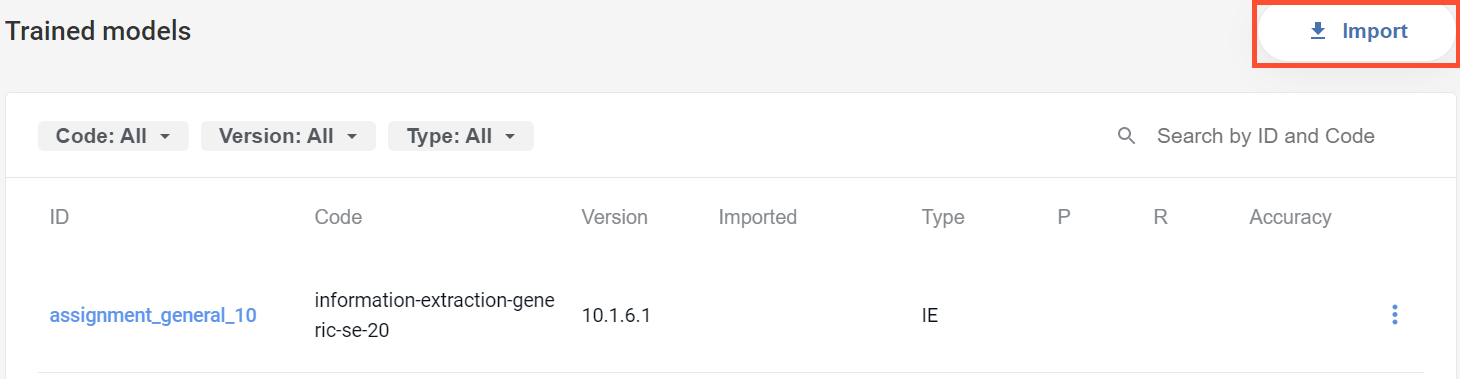
To import a trained model as an Asset Bundle (zip archive) to your environment, click the Import button in the top right corner of the Trained models page.
important
An imported bundle can include only hyper models (artifacts) and trained models. When the bundle contains any other assets, the import fails.
In case you import trained models only, associated hyper models must be already deployed to the target environment. Otherwise, the import fails.
The import status is visible above the trained model and hyper model lists. The following statuses are possible:
Uploading: the bundle is being uploaded to Control Tower. At the stage, users can stop the procedure by clicking the Stop (cross-shaped) button.

Importing: models and artifacts are being uploaded to your environment. At the stage, users can no longer stop the procedure.

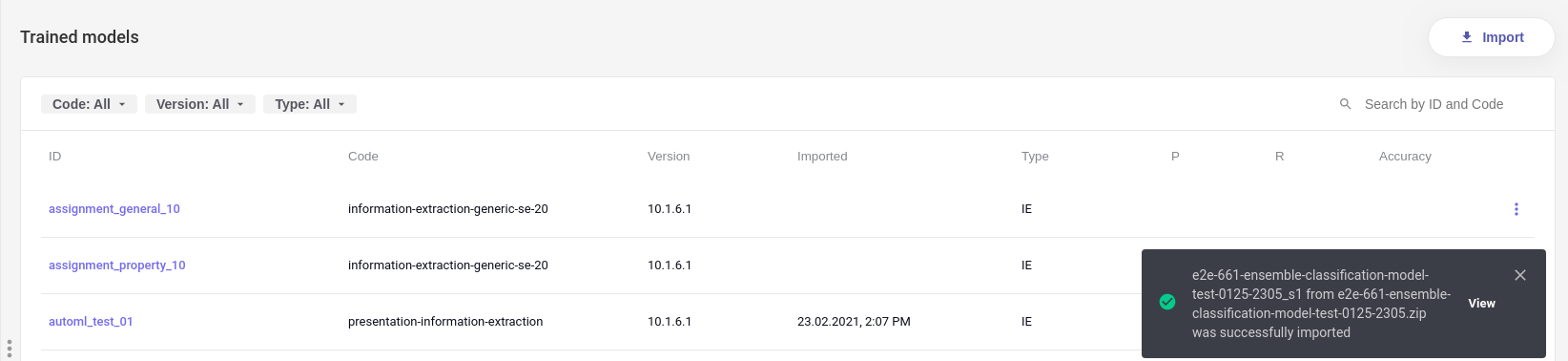
Success: the status appears once the assets from the bundle are moved to the target environment. It disappears automatically after about 15 seconds, or you can click the close button.
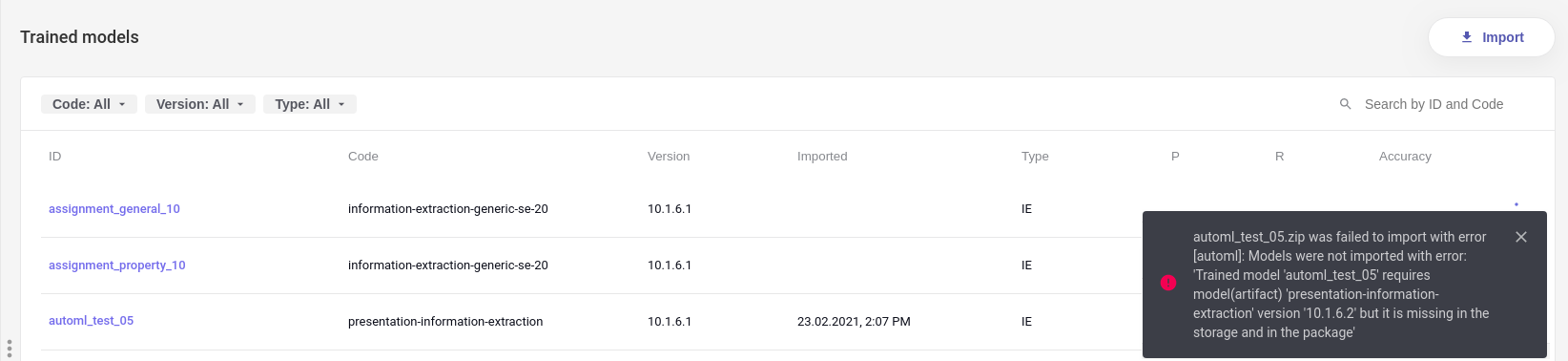
Failed: the status appears for each error. Users need to close the messages manually. Those assets that were imported before the error (if any) appear in the trained model and hyper model lists accordingly.