
High Availability and Disaster Recovery
High availability
High availability is the characteristic of an IT system or service to protect against or recover from minor outages in a short time frame in largely automated fashion.
Main keywords:
- Minor outages
- Short time frame
- Automated
Disaster recovery
Disaster recovery is the ability to continue with IT service(s) in case of major outages, often with reduced capabilities or performance. Disaster recovery solutions typically involve manual activities.
Main keywords:
- Major outages
- Manual
IT services classification
Max minor outage HA scenario |
Max major outage DR RTO |
Max data loss DR RPO |
|
|---|---|---|---|
| Mission critical | 10 min | 8 hours | 2 hours |
Business essential |
1 business hour | 3 days | 1 day |
Business necessary |
1 business day | 1 week | 1 day |
- Mission critical systems: absolutely required for an organization or for business operations. Failure or disruption of mission critical system will result in serious impact on business operations or upon an organization.
- Business essential systems: support day-to-day business operations. Examples of such systems are customer accounting, stock-trading, ERP, and so on.
- Business necessary systems: contribute to the smooth operations and comfortable working conditions. Failure of such systems will have a modest impact on business operations.
Out of scope
Max minor outage |
Max major outage |
Max data loss |
|
|---|---|---|---|
Safety critical |
1 min | 2 hours | |
Business desirable |
> 1 week | > 1 month | 1 week |
Safety critical systems: failure would cause a significant safety risk for the people and/or environment involved. Examples are: life support systems, nuclear reactor monitoring, emergency services dispatch, airplane fly-by-wire.
High availability and disaster recovery of safety critical systems are handled by conceptually different approaches, and are out of scope in this context.
Business desirable systems: improve efficiency of business operations and enhance the organization's performance. Failure of such systems will have a negligible impact on business operations. Recovery can be as simple as fresh install. Out of scope in this context.
Objectives
What:
Business continuity is the overall business objective.
IT service continuity is the derived objective for IT service provider to support the overall business continuity.
How:
- IT management process is established to ensure incidents do not impact service delivery, and is usable within chosen service levels.
- IT service classification (mission-critical, business-important, and so on).
- Availability measurement. Established metrics from a business perspective.
Conceptual model
What:
Improved overall availability.
How:
Minor and major outage categories are defined and agreed for the given IT service.
Major outage is an IT service outages category, happen seldom, serious damage to IT system or/and big business impact. In context of the current topic the term "disaster" is used synonymically.
DR concepts:
- RPO (Recovery point objective): acceptable data loss
- RTO (Recovery time objective): acceptable downtime
For HA scenario assuming no operational data loss, as a result not using RPO term in HA context.
RTO is seldomly used in HA context, rather HA switchover, failover, crossover terms are used.
System model
Below describing typical approaches to high availability and disaster recovery and applicability to address the business requirements.
Cold StandBy
Cold StandBy is also referred to as Backup and Restore.
Overall backup and restore procedure is a must have, as main (e.g. for business-necessary DR) or secondary recovery approach.
Recovery strategy:
- Install and configure the system.
- Restore data from backup.
Data recovery strategy:
Max minor outage HA scenario |
Max major outage DR RTO |
Max data loss DR RPO |
|
|---|---|---|---|
| Mission critical | 10 min | 8 hours | 2 hours |
| Business essential | 1 business hour | 3 days | 1 day |
| Business necessary | 1 business day | 1 week | 1 day |
Warm StandBy
Warm StandBy is also referred to as Active-Passive.
In the case of a failure of the main components, these software components are started on the secondary hardware. Data is regularly mirrored to secondary system using replication or shared disk.
Pre-requisites:
- Software is installed and available on the secondary hardware.
Recovery strategy:
- Make sure main component(s) are shut down.
- Switch over to the secondary component(s).
- Start up secondary component(s).
Data recovery strategy:
Manual switch
Two drivers for going with manual switch:
- Risk mitigation. Especially for DR case, before switch to happen, per Business Continuity process: "disaster" need to be declated.
- Cost optimization. Build out of automatic switch can result in additional expenses for cluster software and effort.
For more details, refer to Warm StandBy.
Max minor outage HA scenario |
Max major outage DR RTO |
Max data loss DR RPO |
|
|---|---|---|---|
| Mission critical | 10 min | 8 hours | 2 hours |
| Business essential | 1 business hour | 3 days | 1 day |
| Business necessary | 1 business day | 1 week | 1 day |
Automatic switch
To facilitate shorter HA, a manual switch over approach is not sufficient anymore.
The process is usually automated using a cluster manager.
For more details, see Fail-Over Cluster.
Max minor outage HA scenario |
Max major outage DR RTO |
Max data loss DR RPO |
|
|---|---|---|---|
| Mission critical | 10 min | 8 hours | 2 hours |
| Business essential | 1 business hour | 3 days | 1 day |
| Business necessary | 1 business day | 1 week | 1 day |
Typical HA and DR deployment
HA and DR strategy can be defined separately for different components.
Commonly used deployment for HA and DR is depicted below.
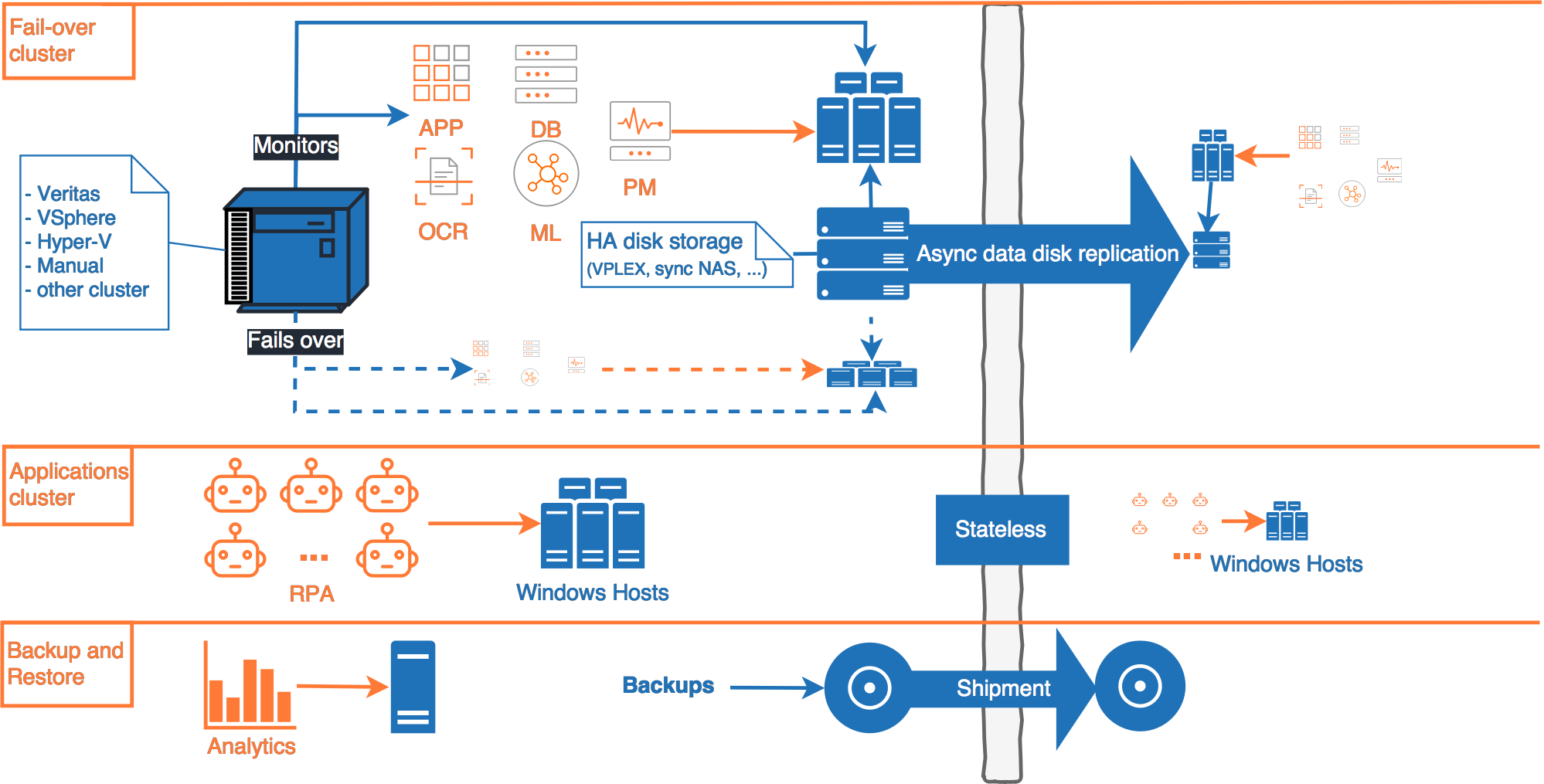
- Blue: infrastructure components
- Orange: WorkFusion components
Fail-over Warm StandBy cluster
For APP, DB, OCR, ML, PM.
It is implemented using established clustering solution:
- For example, using Fail-Over Cluster
- OR Warm StandBy with cluster software for automatic switch-over or with manual switch-over
When applied to Disaster Recovery case, Manual Switch-Over and Continuous replication are utilized.
Applications cluster
Out-of-the-box application cluster for RPA.
Enables seamless fail-over and enables horizontal scaling.
Backup and Restore
As a second line of defense for the case of cluster failure.
As well as the default recovery approach for Analytics (Analytics component is the least business critical, and as a rule has softer recovery objectives).
Also, see Backup and restore.
Useful external materials
Information Technology Infrastructure Library
More specifically: Availability Management and IT Service Continuity Management topics in ITIL 2011
High Availability and Disaster Recovery: Concepts, Design, Implementation
High Availability and Disaster Recovery: Concepts, Design,
Implementation
ISBN-13: 9783540244608
ISBN-10: 3540244603
Author: Klaus Schmidt
Edition: 2006