
Supervised production
Introduction
Supervised Production (SP) means stabilization and incremental FTE load-transfer to Bots.
Unsupervised production (UP) is fully-functional production Bot implementation. Data is flowing through the Business Process workflow, Bots are interacting with applications and processing data in autonomous way, only exceptions are processed manually.
The goal of supervised Production process is to provide a smooth transition from the existing process workflow to the automated Bot system, give a proper experience and confidence to the Business Team with the new approach.
Prerequisites and preparation
Environment
- Production infrastructure is properly configured and environment is ready for the Bot deployment.
- Business Systems and Applications are prepared for Bot interactions (created proper User Ids, granted access, and so on).
- Automation Business Processes are successfully tested on UAT and migrated to PROD (additional logs and timeouts may be added to initial transition stage to simplify monitoring).
Teams
- Business Team is trained and ready to monitor Bot execution and process exceptions: access to the Bot VDIs and WorkSpace environment is provided, audit logs are enabled and transaction analytics is set up.
- Infrastructure Team is making sure all systems are integrated and functioning.
- Automation Team is monitoring Business Process workflow, and prepared to fix issues in high-priority mode.
- WorkFusion product Support Team is monitoring Service Desk for any product-related bugs during transition.
Success criteria and SLA
- Transition timeline and phases are agreed between the teams.
- Baseline is set for a record/transaction processing time (i.e. SLA).
- Expected automation results are well-defined (for example, X% on N number of records).
- Out-of-scope cases (for example, known out-of-scope document types, invalid data values, and so on) are excluded from work and handled separately.
Transition phase
Normal flow
- Based on agreed schedule, process load is incrementally transitioned to the Bots (for example, 25% → 50% → 100%).
- Business Team is handling exceptions in WorkSpace.
- Results are being reviewed by the teams on a scheduled basis (for example, daily for initial transition phase).
Issues
- All occurring issues are triaged (reviewed and classified) by Automation and Business teams.
- Performance and stability issues are addressed by Infrastructure and Automation teams.
- Unclear or recurring issues like performance degradation or memory leaks are reported to the WorkFusion Support Team.
Final phase
- Production system is fully switched to the Unsupervised Production mode.
- All Bots are working in autonomous way.
- Business exceptions are manually handled by SMEs/Business Operations.
- Business and Automation teams are monitoring automation results through the BI/reporting tools.
- Customer IT is automatically alerted by infrastructure monitoring system in case of issues.
Example
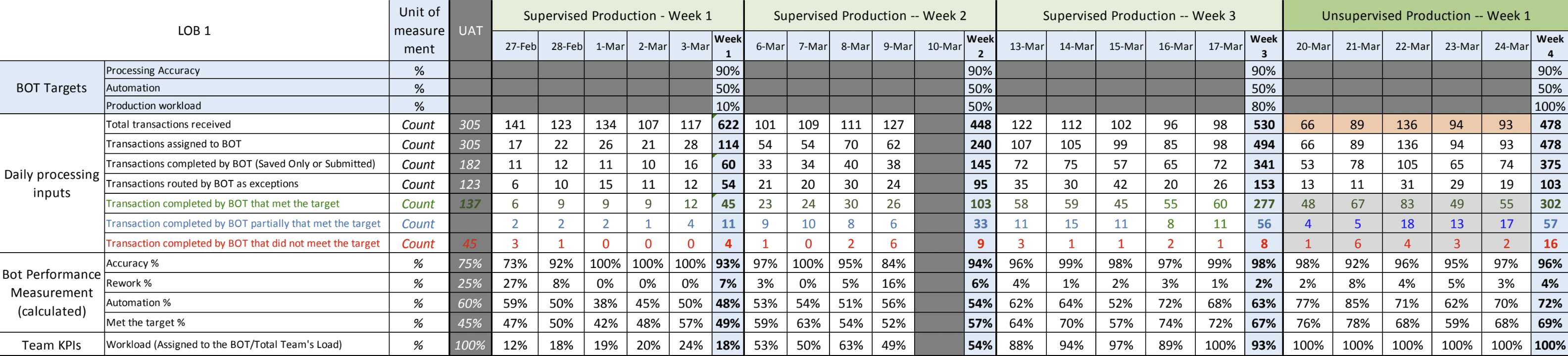
Load transfer: SP (25% load) → SP (50% load) → SP (100% load) → UP (100% load)