
Continuous replication
Replication
Replication involves the copying of data from one location or site to another for the following purposes:
- Ensure consistency between replicated software or hardware resources.
- Improve reliability and disaster recovery by assuring there are up-to-date copies of data across replicated sites.
- Increased fault-tolerance.
- Increased access to data across replicated sites.
Data replication is a best practice for database administration but can also be used for change control where the configuration at the primary site is replicated to the standby systems.
Purpose
The overall purpose of this document is to provide insight into different replication strategies for disk and data file replication.
Terminology
Data replication stores the same data on multiple storage devices.
Active replication is performed by processing the same request at every replica.
Passive replication involves processing each single request on a single replica and then transferring its resulting state to the other replica.
note
Load balancing differs from task replication, since it distributes a load of different computations across machines. It allows a single computation to be dropped in case of failure. Load balancing, however, sometimes uses data replication (especially multi-master replication) internally, to distribute its data among machines. Further, Backups differ from replication in that backups save a copy of data unchanged for long periods of time.
Disk storage replication
Real time storage replication is implemented by distributing updates of block device to several physical hard disks. This way, any file system supported by the operating system can be replicated and this is achieved by disk mirroring.
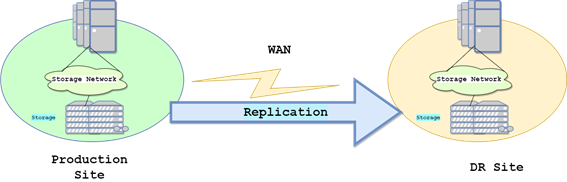
A replication is extendable across the network, so the disks can be located in physically distant locations.
The cross-site replication can be achieved by following three characteristics:
- Synchronous replication: guarantees zero data loss as an atomic operation (i.e. two-phase commits).
- Asynchronous replication: write is happens with a small lag, but helps in performance.
- Semi synchronous replication: replication guarantees that a transaction is correctly copied, but it does not guarantee that the commit on the slave takes place.
Examples of replication technologies
- Hypervisor-based replication (vSphere Replication, Hyper-V Replica)
- Distributed data storage (EMC VPLEX, and alike)
- Host/fabric/array-based replication
- SAN replication
- Asynchronous NAS (often used for long-distance replication for performance reasons)
- Synchronous NAS
- Storage Mirroring
- Azure Storage replication (LRS, ZRS, GRS, RA-GRS)
tip
The performance of the software and databases stored on network-based storage devices depends on the performance of the network connection between the server and the storage device.
For this reason, WorkFusion recommends that you connect the server to the storage device using a private dedicated network connection, which should be 1 Gigabit Ethernet or better.