
Fail-over cluster
Introduction
Modern Fail-Over Cluster implementations rely on specialized cluster management solution(s).
In virtualized environments, the fail-over cluster is as a rule built using the features provided by Hypervisor itself.
Hypervisor replication is a technology that automatically creates and maintains replicas of virtual hard disks or entire virtual machines (depending on the platform that is being used). There are various out-of-the-box features provided by modern hypervisor solutions to achieve disaster recovery and fail-over (high availability).
Replication approaches
This section provides details of various infrastructure service providers' approaches of replications.
VMware vSphere
VMware vSphere replication
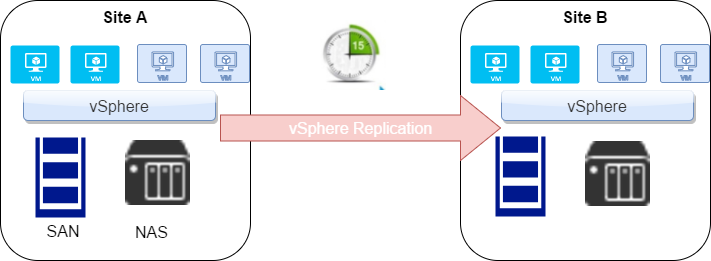
vSphere Replication is a hypervisor-based, asynchronous replication solution for vSphere virtual machines. It is integrated with VMware vCenter Server and the vSphere Web Client. vSphere Replication enables data protection and disaster recovery for the virtual machines in controlled environment.
VMware vSphere fault tolerance
Fault Tolerance is a vSphere feature that ensures virtual machine availability in the event of a hardware failure. Fault Tolerance works by maintaining a second “shadow” copy of a virtual machine, which is continually kept in-sync and up to date with the primary.
VMWare vSphere HA
vSphere HA provides high availability for virtual machines by pooling them and the hosts they reside on into a cluster. Hosts in the cluster are monitored and in the event of a failure, the virtual machines on a failed host are restarted on alternate hosts.
Microsoft Hyper-V
Hyper-V is Microsoft's hardware virtualization product. Hyper-V runs each virtual machine in its own isolated space, which means you can run more than one virtual machine on the same hardware at the same time. You might want to do this to avoid problems such as a crash affecting the other workloads, or to give different people, groups or services access to different systems.
Microsoft Azure Site Recovery
Site Recovery provides ability to set up and manage replication, failover, and failback.
Replication of on-premises VMs and physical servers to Azure, or to a secondary on-premises datacenter is supported.
VMware Workstation/Fusion/Player
VMware Player is a free virtualization hypervisor. This hypervisor technology can only run a single virtual machine (VM) and does not allow you to create VMs. VMware Workstation is a more robust hypervisor with some advanced features, such as record-and-replay and VM snapshot support. This hypervisor technology is better suited for running Windows and Linux on Macs.
Veritas Cluster Server
Veritas Cluster Server (also known as VCS or Veritas Infoscale Availabilty). It allows to deploy both local high-availability and remote clustering for a complete disaster recovery solution.
Red Hat Enterprise virtualization
Red Hat’s Kernel-based Virtual Machine (KVM) has qualities of both a hosted and a bare-metal virtualization hypervisor. KVM turns the Linux kernel itself into a hypervisor so VMs have direct access to the physical hardware. KVM in Red Hat Enterprise Virtualization offers many enterprise-level features and comes with a Windows-based management server for managing multiple KVM hosts. This hypervisor technology is not free, however, and while KVM has enterprise features and scalability, it lacks some of the more advanced features and application programming interfaces that VMware and Microsoft offer.
Choosing best hypervisor technology
There are various other hypervisor solutions are available beside above mentioned. But the selection of the right hypervisor starts with an important decision between bare-metal hypervisor or a hosted hypervisor.
Some important checklist points:
- Insist on excellent performance, simple management and an ability to be integrated into your virtual infrastructure.
- What about high availability? You will need to consider which are the best industry leading and price performing load balancers' or application delivery controllers (ADCs) available in the market today, these are vitally important to deliver your project and keep your servers up and running.
- Reliability
- Scalability
- Last but by no means not least cost, not only of deployment but also the cost of keeping these hypervisors running should never be underestimated.