
Taxonomy
The Taxonomy Answer Type can be used for classification of things such as products, businesses, and articles. In WorkFusion, you can use this answer type along with Data Stores.
How Taxonomy answer looks
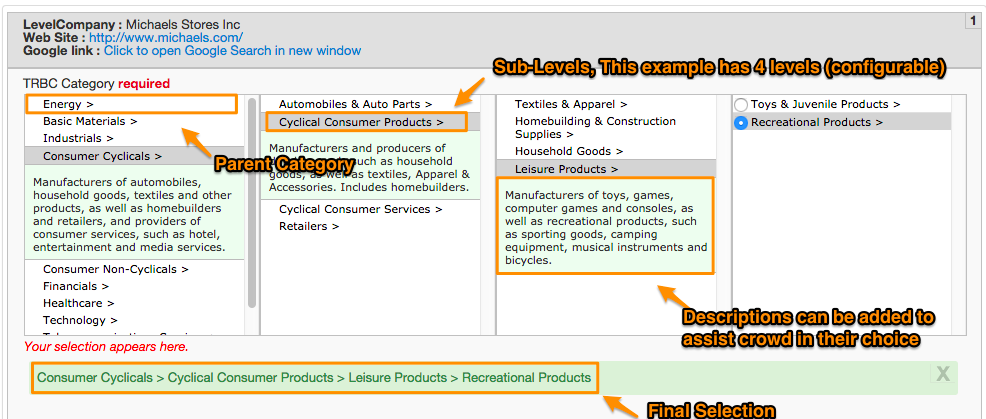
In this example, Worker is classifying a business into an industry category.
There are 4 Levels. Worker is displayed the corresponding sub-levels after choosing the parent category.This helps narrow down choices and increases accuracy and quality of work.
Set up Data Store
The Data Store containing the taxonomy needs the following columns:
ID (0 through [number of levels] - 1): this value will be submitted in the Answer
For above example we need id0, id1, id2, id3Category(0 through [number of levels] - 1): this value will be displayed for Workers.
For above example we need category0, category1, category2, category3Description(0 through [number of levels] - 1): this optional value will be displayed for Workers and is intended for describing the Category.
For above example we need description0, description1, description2, description3
Snapshot of the Datastore used for above example:

It contains the following columns: id0, id1, id2, id3, category0; category1, category2, category3; description0, description1, description2, description3
Category Columns: Contains the name of the category, category0 should contain the top-level category; category1 - the sub-level category and so on.
Description Columns (optional): Contains a description for the category. description0 should contain a description for the top-level category (in this example top level category is "Energy"). description1 should contain description for the first sub-level and so on.
ID Columns:
- id0 contains an id for the top-level category. Notice in this example, id0 is the same for all Energy records. id1 appends the id for the sub-level. "Energy > Fossil Fuels" for example is "5010" and so on.
- id3 (the last id column in this example - corresponding to the 4th level in task) will have all unique values.
note
ID Column does NOT need to be numbers. If your taxonomy does not contain corresponding internal ids, you can just use names of the category instead. For example, category0 and id0 can both be "Energy" etc.
Set up task with Taxonomy
The answer tree in the human task will look like this for the given example:
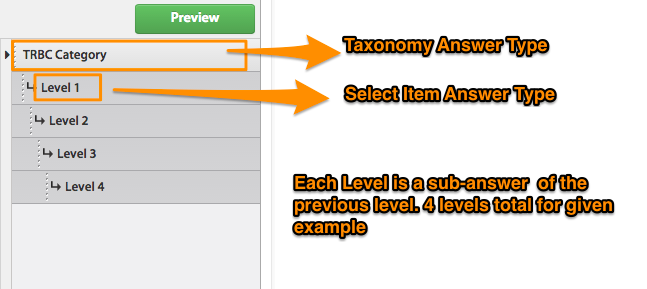
Let's take a look at how both answer types are set up.
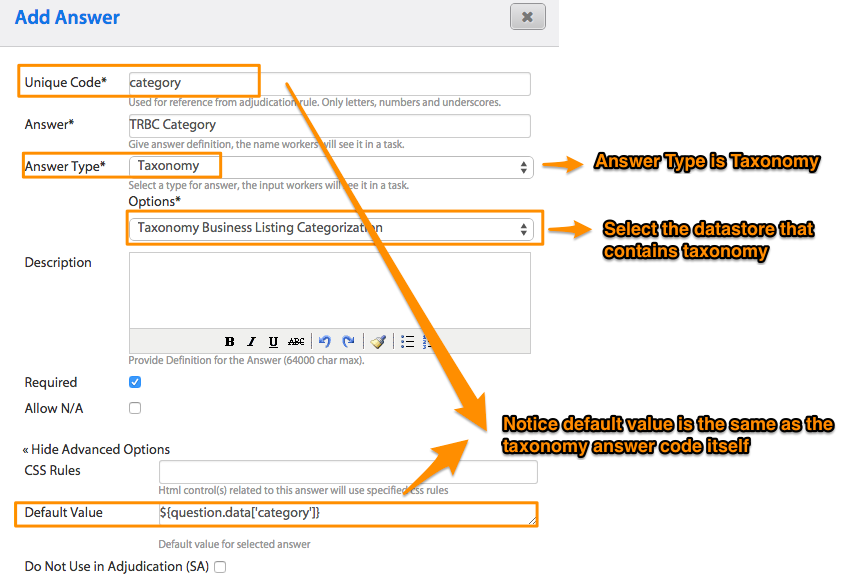
Taxonomy answer
Select answer type Taxonomy
Select the desired Data Store from the Options field that will pop up.
note
Notice that default answer uses the code of this answer type.
Only Data Stores with "category0" column are shown in the list. Thus, you can quickly scan all valid Data Stores and select the one you need.
Code of the answer type can vary. It does not have to be "category" as shown in the screenshot.
Select item answer
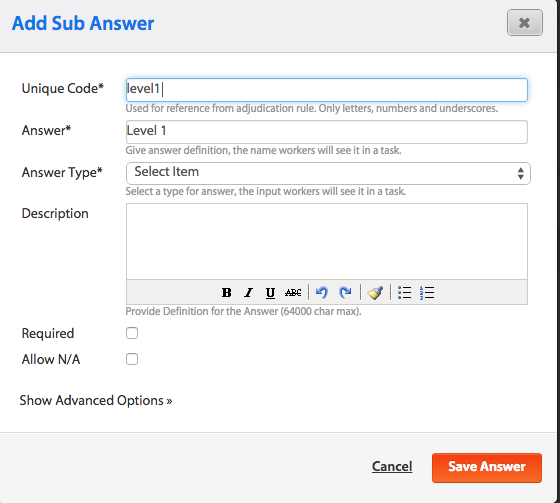
For this example we need 4 Select Item answers, all sub-answers of the previous answer for the 4 levels used in this example.
The point of importance here is the Unique Code. The unique code needs a digit at the end:
- "level1" corresponds to first level of the taxonomy (id0, category0, description0)
- "level2" corresponds to the second level of the taxonomy (id1,category1, description1) and so on
Output
The output of a taxonomy answer will have two parts. You will have two columns in the output:
- one that provides the ID that corresponds to the category (this will be the value of last id column). If you want to setup default value for this answer then you need to use this ID.
- another that provides a textual value of the category.
For this example, we will get the following:
In this example we get something like "50102034" and "Industrials > Industrial & Commercial Services > Diversified Trading & Distributing > Diversified Trading & Distributing"