Configure and run AutoML BP
In the previous step you have activated a Cognitive Bot in the Manual Task. Now, let's configure a AutoML Business Process.
Configure AutoML BP
In the Business Processes section, select your newly created AutoML BP to perform the following steps:
On the Data tab, click Upload Data, and map input columns with answer types, if needed.
Set up AutoML BP parameters: Due Date, Streaming, and so on.
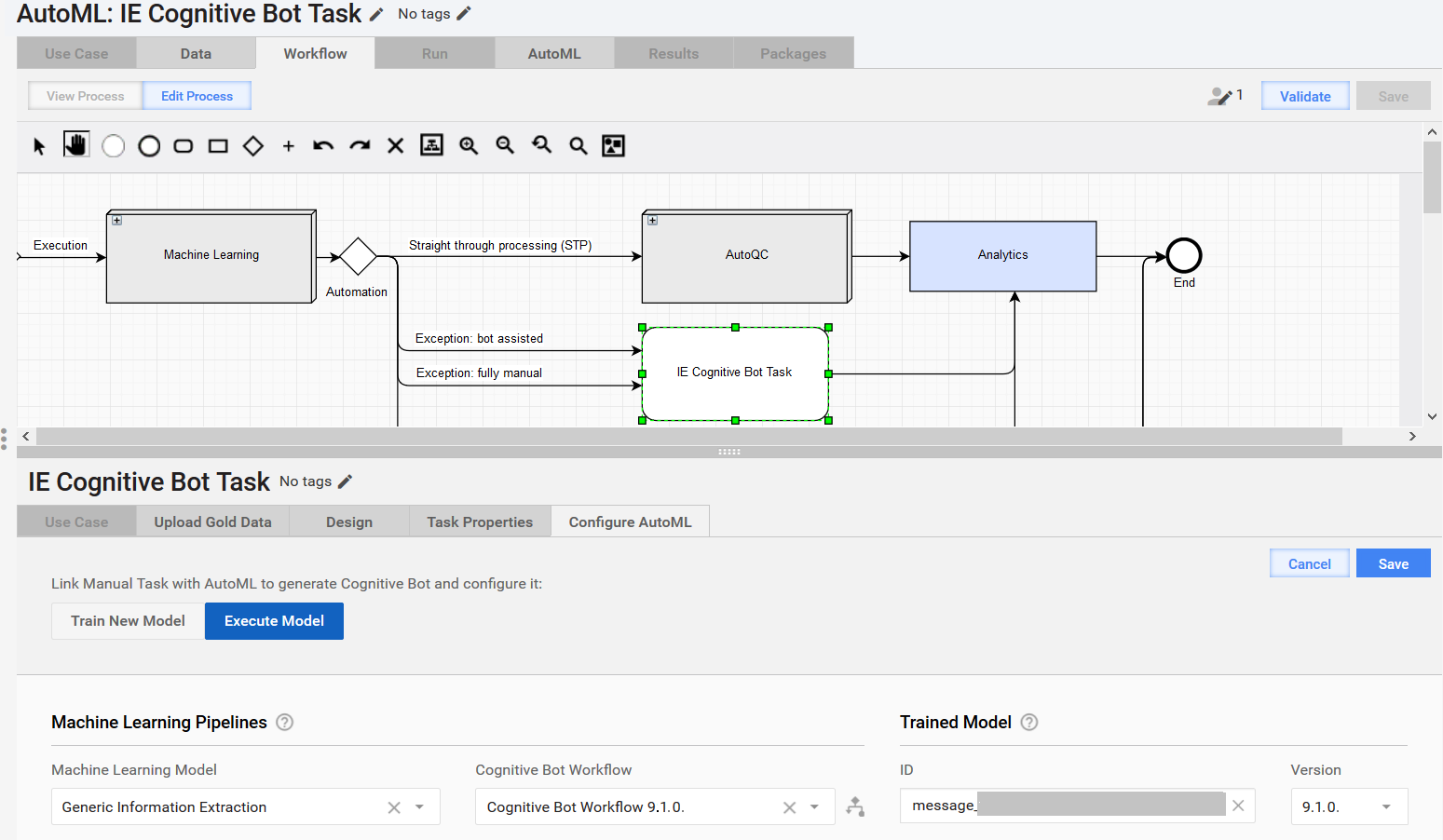
Set up model execution options. Navigate to the Workflow tab and select Manual Task > Configure AutoML > Execute Model.
note
By default, Machine Learning Model, Cognitive Bot Workflow, ID and Version are set according to the training configuration of the initial Manual Task.
- ID: Unique identifier of an experiment group of trained model (set on model training) in the following format:
[answer unique code]_runUUID. You can select other trained model ID from the list, and Cognitive Bot will apply a new selected trained model for execution. This list is not sorted by the Machine Learning Model type. - Version: Version of the selected Machine Learning Model. The list consists of available Machine Learning Models versions. The default value is a version used for the selected Machine Learning Model during training.
- ID: Unique identifier of an experiment group of trained model (set on model training) in the following format:
Run your AutoML BP.
known issue
Input column mapping may not work in the AutoML Business Process after activating the Cognitive Bot in the original Manual Task. To avoid this, provide input data files with column names that match answer codes.
You can optionally edit the AutoML BP bot steps, such as to enable or disable Auto Quality Control (AutoQC), or set data formats, and so on.
Monitor AutoML BP
You can monitor your AutoML BP progress on the BP diagram in the View Mode or on the Data tab.
Example: On the process diagram, 24 documents are uploaded as the input data with the following results:
- 18 documents are successfully extracted by the Cognitive Bot and then normalized.
- 6 documents are routed to human workers because the Cognitive Bot failed to extract information.
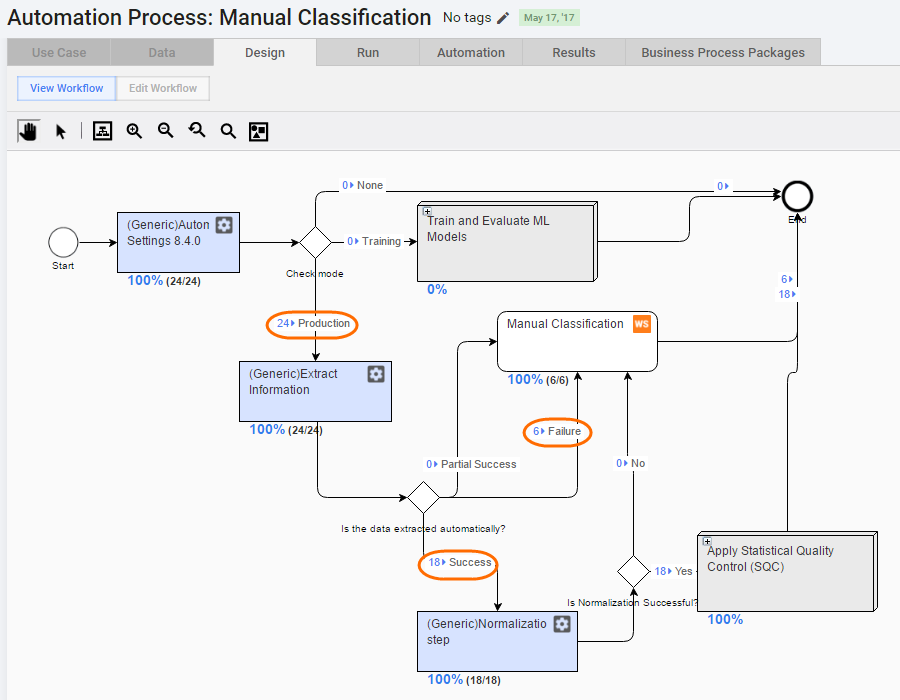
Mind that you still need to complete some number of Manual Tasks in these cases:
Automatic Extraction fails or is partially successful.
Data Normalization fails.
AutoQC is enabled.
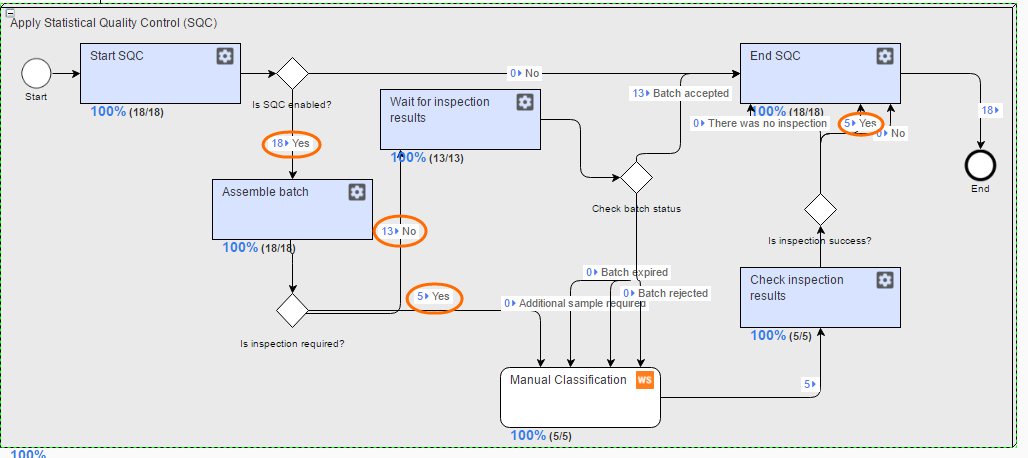
In the previous diagram, 18 documents are successfully extracted and normalized by the Cognitive Bot, and then routed to the AutoQC sub-process, of which:
- 5 documents are taken to inspection tasks for human workers to verify model results.
- 13 documents are put on hold until the inspection results.
Human workers provide the same answers as the Cognitive Bot (Manual Classification step). Therefore, the whole batch is approved and no additional inspection is needed.
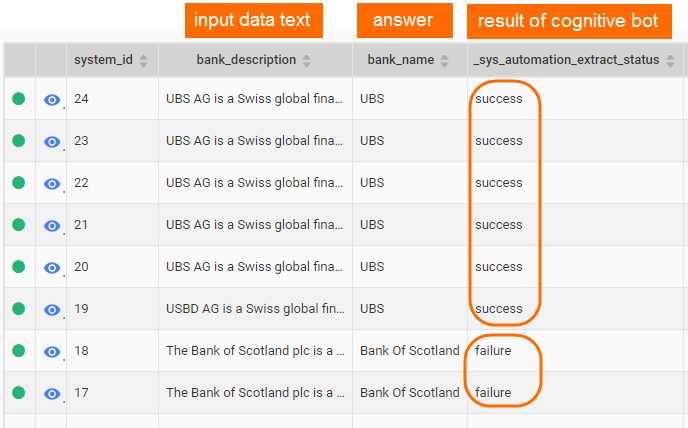
Finally, you get the resulting data partially generated by AutoML, partially submitted by human workers:
Training set update
After human workers process tasks in Workspace, all processed documents supplement training set for the model. Documents processed by human placed to automatically created training set in the following cases:
- Model was trained on other task (or on other instance) than model execution initiated. Once human processed at least one document and task status is Completed, then training set will be created automatically with processed documents.
- Model was trained on the task and training set that used for model training was added manually, then model execution was initiated for the same task. Once human processed at least one document and task status is Completed, then training set will be created automatically with processed documents.
- Task is created by copying a task from one of two previous cases, without changing the task name.
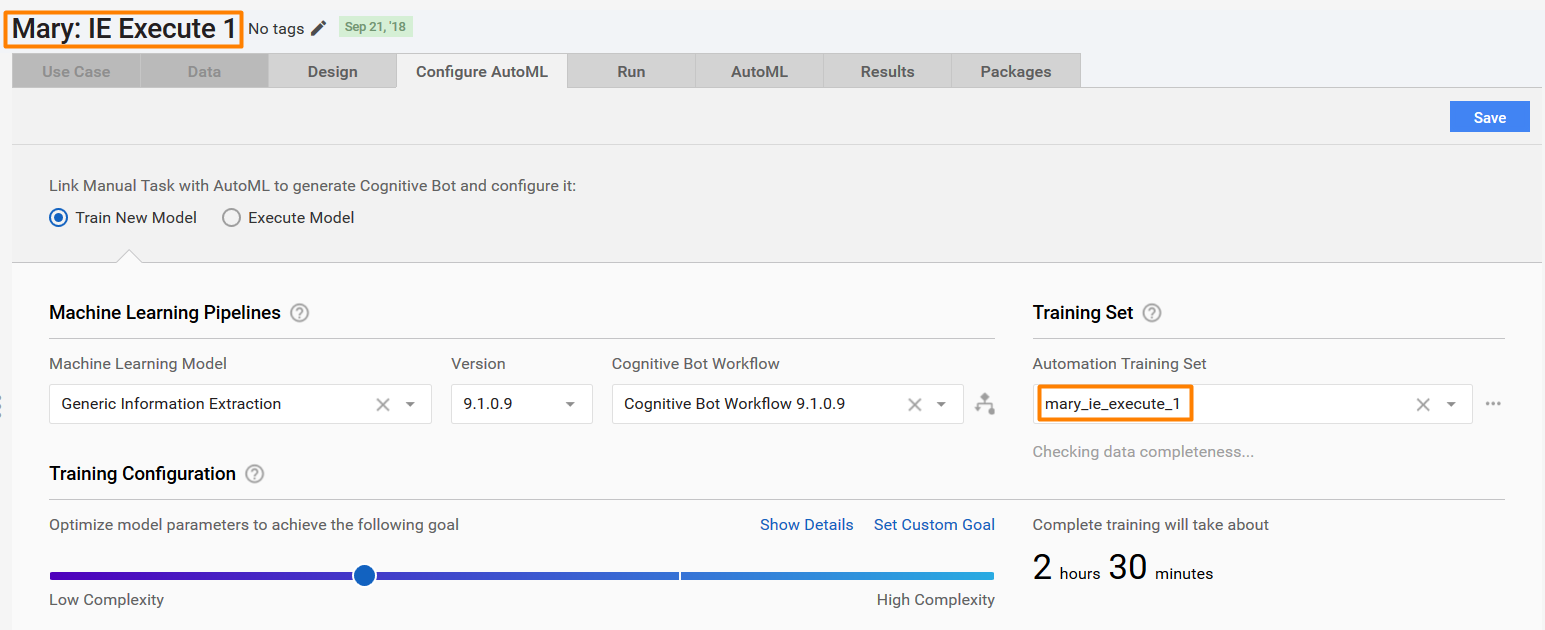
Automatically created training set has the same name as the Manual Task definition name with the following changes: uppercase is changed to lowercase, special characters are removed, spaces are substituted with underscores. Automatically created training set name can be found in the Train new model section of the Configure AutoML tab. The following example shows an automatically created Automation Training Set.