
Automate web elements
Automate basic authentication
Expand to view more
See the code below as an example:
<?xml version="1.0" encoding="UTF-8"?>
<config xmlns="http://web-harvest.sourceforge.net/schema/1.0/config" scriptlang="groovy">
<robotics-flow>
<robot name="webDriver" driver="internet explorer" close-on-completion="false" start-in-private="true">
<script></script>
</robot>
<robot name="desktopDriver" driver="desktop" close-on-completion="true">
<capability name="SEARCH_ALL_WINDOWS" value="true" />
<script></script>
</robot>
<robot name="webDriver" driver="internet explorer" close-on-completion="true">
<script></script>
</robot>
</robotics-flow>
<export include-original-data="false">
<single-column name="status" value="${status.toString()}"/>
</export>
</config>
Automate file download
Expand to view more
The example shows how to automate the Save File As system dialog. A file is saved by the Desktop driver.
tip
- To save a file on an RPA Node, use the
downloadFileOnAgent(String path)method. - To pass a file from an RPA Node to the Control Tower server, use the
downloadFileFromAgent(String path)method.
Your file is saved into the RPA Agent machine's temporary folder. To upload it on S3, use the S3 plugins.
You need to configure an S3 bucket first. To simulate the use of the S3 bucket, refer to Upload files to S3 Minio Storage.
The preconditions are as follows:
- Local disk D.
temp.bucketas the S3 bucket name or any other name. In the latter case, make the corresponding changes in the script.
Switch to Save As in IE 11 and use desktop driver
Expand to view code
See the code below as an example:
<?xml version="1.0" encoding="UTF-8"?>
<config xmlns="http://web-harvest.sourceforge.net/schema/1.0/config" scriptlang="groovy">
<robotics-flow>
<robot name="c3po" driver="internet explorer" close-on-completion="false">
<script></script>
</robot>
<robot name="bsod" driver="desktop" close-on-completion="true">
<capability name="SEARCH_ALL_WINDOWS" value="true"></capability>
<script><![CDATA[
// Switch to 'Save' dialog by Alt+N
switchTo().window('[CLASS:IEFrame]')
sendKeys(Keys.chord(Keys.LEFT_ALT, 'n'))
// By TAB > ARROW_DOWN > ARROW_DOWN > ENTER pull up 'Save As' and click context menu item
pressTab()
sendKeys(Keys.ARROW_DOWN)
sendKeys(Keys.ARROW_DOWN)
pressEnter()
// Switching to 'Save As' window
switchTo().window('[CLASS:#32770]')
// Entering full path of file to be saved
def tempPath = 'D:\\_temp\\'
uniqueId = "${UUID.randomUUID()}.json"
def savePath = tempPath + uniqueId
$('[CLASS:Edit;INSTANCE:1]').sendKeys(savePath).pressEnter()
// saving file content to a byte array
file_content = downloadFileFromAgent(savePath)
]]></script>
</robot>
<robot name="c3po" driver="internet explorer" close-on-completion="true"/>
</robotics-flow>
<!-- creating a file on S3 storage -->
<var-def name="file_s3_location">
<s3 bucket="temp.bucket">
<s3-put path="_r2d2/${uniqueId}" content-type="application/json" content-disposition="inline" acl="PublicRead">
<script return='file_content' />Download file in Chrome
The implementation does not guarantee correct parallel execution of the script on a single node.
Expand to view code
See the code below as an example:
<?xml version="1.0" encoding="UTF-8"?>
<config xmlns="http://web-harvest.sourceforge.net/schema/1.0/config" scriptlang="groovy">
<script><![CDATA[
// Set your Chrome default download directory here
downloadDir = 'C:/Users/Your Username/Downloads/'
getLastModifiedFileName = {RemoteWebDriver aDriver, String dirPath ->
return (String) aDriver.executeScript(
" File dir = new File(\"" + dirPath.replace('\\', '/') + "\");\n" +
" File[] files = dir.listFiles();\n" +
" if (files == null || files.length == 0) {\n" +
" return null;\n" +
" }\n" +
"\n" +
" File lastModifiedFile = files[0];\n" +
" for (int i = 1; i < files.length; i++) {\n" +
" if (lastModifiedFile.lastModified() < files[i].lastModified()) {\n" +
" lastModifiedFile = files[i];\n" +
" }\n" +
" }\n" +
"return lastModifiedFile.getAbsolutePath();"
, "GROOVY");
}
getFileContent = {RemoteWebDriver aDriver, String absoluteFilePath ->
Object res = aDriver.executeScript(
"def bytes = new File('" + absoluteFilePath.replace('\\', '/') + "').bytes; \n"
+ "return Base64.getEncoder().encodeToString(bytes);", "GROOVY");
byte[] content = Base64.getDecoder().decode(res.toString());
return content;
}
getDownloadedFile = {RemoteWebDriver desktopDriver, String downloadDir, String latestFilePath ->
String downloadFilePath = getLastModifiedFileName(desktopDriver, downloadDir);
// Wait until new file appears.
int maxCounter = 1000;
boolean downloadStarted = downloadFilePath != null && !downloadFilePath.equals(latestFilePath);
while (!downloadStarted && maxCounter > 0) {
Thread.sleep(10);
downloadFilePath = getLastModifiedFileName(desktopDriver, downloadDir);
downloadStarted = downloadFilePath != null && !downloadFilePath.equals(latestFilePath);
maxCounter--;
}
// Lets wait until latest file is not tmp or crdownload.
if (downloadStarted) {
maxCounter = 300;
downloadFilePath = getLastModifiedFileName(desktopDriver, downloadDir);
String fileExtension = org.apache.commons.io.FilenameUtils.getExtension(downloadFilePath);
boolean isDownloading = "crdownload".equals(fileExtension) || "tmp".equals(fileExtension);
while (isDownloading && maxCounter > 0) {
Thread.sleep(100);
downloadFilePath = getLastModifiedFileName(desktopDriver, downloadDir);
fileExtension = org.apache.commons.io.FilenameUtils.getExtension(downloadFilePath);
isDownloading = "crdownload".equals(fileExtension) || "tmp".equals(fileExtension);
maxCounter--;
}
if (!isDownloading) {
return getFileContent(desktopDriver, downloadFilePath);
}
}
throw new Exception("Some issues during file download");
}
]]></script>
<robotics-flow>
<robot name="desktopDriver" driver="desktop" close-on-completion="false">
<script></script>
</robot>
<robot name="robotDriver" driver="chrome" close-on-completion="true"
start-in-private="true">
<script></script>
</robot>
<script></script>
</robotics-flow>
<!-- Upload to S3 or perform any other actions. -->
<!-- Export your values -->
<export include-original-data="true">
<single-column name="content" value="${documentContent}"></single-column>
</export>
</config>
Automate file upload
Expand to view more
See the code below as an example:
<?xml version="1.0" encoding="UTF-8"?>
<config xmlns="http://web-harvest.sourceforge.net/schema/1.0/config" scriptlang="groovy">
<robotics-flow>
<robot name="bb8" driver="desktop" close-on-completion="true">
<script></script>
</robot>
<robot name="webRobot" driver="internet explorer" close-on-completion="false" start-in-private="true">
<script><![CDATA[
def loginPage = 'http://mail.google.com'
def username = 'tuk.tuk.rpa@gmail.com'
def password = 'work4WorkFusion!1'
def mailSubject = 'Attach PDF'
def mailBody = 'This is an RPA message with attached PDF file.'
timeouts(20 * 1000)
// Login into the mail system
open(loginPage)
$('#identifierId').val(username).pressEnter()
$(byXpath("//*[@name='password']")).val(password)
$('#passwordNext').click()
// Populate new message fields
$(byText('COMPOSE')).click();
$(By.name('to')).val(username).pressTab()
$(by('placeholder', 'Subject')).val(mailSubject).pressTab()
$('.editable').val(mailBody).pressEnter()
// Start attaching file.
$(byXpath("//div[@class='a1 aaA aMZ']")).click()
]]></script>
</robot>
<robot name="r2d2" driver="desktop" close-on-completion="true">
<capability name="SEARCH_ALL_WINDOWS" value="true" />
<script></script>
</robot>
<robot name="webRobot" driver="internet explorer" close-on-completion="true">
<script></script>
</robot>
</robotics-flow>
<export include-original-data="false">
<single-column name="rpa_local_file_path" value="${filePath}"/>
</export>
</config>
The same example that uses the Universal Driver is as follows:
<?xml version="1.0" encoding="UTF-8"?>
<config xmlns="http://web-harvest.sourceforge.net/schema/1.0/config" scriptlang="groovy">

    <robotics-flow>
        <robot name="bb8" driver="universal" close-on-completion="true">
            <capability name="SEARCH_ALL_WINDOWS" value="true" />
            <script> <![CDATA[

                // Copy the file to the RPA machine.
                def s3Path = 'https://rpa-tutorial.s3.amazonaws.com/trainings/pdf-sample.pdf'
                filePath = downloadFileOnAgent(s3Path)

                def loginPage = 'http://mail.google.com'
                def username = 'tuk.tuk.rpa@gmail.com'
                def password = 'work4WorkFusion!1'
                def mailSubject = 'Attach PDF'
                def mailBody = 'This is an RPA message with attached PDF file.'

                timeouts(20 * 1000)

                // Login into the mail system
                openIE(loginPage)
                $('#identifierId').val(username).pressEnter()
                $(byXpath("//*[@name='password']")).val(password)
                $('#passwordNext').click()

                // Populate new message fields
                $(byText('COMPOSE')).click();
                $(By.name('to')).val(username).pressTab()
                $(by('placeholder', 'Subject')).val(mailSubject).pressTab()
                $('.editable').val(mailBody).pressEnter()

                // Start attaching file.
                $(byXpath("//div[@class='a1 aaA aMZ']")).click()


                // Attach file using "upload file" dialog.
                switchTo().window('[CLASS:#32770]')
                $('[CLASS:Edit;INSTANCE:1]').sendKeys(filePath)
                $('[CLASS:Button;INSTANCE:1]').click()

                switchTo().window('[CLASS:IEFrame]')
                $(byText('Send')).click()
                $(withText('Your message has been sent')).shouldBe(VISIBLE)
                sleep(3000)

            ]]></script>
        </robot>
    </robotics-flow>

    <export include-original-data="false">
        <single-column name="rpa_local_file_path" value="${filePath}"/>
    </export>

</config>
Automate drag-and-drop operations
Expand to view more
Some web applications have functionality allowing to drag web elements from one location and drop them on a defined area or even another web element.
These kinds of complex actions are not available in basic element properties. You can automate drag-and-drop actions using advanced user interactions.
The action chain generator implements the Builder pattern to create a composite action containing a group of other actions. It eases building actions by configuring an action chains generator instance and invoking its perform() method to get the complex action.
actions().dragAndDrop(
    $('From Selector'),
    $('To Selector'))
    .perform()
In this example, drag the Mystery & Thrillers folder from the left table to the Horror folder of the right side table.
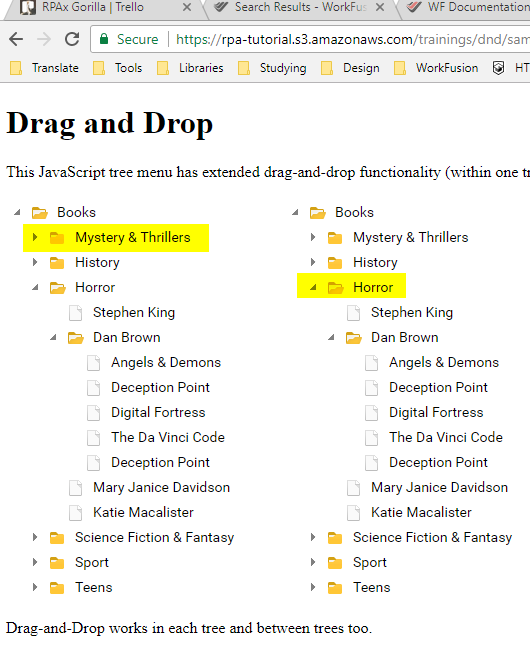
See the code below as an example:
<?xml version="1.0" encoding="UTF-8"?>
<config xmlns="http://web-harvest.sourceforge.net/schema/1.0/config" scriptlang="groovy">
    <robotics-flow exclusive="true">
        <robot driver="${driver}">
            <script><![CDATA[
                timeouts(10 * 1000)

                // open site
                open('https://rpa-tutorial.s3.amazonaws.com/trainings/dnd/samples/dhtmlxTree/05_drag_n_drop/12_tree_drag.html');

                // find base element
                element = $(byXpath('//*[@id="treeboxbox_tree"]/div/table/tbody/tr[2]/td[2]/table/tbody/tr[2]/td[2]/table/tbody/tr[1]/td[4]/span'));

                // find target element
                target = $(byCssSelector('#treeboxbox_tree2 > div > table > tbody > tr:nth-child(2) > td:nth-child(2) > table > tbody > tr:nth-child(4) > td:nth-child(2) > table > tbody > tr:nth-child(3) > td:nth-child(2) > table > tbody > tr:nth-child(1) > td.dhxTextCell.standartTreeRow > span'));

                // get base element center coordinates
                int elementX = element.getLocation().getX()+element.getSize().width/2;
                int elementY = element.getLocation().getY()+element.getSize().height/2;

                // get target element center coordinates
                int targetX = target.getLocation().getX()+target.getSize().width/2;
                int targetY = target.getLocation().getY()+target.getSize().height/2;

                // move mouse to base element and click and hold
                actions().moveByOffset(elementX, elementY).clickAndHold().build().perform();

                sleep(500);

                // move mouse to target element and click a click context for make realese
                actions().moveByOffset(targetX-elementX, targetY-elementY).build().perform();

                // for IE need to use next work around
                if(driver.toString().equalsIgnoreCase("internet explorer")) {
                    actions().contextClick().build().perform();
                } else {
                    // for all other drivers
                    actions().release().build().perform();
                }

                sleep(5000)
                ]]></script>
        </robot>
    </robotics-flow>
    <export include-original-data="true"/>
</config>
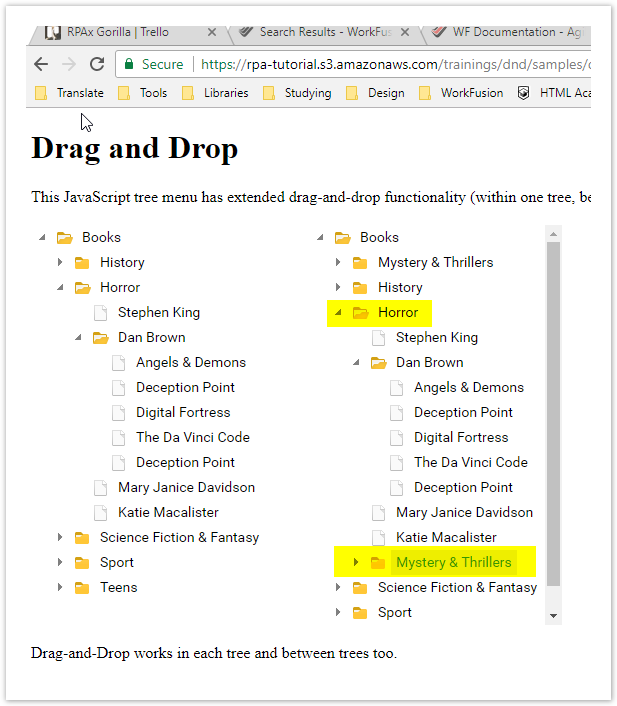
The Mystery & Thrillers folder is moved to the Horror folder. The new folder structure looks like this:
Automate checkbox and radio button operations
Apply selection methods
Expand to view more
Checkboxes and radio buttons deal the same way, and you can perform the below-mentioned operations on either of them. For a sample web form, refer to the sample personal information form.
ID
If ID is given for a radio button or a checkbox and you need to click it irrespective of its value, the command is like this:
open("https://rpa-tutorial.s3.amazonaws.com/trainings/iframe/form.html")
$(byId('sex-1')).click()
IsSelected
Apply the IsSelected method, if your choice is based on the pre-selection of the radio button or checkbox and you need to choose the deselected radio button or checkbox. Assume there are two radio buttons and checkboxes. One is selected by default, and you need to select the other one. With IsSelectedstatement, you can figure out whether the element is selected or not:
open("https://rpa-tutorial.s3.amazonaws.com/trainings/iframe/form.html")

// Store all the elements of the same category in the list of WebElements
oRadioButton = $$(byName('sex'))

// Create a Boolean variable that holds the value (True/False)
def bValue = false

// This statement returns True, if the first radio button is selected
bValue = oRadioButton.get(0).isSelected()

// This checks that if the value is True, the first radio button is selected
if(bValue){
    // This selects the second radio button, if the first radio button is selected by default
    oRadioButton.get(1).setSelected(true)
} else {
    // If the first radio button is not selected by default, the first one is selected
    oRadioButton.get(0).click()
}

sleep(2000)
The name is always the same for the same group of radio buttons or checkboxes, but their values are different. If you find the element with the name attribute, then it means that it may contain more than one element; hence you need to use the findElements ($$) method and store the list of WebElements.
Value
You can select radio buttons or checkboxes with their values.
open("https://rpa-tutorial.s3.amazonaws.com/trainings/iframe/form.html")

// Find the checkboxes
def oCheckBox = $$(byXpath("//div[@class='control-group'][14]/input"))

// This tells you the number of checkboxes are present
int iSize = oCheckBox.size()

// Start the loop from the first checkbox to the last one
for(int i=0; i < iSize ; i++ ){

    // Store the checkbox name to a variable using the "value" attribute
    def sValue = oCheckBox.get(i).getAttribute('value')                   // or oCheckBox.get(i).val()

    // Select the checkbox if the checkbox value is the same that you are looking for
    if (sValue.equalsIgnoreCase("Robotics Webdriver")) {
        oCheckBox.get(i).click()
        // This takes the execution out of the loop
        break
    }
}

sleep(2000)
CssSelector
To select a checkbox or a radio button, use its value.
open("https://rpa-tutorial.s3.amazonaws.com/trainings/iframe/form.html")

$("input[value='Robotics IDE']").click()


// or use the setSelected(true/false) method


$("input[value='QTP']").setSelected(true)
Example 1
Open https://rpa-tutorial.s3.amazonaws.com/trainings/iframe/form.html.
To select the deselected radio button (female) for the Sex category, use the
IsSelectedmethod.To select the third radio button for the Years of Exp category, use the
IDattribute.To check the Automation Tester checkbox for the Profession category, use the
Valueattribute to match the selection.To check the Robotics IDE checkbox for the Automation Tool category, use
cssSelector.<config xmlns="http://web-harvest.sourceforge.net/schema/1.0/config" scriptlang="groovy"> <robotics-flow> <robot name="webDriver" driver="internet explorer" close-on-completion="true" start-in-private="true"> <script><![CDATA[ timeouts(15000) open('https://rpa-tutorial.s3.amazonaws.com/trainings/iframe/form.html') // Step 3 : Select the deselected Radio button (female) for category Sex (Use IsSelected method) // Storing all the elements under category 'Sex' in the list of WebLements def rdBtn_Sex = $$(byName('sex')) // This statement will return True, in case of first Radio button is selected def bValue = rdBtn_Sex.get(0).isSelected() // This will check that if the bValue is True means if the first radio button is selected if(bValue == true){ // This will select Second radio button, if the first radio button is selected by default rdBtn_Sex.get(1).click() } else { // If the first radio button is not selected by default, the first will be selected rdBtn_Sex.get(0).click() } //Step 4: Select the Third radio button for category 'Years of Exp' (Use Id attribute to select Radio button) def rdBtn_Exp = $(byId('exp-2')) rdBtn_Exp.click() // STep 5: Check the Check Box 'Automation Tester' for category 'Profession'( Use Value attribute to match the selection) // Find the Check Box or radio button element by Name def chkBx_Profession = $$(byName('profession')) // This will tell you the number of Check Boxes are present int iSize = chkBx_Profession.size() // Start the loop from first Check Box to last Check Boxe for(int i=0; i < iSize ; i++ ) { // Store the Check Box name to the string variable, using 'Value' attribute def sValue = chkBx_Profession.get(i).val() // Select the Check Box it the value of the Check Box is same what you are looking for if (sValue.equalsIgnoreCase('Automation Tester')){ chkBx_Profession.get(i).click() // This will take the execution out of for loop break } } // Step 6: Check the Check Box 'Robotics IDE' for category 'Automation Tool' (Use cssSelector) $("input[value='Robotics IDE']").click() sleep(2000) ]]></script> </robot> </robotics-flow> <export include-original-data="false" /> </config>
Use drop-down and multiple select operations
Expand to view more
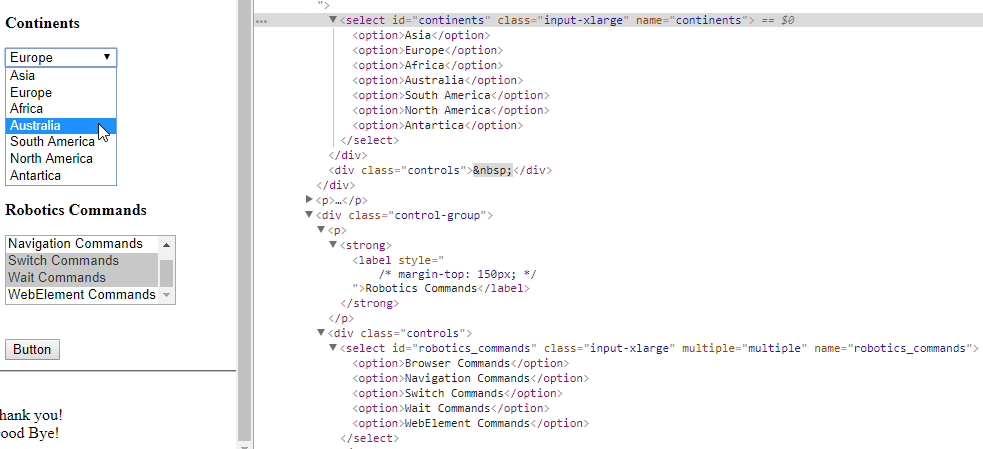
Like checkboxes and radio buttons, drop-down and multiple selection operations work together almost the same way. To perform any action, identify the element group, as a drop-down or multiple select is not a single element. They always have a single name contain one or more elements or options. The only difference is deselecting statement, and multiple selections are not allowed on a drop-down.
It is an ordinary operation like selecting any other element on a webpage. You can choose it by ID, Name, CSS, XPath, and so on.
Select class
The Select class models a <select> tag, providing helper methods to select and deselect options. It performs multiple operations on a DropDown object and Multiple Select object. As Select is an ordinary class, its object is also created by a new keyword with the regular class creation syntax.
import org.openqa.selenium.support.ui.Select


open('https://rpa-tutorial.s3.amazonaws.com/trainings/iframe/form.html')

def continents = new Select($(byId('continents')))
continents.getOptions().each {
    println(it.getText())
}
Select commands
You can access the following Select class methods:
| Type | Method | Simplified API method | Description |
|---|---|---|---|
void | selectByIndex(int index) | selectOption(int index) | Selects the option at the given index. |
void | selectByValue(String value) | selectOptionByValue(String value) | Selects all options that have a value matching the argument. |
void | selectByVisibleText(String text) | selectOption(String text) | Selects all options that display text matching the argument. |
List<WebElement> | getAllSelectedOptions() | - | Gets a list of all selected option elements. |
WebElement | getFirstSelectedOption() | getSelectedOption() | Gets the first selected option. |
| - | getSelectedText() | Gets text of a selected option in the select field | |
| - | getSelectedValue() | Gets a value of a selected option in the select field. If the value attribute does not exist, it returns the option text. | |
List<WebElement> | getOptions() | - | Gets a list of all option elements that are child elements of the <select> tag. |
boolean | isMultiple() | - | Checks whether the control supports multiple selection. |
void | deselectAll() | - | Clears all selected entries. The method works only for Multi Select elements. |
void | deselectByIndex(int index) | - | Deselects the option at the given index. The method works only for Multi Select elements. |
void | deselectByValue(String value) | - | Deselects all options that have a value matching the argument. The method works only for Multi Select elements. |
void | deselectByVisibleText(String text) | - | Deselects all options that display text matching the argument. The method works only for Multi Select elements. |
See the details on using the methods below:
selectByVisibleText(String text):voidIntended to choose or select an option given under any drop-downs and multiple selection boxes with the
selectByVisibleTextmethod. Takes a parameter of String that is one of the texts of theSelectelement and returns nothing.def continents = new Select($(byId('continents'))) continents.selectByVisibleText('Africa') // Simplified API method - selectOption(String text) $(byId('continents')).selectOption('Africa')selectByIndex(int arg0):voidIs almost the same as
selectByVisibleText. The only difference is that you provide the option's index number rather than the option text. Takes a parameter ofintthat is the index value of theSelectelement and returns nothing.def continents = new Select($(byId('continents'))) continents.selectByIndex(2) // Simplified API method - selectOption(int index) $(byId('continents')).selectOption(2)The index starts from zero, so the third position value ("Africa") is at index 2.
selectByValue(String arg0):voidIs the same as above. The only difference is that it asks for the value of the option rather than the option text or index. Takes a parameter of String that is the value of the
Selectelement and returns nothing.def continents = new Select($(byId('continents'))) continents.selectByValue('AFR') // Simplified API method - selectOptionByValue(String value) $(byId('continents')).selectOptionByValue('AFR')The value of an option and the text of the option may not be always the same. The value may not be assigned to the
Selectelement.getOptions( ):List<WebElement>Gets all options belonging to the
<select>tag. Takes no parameter and returnsList<WebElements>.Sometimes, you need to count the elements in the drop-down and multiple select box to use the loop on the
Selectelement.def continents = new Select($(byId('continents'))) def optionsList = continents.getOptions() println('Options count:' + optionsList.size()) optionsList.each { println(it.getText()) }getSelectedYou can get selected option, its text, and value using the Simplified API:
def continents = $(byId('continents'))
continents.selectOption(4)


println continents.getSelectedText()
println continents.getSelectedValue()
println continents.getSelectedOption().getText()
isMultiple( ):booleanDefines whether the
Selectelement supports multiple selecting options at the same time or not. Accepts nothing and returns a Boolean value:trueorfalse.This is done by checking the value of the
multipleattribute.import org.openqa.selenium.support.ui.Select open('https://rpa-tutorial.s3.amazonaws.com/trainings/iframe/form.html') def continents = new Select($(byId('continents'))) def commands = new Select($('#robotics_commands')) println 'Is the 1st select multiple? ' + continents.isMultiple() println 'Is the 2nd select multiple? ' + commands.isMultiple()
Example 2: multiple selection box or list
Open https://rpa-tutorial.s3.amazonaws.com/trainings/iframe/form.html.
To select the Robotic Commands multiple selection box, use the Name locator.
To select the Browser Commands option and then deselect it, use
selectByIndexanddeselectByIndex.To select the Navigation Commands option and then deselect it, use
selectByVisibleTextanddeselectByVisibleText.Print and select all the options for the selected multiple selection list.
Deselect all options.
<?xml version="1.0" encoding="UTF-8"?>
<config xmlns="http://web-harvest.sourceforge.net/schema/1.0/config"
    scriptlang="groovy">

    <robotics-flow>
        <robot name="webDriver" driver="internet explorer"
            close-on-completion="true" start-in-private="true">
            <script><![CDATA[
                import org.openqa.selenium.support.ui.Select
                timeouts(15000)

                // Step 1: Open URL.
                open('https://rpa-tutorial.s3.amazonaws.com/trainings/iframe/form.html')

                // Step 2: Multiple select box. Use the Name locator to identify the element.
                def element = $(byName('robotics_commands'))
                def commands = new Select(element)
                element.scrollTo()

                // Step 3: Select the Browser Commands option and then deselect it. Use selectByIndex and deselectByIndex.
                commands.selectByIndex(0)
                sleep(1000)
                commands.deselectByIndex(0)

                // Step 4: Select the Navigation Commands option and then deselect it. Use selectByVisibleText and deselectByVisibleText.
                commands.selectByVisibleText('Navigation Commands')
                sleep(1000)
                commands.deselectByVisibleText('Navigation Commands')

                // Step 5: Print and select all the options for the selected multiple selection list.
                def oSize = commands.getOptions()
                int iListSize = oSize.size()
                def optionList = []

                // Set up the loop to print all the options.
                for (int i = 0 ; i < iListSize; i++) {
                    optionList.add(commands.getOptions().get(i).getText())
                    commands.selectByIndex(i)
                    sleep(1000)
                }
                println "List of options: ${optionList.toString()}"

                // Step 6: Deselect all commands.
                commands.deselectAll()
            ]]></script>
        </robot>
    </robotics-flow>
    <export include-original-data="false" />
</config>
Automate mouse hover
Expand to view more
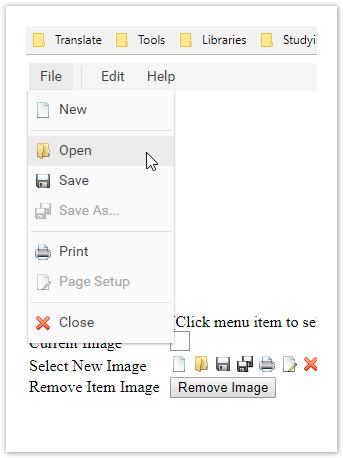
To click an item of the drop-down menu, use the hover() method:
See the code below as an example:
<?xml version="1.0" encoding="UTF-8"?>
<config xmlns="http://web-harvest.sourceforge.net/schema/1.0/config" scriptlang="groovy">

    <robotics-flow>
        <robot name="r2d2" driver="internet explorer"
            close-on-completion="true">
            <script><![CDATA[
                timeouts(40 * 1000)
                open('https://rpa-tutorial.s3.amazonaws.com/trainings/dnd/samples/dhtmlxMenu/04_items/08_change_items_images.html')

                $$('.top_level_text').get(0).hover()
                $(byText('Open')).click()
                $(byXpath('//*[@id="imgList"]/span[7]/img')).click()

                sleep(2000)

                $$('.top_level_text').get(1).hover()
                $(byText('Select All')).click()
                $('input').click()

                sleep(2000)

                $$('.top_level_text').each { item ->
                    item.hover()
                    sleep(2000)
                }
            ]]></script>
        </robot>
    </robotics-flow>
    <export include-original-data="false" />
</config>
Automate dynamic web elements
Expand to view more
Most of sites are dynamic and change the page content by JS scripts while a user interacts with a page.
<?xml version="1.0" encoding="UTF-8"?>
<config xmlns="http://web-harvest.sourceforge.net/schema/1.0/config" scriptlang="groovy">
<robotics-flow>
<robot name="roboticsDriver" driver="chrome" close-on-completion="true" start-in-private="true">
<script></script>
</robot>
</robotics-flow>
<export include-original-data="true"></export>
</config>
In the example above, you access http://alibaba.com, enter a product name, and try to swap the page in the loop. If you run this Bot Task, it finishes with the exception: "unknown error: Element ... is not clickable at point (1320, 994). Other element would receive the click..."
The exception occurs as the bot produces actions like a human. It moves the cursor to the element and sends a signal that the mouse button is pressed. This variant works in most cases, but not for this site. While the mouse cursor moves to the Next Page button, the site loads more elements, and the button changes its coordinates, so a click is sent to another UI element.
There are two main variants how to avoid errors: by using the
hover() method or JavaScriptExecutor.
Click by JS
Expand to view more
You can write a JS script that presses the button. That method is preferable since the button is pressed without scrolling and moving the cursor.
<?xml version="1.0" encoding="UTF-8"?>
<config xmlns="http://web-harvest.sourceforge.net/schema/1.0/config" scriptlang="groovy">

   <robotics-flow>
       <robot name="roboticsDriver" driver="chrome" close-on-completion="true" start-in-private="false">
           <script><![CDATA[
               timeouts(40 * 1000);
               open("https://www.alibaba.com");
               $(byXpath("//input[@name='SearchText']")).val('sword');
               $(byXpath("//input[@value='Search']")).click();
               result = []
               5.times { page ->
                    element = $(byXpath("//div[contains(@class,'ui2-pagination-pages')]/a[@class='next']"));
                    JavascriptExecutor js = (JavascriptExecutor)driver();
                    js.executeScript("arguments[0].click();", element);
                    sleep(2000); // isn't really necessary, but helps to you to check, that pages are changing,
                                 // without sleeping they will change to fast for naked eye.
               }
           ]]></script>
       </robot>
   </robotics-flow>

   <export include-original-data="true"></export>
</config>
Use hover() method
Expand to view more
You can use the hover() method for loading extra elements before you click the button.
Move the cursor to the element before clicking:
    elem = $(byXpath("//div[contains(@class,'ui2-pagination-pages')]/a[@class='next']")).hover()
    elem.click()
However, it doesn't help as the bot needs more time to update its cash. Add sleep or wait to the code:
    elem = $(byXpath("//div[contains(@class,'ui2-pagination-pages')]/a[@class='next']")).hover()
    sleep(1000)
    elem.click()
It still generates an exception: "stale element reference: element is not attached to the page document."
The error occurs because the page was changed, but the bot tries to access the element presented on the previous page and needs some time to reevaluate XPath. Add another sleep.
<?xml version="1.0" encoding="UTF-8"?>
<config xmlns="http://web-harvest.sourceforge.net/schema/1.0/config" scriptlang="groovy">
<robotics-flow>
<robot name="roboticsDriver" driver="chrome" close-on-completion="true" start-in-private="false">
<script></script>
</robot>
</robotics-flow>
<export include-original-data="true"></export>
</config>
Automate dynamic web tables
Expand to view more
A table is a kind of HTML data displayed with the help of the <table> tag in conjunction with the <tr> and <td> tags. Although there are other tags for creating tables, these are the basics for creating a table in HTML:
<tr>defines a row.<td>specifies a column cell of a table. Each cell in the Excel sheet can be represented as<td>in the HTML table. The<td>elements are the data containers that can enclose all sorts of HTML elements like text, images, lists, other tables, and so on.
An Excel sheet is a simple example of table structures. Whenever you put some data to Excel, you add some heading as well. In HTML, the <th> tag is used for headings.
Expand to view code for table without heading
<table border="1" width="100%">
        <tbody>
                <tr>
                        <td>Automation Tool</td>
                        <td>Licensing</td>
                        <td>Notes</td>
                </tr>
                <tr>
                        <td>RPA Express</td>
                        <td>Free</td>
                        <td>Can be extended with multiple bots</td>
                </tr>
                <tr>
                        <td>WorkFusion SPA</td>
                        <td>Commercial</td>
                        <td>Contains Cognitive component</td>
                </tr>
        </tbody>
</table>
The <th> tag stands for a table cell heading and is used instead of <td> when the cell content is a heading instead of the actual cell data.
It is the obvious choice inside the <thead> element that can contain, for example, the first row of your table, but you can also use it for the first column to indicate table row headings.
The <tfoot> table footer is always displayed under the <tbody>, even if its code is before the table body. A table can have a name given using the <caption> tag.
Expand to view code for table with heading
<table border="1" width="100%">
        <caption>Sample Table</caption>
        <thead>
                <tr>
                        <th>Automation Tool</th>
                        <th>Licensing</th>
                        <th>Notes</th>
                </tr>
        </thead>
        <tfoot>
              <tr>
                <td colspan="3"><em>Public Info</em></td>
              </tr>
        </tfoot>
        <tbody>
                <tr>
                        <td>RPA Express</td>
                        <td>Free</td>
                        <td>Can be extended with multiple bots</td>
                </tr>
                <tr>
                        <td>WorkFusion SPA</td>
                        <td>Commercial</td>
                        <td>Contains Cognitive component</td>
                </tr>
        </tbody>
</table>
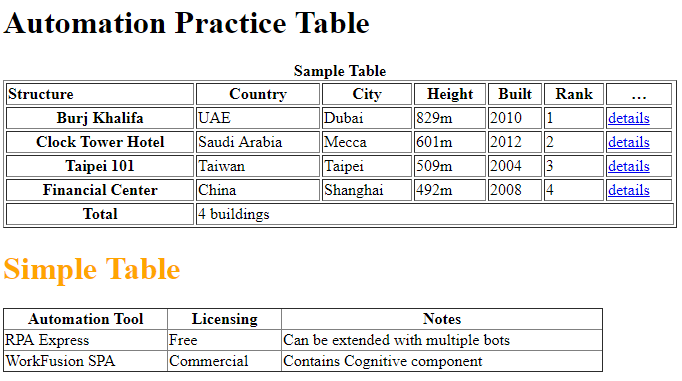
To handle dynamic web tables, first, inspect the table cell and get its HTML location. In most cases, tables contain text data, and you can extract the data given in each row or column of the table.
Sometimes, tables have links or images. You can perform any action on those elements if you find the HTML location of the containing cell. For a sample, refer to the automation practice table page.
Expand to view examples
Example 1
Let’s take the above table and choose Row 2 Column 3 cell (Dubai):
//*[@id="content"]/table/tbody/tr[1]/td[2]
If you divide the XPath into three different parts, you have:
- Table location on the web page:
//*[@id="content"]/. - Table body (data):
table/tbody/. - Table row 1 and table column 2 (the first visible row is in
<thead>, and the first visible column is<th>):tr[1]/td[2]
If you use this XPath, you get the specified table cell. To get the "Selenium" text from the table cell, use the getText() method of the WebDriver element:
open('https://rpa-tutorial.s3.amazonaws.com/trainings/table-automation.html')
def cellText = $(byXpath("//*[@id='content']/table/tbody/tr[1]/td[2]")).getText()
Example 2
Tables can contain a large amount of data, and you may need to pass rows and columns dynamically.
In that case, build your XPath using variables:
open('https://rpa-tutorial.s3.amazonaws.com/trainings/table-automation.html')
def sRow = 1
def sCol = 2
def cellText = $(byXpath("//*[@id='content']/table/tbody/tr[${sRow}]/td[${sCol}]")).getText()
Example 3
If the row and columns are dynamic, and all you know is the Text value of any cell, take out the corresponding values of that particular cell.
For example, you have to record all possible values in the "Licensing" column from the above example:
open('https://rpa-tutorial.s3.amazonaws.com/trainings/table-automation.html')

def colHeading = 'Licensing'
def columnValues = []
def tBodyXpath = "//*[@id='main']/div[2]/div/div[2]/table/tbody"
def totalRows = $$(byXpath("${tBodyXpath}/tr")).size()

for(int i=1;i<=3;i++) {

    def sValue = $(byXpath("${tBodyXpath}/tr[1]/th[${i}]")).getText()

    if(sValue.equalsIgnoreCase(colHeading)) {
        // If the sValue match with the description, it will initiate one more inner loop for all the columns of 'i' row
        for(int j=2; j<=totalRows; j++){
            def tempVal = $(byXpath("${tBodyXpath}/tr[${j}]/td[${i}]")).getText()
            columnValues.add(tempVal)
        }
        break
    }
}
log.warn(columnValues.toString())
Example 4
Click the Detail link of the first row and the last column.
open('https://rpa-tutorial.s3.amazonaws.com/trainings/table-automation.html')
$(byXpath("//*[@id='content']/table/tbody/tr[1]/td[6]/a")).click()
Example 5
Get the value from the Dubai cell using a dynamic XPath.
Print all the column values of the Clock Tower Hotel row.
open('https://rpa-tutorial.s3.amazonaws.com/trainings/table-automation.html')
def sRow = 1
def sCol = 2
def sColumnValue = []

//Here we are locating the xpath by passing variables in the xpath
def sCellValue = $(byXpath(".//*[@id='content']/table/tbody/tr[" + sRow + "]/td[" + sCol + "]")).getText()
println(sCellValue)
def sRowValue = 'Clock Tower Hotel'

//First loop will find the 'ClOCK TOWER HOTEL' in the first column
for (int i=1; i<=5; i++) {
    def sValue = null
    sValue = $(byXpath(".//*[@id='content']/table/tbody/tr[" + i + "]/th")).getText()
    if(sValue.equalsIgnoreCase(sRowValue)){
        // If the sValue match with the description, it will initiate one more inner loop for all the columns of 'i' row
        for (int j=1; j<=5; j++){
            def temp = $(byXpath(".//*[@id='content']/table/tbody/tr[" + i + "]/td["+ j +"]")).getText()
            sColumnValue.add(temp)
        }
        break
    }
}
log.warn(sColumnValue.toString())
Example 6
Get the HTML Table Example table.
Put each table row into Export as a separate column (variable).
<?xml version="1.0" encoding="UTF-8"?> <config xmlns="http://web-harvest.sourceforge.net/schema/1.0/config" scriptlang="groovy"> <robotics-flow> <!-- Internet explorer driver --> <robot name="webDriver" driver="internet explorer" close-on-completion="true" start-in-private="true"> <script></script> </robot> </robotics-flow> <var-def name="xmlSource"> <html-to-xml> <script return="pageSource" /></script> <loop item="rowXml" index="idx"> <list> <xpath expression="//tr"> <script return="tableXml" /></script> <loop item="valString"> <list> <xpath expression="//td/text()"> <var name="rowXml" /> </xpath> </list> <body> <script></script> </body> </loop> <script></script> </body> </loop> <!-- Export values to the output CSV file --> <export include-original-data="true"> <loop item="rpaVar"> <list> <script return="keys"> keys = new ArrayList(rpaVariables.keySet()) </script> </list> <body> <single-column name="${rpaVar}"> <template>${rpaVariables.get(rpaVar.toString())}</template> </single-column> </body> </loop> </export> </config>
Execute Groovy script
Expand to view more
The feature allows executing GroovyScript on a Bot machine (Windows RPA Server), not in Control Tower. For more details, see the JavaDoc link.
You can optionally pass a timeout and parameters for your GroovyScript. The possible variants of the executeGroovyScript() method are as follows:
executeGroovyScript(script)executeGroovyScript(script, timeout)executeGroovyScript(script, scriptParams)executeGroovyScript(script, timeout, scriptParams)
You can create the scriptParams object using the following syntax:
import com.workfusion.rpa.helpers.ScriptParams

// initializing the object
def scriptParams = new ScriptParams(['fileSuffix':'.txt', 'fileData':fileData])

// adding one property
scriptParams.add('filePrefix','temp-')

// adding multiple properties
scriptParams.addAll(['key1':'val1', 'key2':'val2'])
Execute JavaScript
Expand to view more
JavaScript is the preferred language inside the browser to interact with an HTML document object model (DOM). It means that a Browser has a JavaScript implementation in it and understands the JavaScript commands. You can disable it using browser options in your browser. The web driver still uses JavaScript to perform some actions.
For example, the XPath element search is implemented in JavaScript for Internet Explorer for you to overcome the lack of an XPath engine in this browser.
executeJavaScript(script, arguments)
JavaScriptExecutor comes separately and also comes under the WebDriver, but both do the same thing.
Expand to view code
<?xml version="1.0" encoding="UTF-8"?>
<config xmlns="http://web-harvest.sourceforge.net/schema/1.0/config" scriptlang="groovy">
    <robotics-flow>
        <robot driver="chrome" name="web" close-on-completion="true">
            <script><![CDATA[

                open("https://rpa-tutorial.s3.amazonaws.com/trainings/dnd/samples/dhtmlxTree/02_checkboxes/05_tree_checkboxes.html")
                sleep(2000)

                // selecting a tree element and checking its branch
                executeJavaScript(
                    "document.querySelector('#treeboxbox_tree table table tr:nth-child(1) > td > span').click();" +
                    "document.querySelector('body > table > tbody > tr:nth-child(1) > td:nth-child(2) > a:nth-child(9)').click();"
                )
                sleep(2000)

                // invoking alert in JS and passing parameters to script
                def messages = ['Hello ', 'from ']
                executeJavaScript("alert(arguments[0][0] + arguments[0][1] + arguments[1])", messages, 'JS')
                sleep(2000)
                dismiss()

                // getting a node value using JS
                element = executeJavaScript("return document.querySelector('body > p').textContent;")

            ]]></script>
        </robot>
    </robotics-flow>
    <export include-original-data="false">
        <single-column name="paragraph" value="${element}"/>
    </export>
</config>
You can use Java scripts to find an element by XPath:
value = executeScript("return document.evaluate( '//body//div/iframe' ,document, null, XPathResult.FIRST_ORDERED_NODE_TYPE, null ).singleNodeValue;")
The document.evaluate() command is the Xpath evaluator in JavaScript. The signature of the function is as follows:
document.evaluate( xpathExpression, contextNode, namespaceResolver, resultType, result );
Mind the following parameters:
xpathExpression: A string containing the XPath expression to be evaluated.contextNode: A node in the document against which thexpathExpressionshould be evaluated, including all its child nodes. The document node is the most commonly used.NamespaceResolver: A function passed any namespace prefixes contained withinxpathExpressionthat returns a string representing the namespace URI associated with that prefix.resultType: A constant that specifies the desired result type to be returned as a result of the evaluation. The most commonly passed constant isXPathResult.ANY_TYPEthat returns the results of the XPath expression as the most natural type.result: If an existingXPathResultobject is specified, it is reused to return the results. Specifying a null creates a newXPathResultobject
The actions you can perform are as follows:
Find any element on a page.
element = $(byId('some-id'))You can do the same thing using JavaScript:
element = executeScript("return document.getElementById('gsc-i-id1');")Change the element attribute style. You can change the style property of elements to modify the element rendered view.
executeScript("document.getElementById('text-4').style.borderColor = 'Red'");Coloring elements can also help you take screenshots with visual markers to identify problematic elements.
Get any value of valid element attributes.
$(byId('some-id')).getAttribute('Class')The code gets the value of the element class attribute with
id = gsc-i-id1.You can execute the same thing in JavaScript:
className = executeScript("return document.getElementById('gsc-i-id1').getAttribute('class');")Get frames in a browser. To know the total number of frames on a web page in JavaScript, use the following syntax:
numberOfIframes = executeScript("return document.frames.length;")tip
For more information on iFrames, refer to Handle iFrames
Add an element to the DOM.
executeScript("var btn = document.createElement('BUTTON'); document.body.appendChild(btn);")Get the window size. The size of inner browser window is the size of the window in which you see a web page:
height = executeScript("return window.innerHeight;")
width = executeScript("return window.innerWidth;")
Navigate to a different page.
executeScript("window.location = 'https://wikipedia.org'")Generate an alert pop window.
executeScript("alert('hello world');")Click an action.
executeScript("arguments[0].click();", element)Refresh a browser.
executeScript("history.go(0)")Get web page inner text.
sText = executeScript("return document.documentElement.innerText;").toString()Get a web page title.
sText = executeScript("return document.title;").toString()Scroll a page.
executeScript("window.scrollBy(0,150)")Similarly, you can execute practically any JavaScript command.
Execute script asynchronously and return result
executeAsyncScript(script, arguments) allows executing the JavaScript code asynchrously.
<?xml version="1.0" encoding="UTF-8"?>
<config xmlns="http://web-harvest.sourceforge.net/schema/1.0/config" scriptlang="groovy">
<robotics-flow>
<robot driver="chrome">
<script></script>
</robot>
</robotics-flow>
<export include-original-data="true">
</export>
</config>
Handle JavaScript alerts and popup boxes
Expand to view more
An alert is a pop-up window that comes up on the screen. There are many user actions that can result in alerts. For example, a user clicks a button that displays a message, and a web page asks for some extra information.
tip
For a sample, refer to a test page for alerts.
Alerts differ from regular windows. They block any action on an underlying web page if they are present on the web page, and you get the following exception:
UnhandledAlertException: Modal dialog present
UnhandledAlertException: unexpected alert open
To reproduce the exception, you can use this code:
<?xml version="1.0" encoding="UTF-8"?>
<config xmlns="http://web-harvest.sourceforge.net/schema/1.0/config" scriptlang="groovy">
    <robotics-flow>
        <robot name="ie" driver="chrome" close-on-completion="true">
            <script><![CDATA[

                open('https://rpa-tutorial.s3.amazonaws.com/trainings/alert.html')

                //This step will result in an alert on screen
                $(byText('Simple Alert')).click()

                //Once alert is present try to click on any button on the page
                $(byText('Confirm Pop up')).click()

            ]]></script>
        </robot>
    </robotics-flow>
    <export include-original-data="false" />
</config>
JavaScript provides mainly three types of alerts:
Simple alert
document.alert("This is a simple alert");
//or
alert("This is a simple alert");
Confirmation alert
var popuResult = confirm("Confirm pop up with OK and Cancel button");Prompt alert
var person = prompt("Do you like RPA?", "Yes/No");
To handle alerts, the RPA driver provides the alert interface (switchTo().alert()) that presents the following methods:
accept()accepts the alert.dismiss()dismisses the alert.getText()gets the text of the alert.sendKeys()writes some text to the alert.
Simplified API methods that do not require switching to an alert are as follows:
confirm()accepts (clicks Yes or Ok) in the existing confirmation dialog (JavaScriptalertorconfirm).confirm(String expectedDialogText)is the same as previous. If not null,expectedDialogTextchecks that the confirmation dialog displays this message (case-sensitive).dismiss()dismisses (clicks No or Cancel) in the existing confirmation dialog (JavaScriptalertorconfirm).dismiss(String expectedDialogText)is the same as previous. If not null,expectedDialogTextchecks that the confirmation dialog displays this message (case-sensitive).
<?xml version="1.0" encoding="UTF-8"?>
<config xmlns="http://web-harvest.sourceforge.net/schema/1.0/config" scriptlang="groovy">
    <robotics-flow>
        <robot name="ie" driver="internet explorer" close-on-completion="true">
            <script><![CDATA[

                open('https://rpa-tutorial.s3.amazonaws.com/trainings/alert.html')

                // Confirming a simple alert
                $(byText('Simple Alert')).click()
                sleep(2000)
                confirm('A simple Alert')

                // Getting text and dismissing a Confirm popup
                $(byXpath('//td[2]/button')).click()
                alert_text = switchTo().alert().getText()
                sleep(2000)
                dismiss()

                // Typing into a Prompt popup and confirming
                $('td:last-child > button').click()
                sleep(2000)
                switchTo().alert().sendKeys('sure')
                confirm()

            ]]></script>
        </robot>
    </robotics-flow>
    <export include-original-data="false">
        <single-column name="second_alert_text" value="${alert_text}"/>
    </export>
</config>